
S&P 500 has posted gains after every midterm since 1950
Kospi rose in 6 of 9 midterm cycles
Democrats seen with 63% chance of taking Congress; rate stability eyed
Democratic win favors ESS, renewables; Republican win favors AI infrastructure
Expectations are growing that the US midterm elections could serve as a catalyst for a rebound in both domestic and global stock markets. Historically, midterms have tended to lift share prices regardless of which party wins, as political and policy uncertainty clears.
However, the outcome is expected to determine which sectors benefit most. A Democratic victory — widely seen as the more likely result — would put semiconductors, secondary batteries and renewable energy in the spotlight, while a Republican win would favor stocks tied to AI data center infrastructure.
Financial investment industry analysts say the midterms, scheduled for Tuesday (local time), are likely to resolve a key source of market uncertainty. As the direction of US fiscal, trade and industrial policy becomes clearer around the election, the uncertainty that has weighed on investor sentiment could ease, analysts said.
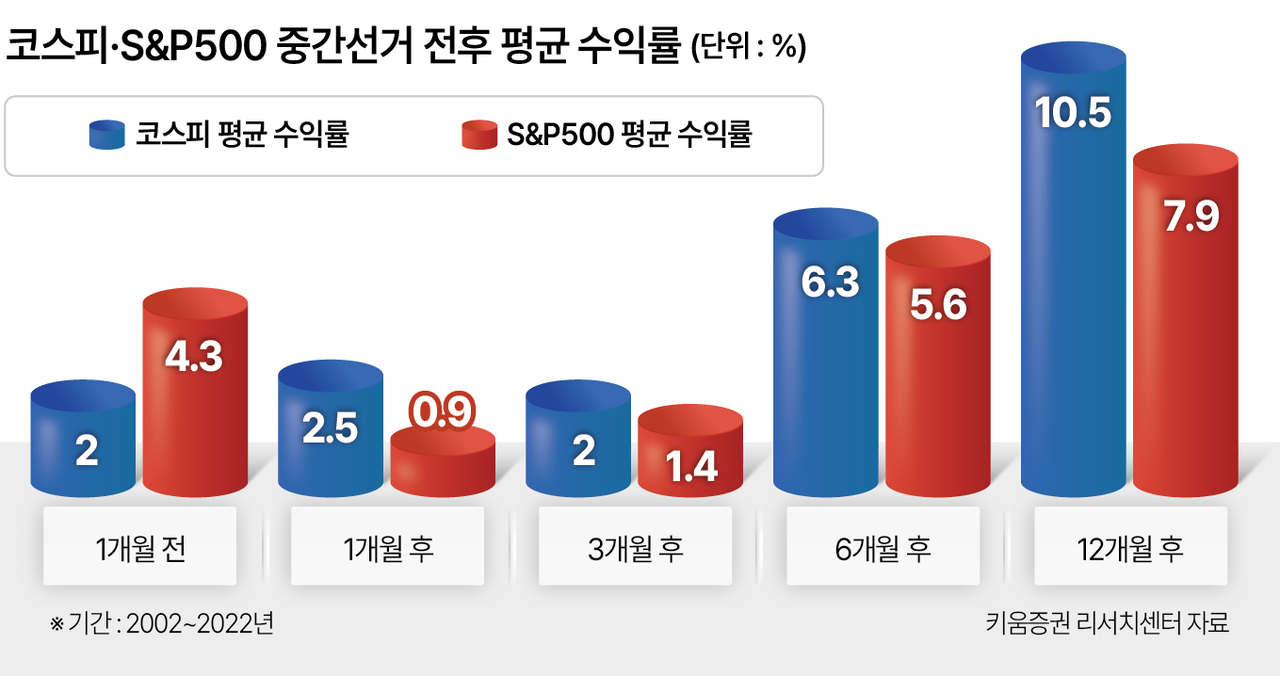
Historical data supports that view. An analysis by Daishin Securities of all 19 US midterm elections since 1950 found that the S&P 500 posted positive returns in both the six-month and 12-month periods following each election. The average 12-month return after a midterm reached 15.1 percent.
The Kospi has also tended to rise after US midterms. In the nine midterm cycles from 1990 through 2022, the Kospi posted positive 12-month returns in six instances — a 67 percent hit rate — with a median return of 2.6 percent.
The gains, however, have been less consistent than those on US markets. While US midterms can have a positive effect on Korean equities, analysts note that the actual magnitude of any advance has varied depending on domestic economic conditions and corporate earnings.
In the financial investment industry, a Democratic takeover of Congress is seen as likely to create relatively favorable financial conditions for equities. With the party able to put the brakes on the Trump administration's tax cuts and expanded fiscal spending, upward pressure on government bond yields could ease. A shift from the current "unified government" — in which Republicans control the presidency and both chambers — to a "divided government" would strengthen congressional checks on fiscal expansion, alleviating concerns about rising US government bond issuance and reducing upward pressure on long-term interest rates.
In past midterms where a unified government gave way to a divided one, US government bond yields fell sharply after the vote — a pattern seen in five such transitions. "When the government shifts to a divided configuration, the US 10-year yield has dropped more than 60 basis points over the six months following the midterms," said Park Jun-woo, a researcher at Hana Securities. If Republicans unexpectedly hold both chambers, however, upward momentum could weaken. Renewed concerns about the Trump administration's tax cuts and spending expansion could push US government bond yields and the dollar higher.
The sectors in focus are also expected to differ depending on the outcome. A Democratic sweep of both chambers would make secondary batteries and renewable energy stocks — alongside semiconductors — the primary beneficiaries, as the party's push to reverse the Trump administration's rollback of clean-energy policies could revive investment expectations for those industries.
"Clean energy and ESS are the themes where the strongest rebound is expected in a blue-wave scenario," said Kim Jae-seung, a researcher at Hyundai Motor Securities. Kim noted that Democrats are pushing to restore clean-energy tax credits under the Inflation Reduction Act that President Trump scaled back, and to expand investment in transmission grids and ESS.
Restoring electric vehicle tax incentives is seen as more difficult, however, meaning that within the secondary battery space, the ESS segment is expected to benefit more than EV-related plays, analysts said.
Semiconductors are seen as likely to hold up relatively well regardless of the outcome. While a Democratic win could bring tighter regulation on data center construction in the United States, big tech companies are expected to continue diversifying data center investment globally, and sovereign AI investment by individual countries is projected to persist.
If Republicans retain majorities in both chambers, attention is expected to shift toward IT hardware and AI data center infrastructure stocks. With the Trump administration's push to expand AI infrastructure investment and streamline data center permitting set to continue, companies in semiconductor materials, components and equipment — as well as power infrastructure — stand to benefit, analysts said.
"Semiconductors, shipbuilding and biotech carry no downside risk under any outcome and overlap with our top picks for 2027," said Lee Kyung-min, a researcher at Daishin Securities. "Securities, internet and secondary batteries would be the complementary sectors in a Democratic win, while defense, nuclear power and insurance would fill that role in a Republican win," Lee added.

th5@heraldcorp.com




