
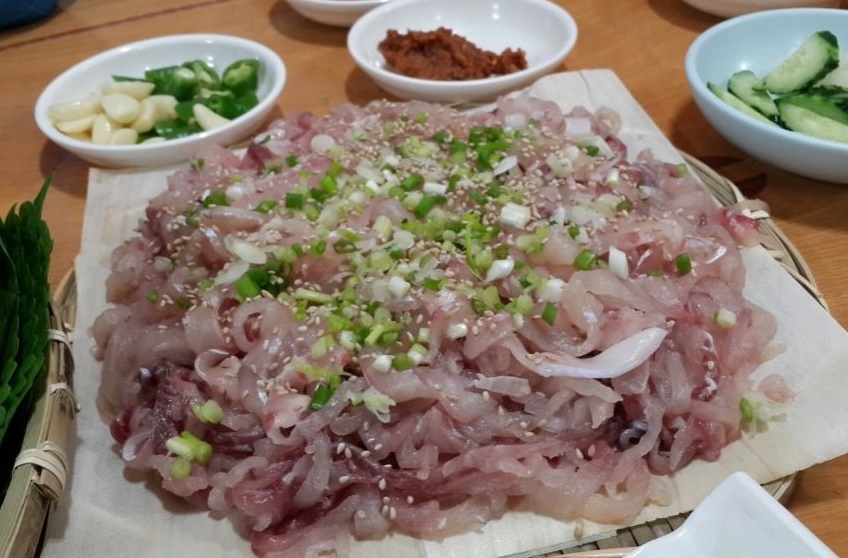
Eating raw freshwater fish can lead to parasitic infection and significantly raise the risk of bile duct cancer, a doctor has warned. Parasites found in freshwater fish can enter the body through the mouth, take up residence in the bile ducts and trigger chronic inflammation over time.
Hwang Jun-seong, a gastroenterology professor at Changwon Hanmaeum Hospital, recently named raw freshwater fish as a food people should never eat, speaking on a YouTube channel, according to the medical community Thursday.
"This is not just something to avoid — it is absolutely off-limits. Freshwater fish harbor a parasite called distoma," Hwang said. "Once the parasite enters the body, it can cause gallstones and bile duct cancer. Even a past distoma infection is a risk factor for bile duct cancer."
Hwang added that a single exposure does not guarantee infection but does create a risk. "I want to put up a sign outside my clinic saying 'No raw carp sashimi,'" Hwang said.
The liver fluke — also known as "gan distoma" — can infect people through the habit of eating raw freshwater fish. Larvae inside the fish enter the human body through the mouth. Carp-family species such as common carp, crucian carp and false crucian carp are among the main sources of infection.
Once liver fluke larvae enter the body and settle in the bile ducts, they can parasitize there for years, irritating the bile duct walls and causing chronic inflammation. If the condition persists over a long period, the risk of developing bile duct cancer rises.
Hwang said he frequently encounters parasitic infection cases in clinical practice. "There are times when we remove parasites directly from the bile duct," Hwang said. "In other regions you might see a case once every few years, but in Changwon we see it far too often." Hwang added that the area around the lower Nakdong River has the highest prevalence of bile duct cancer in the country.
Areas near the Nakdong River have in fact recorded elevated rates of gallbladder and bile duct cancer. According to a cancer incidence map by municipality published by the Ministry of Health and Welfare in 2016, the incidence of gallbladder and other bile duct cancers among men was highest nationwide in Busan's Gangseo-gu, at 19.2 cases per 100,000 people, during the 1999–2003 period.
The same cancer's incidence rate among women also ranked first nationwide in Busan's Gangseo-gu during the 2004–2013 period. High rates were also recorded in South Gyeongsang Province's Haman-gun, Miryang and Changnyeong-gun, as well as North Jeolla Province's Sunchang-gun.
A probe by the Korea Disease Control and Prevention Agency targeting 40,000 residents in high-risk parasitic infection areas along the Nakdong and Seomjin rivers found an overall intestinal parasite infection rate of 5.3 percent on average, with residents near the Nakdong River recording the highest rate at 7.4 percent.
Health authorities believe the high liver fluke infection rate in the Nakdong River basin is linked to the local habit of eating raw freshwater fish.
The most reliable way to prevent liver fluke infection is to cook freshwater fish thoroughly. According to the US Centers for Disease Control and Prevention, salting, smoking or pickling freshwater fish may not be sufficient to eliminate infectious parasites.
Caution is also required during food preparation. The KDCA recommends against using the same knife and cutting board that touched raw freshwater fish on other ingredients. Cooking utensils should be kept separate, and any tools that come into contact with raw freshwater fish should be sterilized in boiling water.
Anyone who has eaten raw freshwater fish should not rely on symptoms alone to determine whether they are infected. Liver fluke infection can be diagnosed through stool tests that detect parasite eggs, among other methods. If infection is confirmed, treatment with the antiparasitic drug praziquantel follows. When prolonged infection damages the bile ducts, the damage may not fully heal even after the parasites are removed, making early diagnosis and treatment critical.
bbo@heraldcorp.com




