
National Security Adviser appears at National Assembly national audit; pursues phased denuclearization through 'halt, reduction, dismantlement'
Nuclear submarine acquisition, key technology protection prioritized; OPCON talks to intensify amid delayed SCM
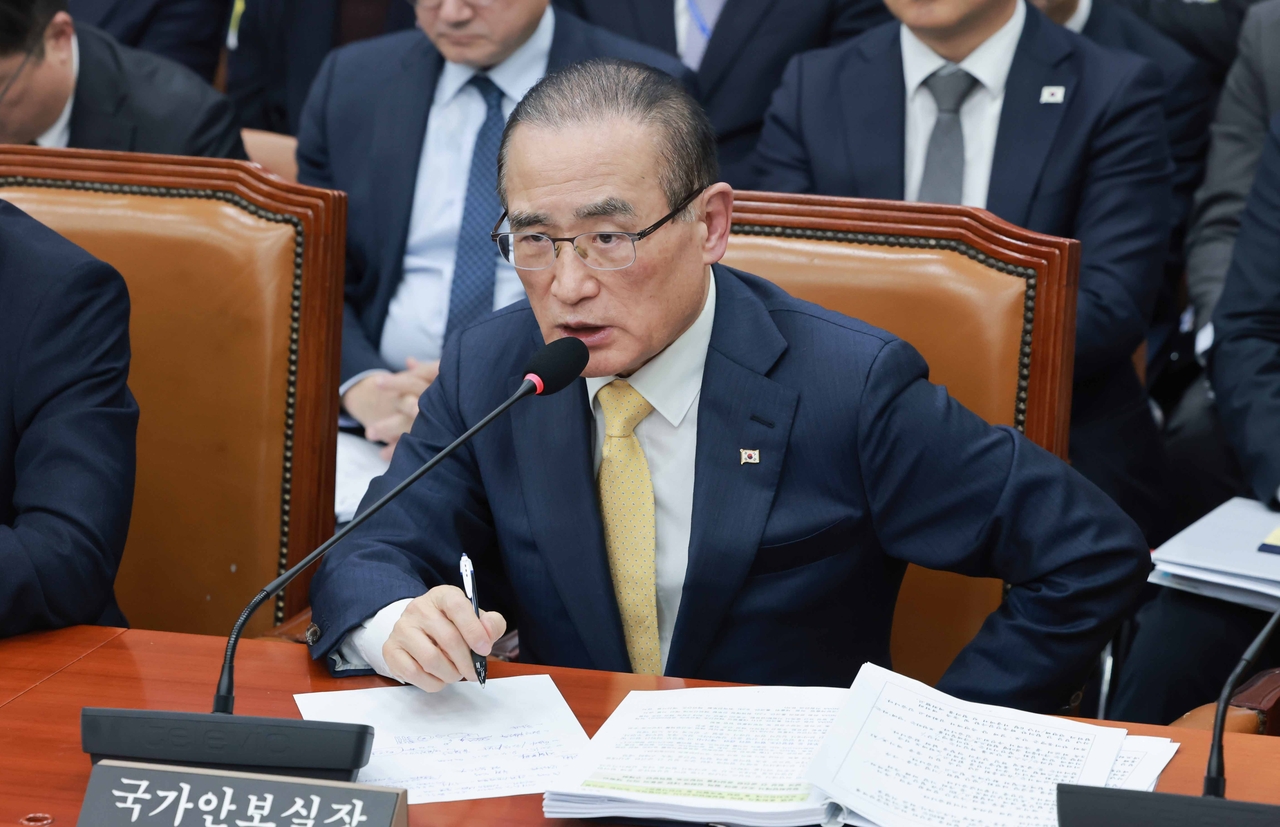
National Security Adviser Wi Sung-lac on Thursday pledged to restore severed inter-Korean dialogue, recover wartime operational control at the earliest opportunity and pursue the acquisition of advanced military capabilities including nuclear-powered submarines, speaking at a National Assembly national audit of Cheong Wa Dae.
In opening remarks at the House Steering Committee's national audit, Wi said the government's commitment to peace would not waver. "Our goal of easing inter-Korean tensions and achieving a peace in which there is no need to fight will never be shaken," Wi said. "We will continue to reduce tensions and build trust while working to restore the dialogue that has been severed."
Wi also reaffirmed South Korea's role as a mediator in North Korea-US relations. "We will continue to serve as a pacemaker for North Korea-US dialogue," Wi said, adding that because President Donald Trump has expressed a willingness to engage, "we will do our part to ensure that momentum translates into actual talks." Wi then said the government would pursue "phased, practical progress toward denuclearization through halt, reduction and dismantlement" alongside inter-party dialogue aimed at establishing a peace regime.
Wi outlined plans to strengthen self-reliant defense capabilities and secure advanced military assets. "Peace can only be sustained on the foundation of robust security," Wi said. "The government will realize self-reliant national defense and strengthen our independent defense capabilities." Wi then said the government would "swiftly recover OPCON and pursue the acquisition of advanced capabilities including nuclear-powered submarines," while reinforcing the democratic and institutional foundations of the military and supporting the K-defense industry's rise as a core national industry.
Wi also presented measures on economic security and cybersecurity. "As supply chain threats have become a constant reality due to the Middle East crisis and major countries' export controls, we will strengthen supply chain management by maintaining close communication with industry," Wi said. "We will do our utmost to protect core national technologies — treating the protection of key industrial technology as a matter of national security — through rigorous investigation and punishment of technology leaks." On cybersecurity, Wi said the government would "accelerate the development of security-enhanced AI models and shift the national cyber response system to an AI-based framework to respond without gaps to evolving threats."
Lawmakers also pressed Wi on how the government plans to respond to US requests for a deployment to the Strait of Hormuz. Asked by Rebuilding Korea Party lawmaker Kim Jun-hyung whether the government was considering expanding the operational area of the Cheonghae Unit or dispatching maritime patrol aircraft, Wi said, "We are at the stage of reviewing various options — nothing has been decided." Wi added that patrol aircraft "have been considered internally" but that no decision had been made, noting that Japan also operates patrol aircraft in the area.
Democratic Party of Korea lawmaker Kim Seong-hoe asked about concerns over the OPCON transfer raised by the postponement of the Security Consultative Meeting to early next year. Wi said there had been "some convergence of views on the conditions and timing" of the OPCON recovery and pledged to "continue making progress and report back with results." Asked about contingency plans if a decision on the transfer year is delayed, Wi said the government had "various options in mind" but was currently "focused on meeting the conditions for determining the timing of the OPCON transfer through consultations with the United States."
Wi shrugged off allegations of a rift between the president and the National Security Office. When Kim Jun-hyung suggested there were differences of view on denuclearization, combined US-South Korea military exercises and the response to landmine explosions, Wi denied it. "That is a misunderstanding," Wi said. "The president speaks to the direction we must take. My view is that while today's reality is difficult, we agree on the direction we must head — it is not a significant difference."
sunpine@heraldcorp.com




