
12 sites targeted for this year, 11 already operating
AI analyzes egg appearance and hairline cracks
Goal: AI to handle 56.5% of all grading volume
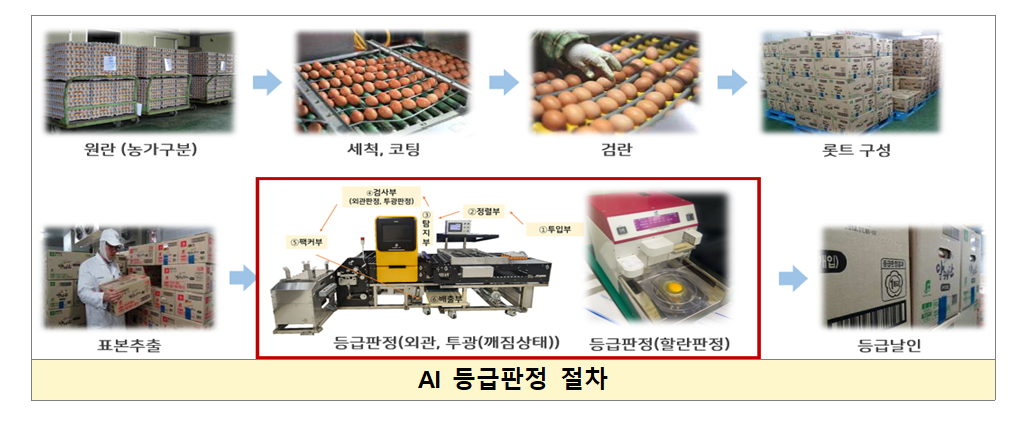
A system that uses artificial intelligence to assess egg quality — a task previously done by human inspectors — is set for major expansion. The AI equipment photographs and analyzes eggshell cleanliness and detects hairline cracks, replacing manual visual checks. The goal is to deploy the technology at 52 facilities nationwide by 2030, covering more than half of all egg grading volume.
The Korea Institute for Animal Products Quality Evaluation announced Thursday it plans to expand AI-based egg quality assessment equipment to 52 facilities across the country by 2030.
The institute has already deployed the equipment at YJ Food, an agricultural corporation in Pyeongtaek, Gyeonggi Province, where it is being used in actual grading operations. The rollout follows a pilot program that began at a single site last year.
AI equipment is currently installed and operating at 11 egg collection centers. Of these, eight are facilities where the institute's own quality assessors conduct grading, while the remaining three are quality-grade certification sites managed by in-house quality control personnel.
The institute plans to expand coverage to 12 sites this year, followed by 22 sites next year, 32 in 2028, 42 in 2029, and 52 by 2030. The target is for AI grading to account for at least 56.5 percent of total grading volume by 2030.
Under the previous system, quality assessors visually inspected each egg's exterior and checked for cracks by hand. The AI equipment photographs the egg's surface and analyzes light-transmission images to evaluate quality.
The exterior inspection captures each egg from four angles to assess shell cleanliness and detect abnormalities. The light-transmission check shines light through the egg and analyzes the resulting image to identify hairline fractures and cracks.
The institute began a technical review in 2023 and developed automated exterior and light-transmission grading equipment in 2024. After field testing that started in April last year, the system entered full grading use this year.
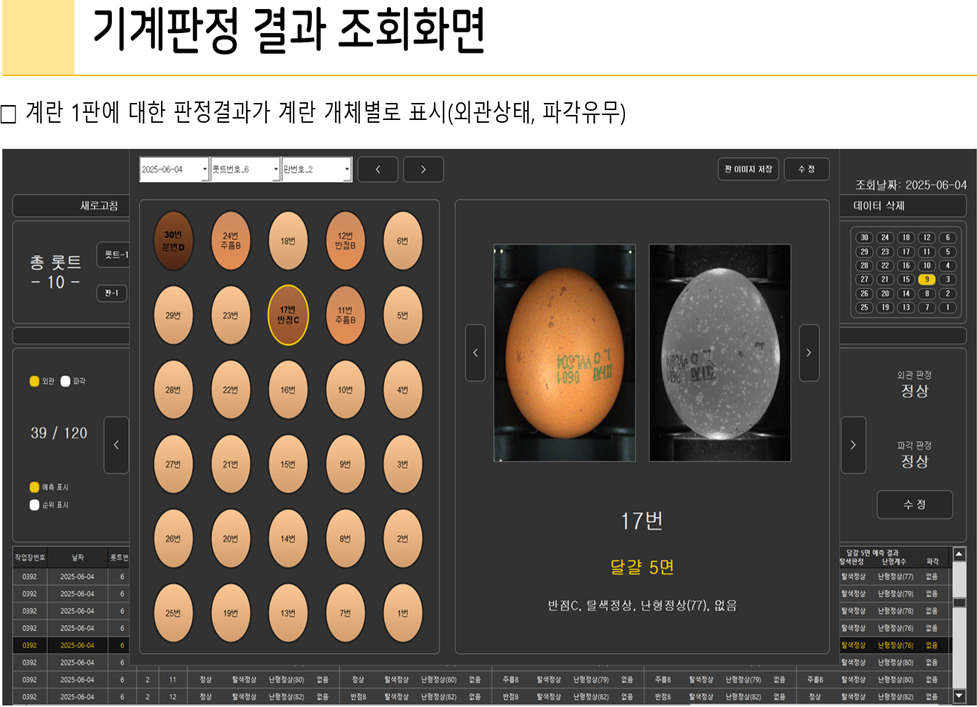
By shifting items that once relied on visual inspection to machine measurement, the AI system improves grading objectivity and enables systematic accumulation of quality data.
The institute is also building a system to share AI grading data with farms and retailers. It plans to analyze defect rates and shell-crack occurrences by farm to help improve feeding management and egg collection and handling practices.
Retailers will receive quality data to help them source eggs of consistent grade. The institute is also developing technology to grade eggs in real time by linking the AI system with egg-sorting machines, and plans to activate a shell-marking system that stamps each egg with its grade — 1+, 1 or 2.
Park Su-jin, president of the Korea Institute for Animal Products Quality Evaluation, said AI-based egg quality assessment "will be an important turning point that provides the public with fresher and safer food while raising the objectivity and reliability of livestock product quality evaluation to a new level." Park added that the institute would "continue to actively leverage AI and data to build a livestock distribution environment that producers, retailers and consumers can all trust."
adastra@heraldcorp.com




