
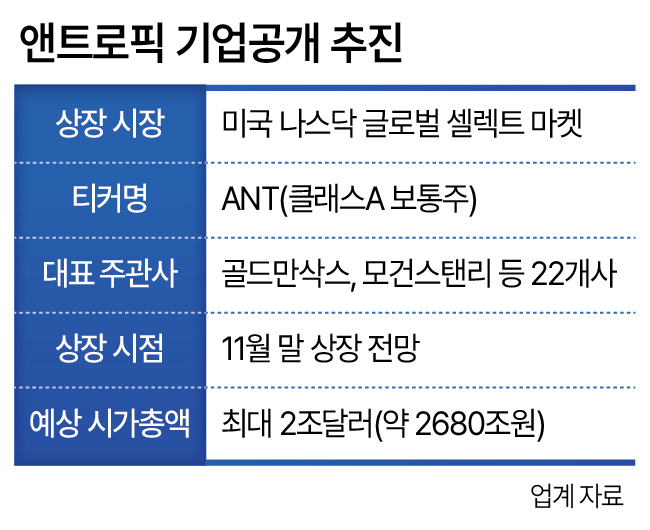
Anthropic, the developer of the Claude generative AI model, is drawing keen interest from Korean investors as the company prepares to list on the US NASDAQ under the ticker ANT in November.
With an expected market capitalization of $2 trillion and an offering size of up to $100 billion, the initial public offering is widely regarded as the biggest of the year — potentially eclipsing SpaceX's recent debut. The IPO subscription route is in effect closed to retail investors in Korea, however, and the prospect of extreme early share price volatility combined with concerns over valuation means investors will need to think carefully about their approach.
According to the financial investment industry, the S-1 registration statement Anthropic filed with the US Securities and Exchange Commission lists 22 underwriters in its syndicate, including Goldman Sachs and Morgan Stanley. Not a single Korean brokerage is among them.
Korea Investment Partners, a venture investment firm and subsidiary of Korea Investment, did purchase $10 million worth of Anthropic secondary shares in 2024, but that transaction involved only the firm's proprietary capital and a limited number of institutional investors — retail investors had no avenue to participate.
With direct IPO subscriptions in effect off the table for Korean retail investors, the realistic investment options available to them come down to three: buying ETFs that include Anthropic, investing indirectly through listed companies that hold pre-IPO stakes or secondary shares, and buying shares directly on the market on the first day of trading.
Asset managers have been racing to launch ETFs that can add Anthropic to their holdings early. A representative example is the HANARO US Agentic AI TOP2+, launched last month by NH-Amundi Asset Management. The "TOP2" in the product name is understood to refer to Anthropic and OpenAI. Once Anthropic lists and its inclusion is confirmed under the underlying index methodology, the ETF will add the stock within two business days of the listing date.
Hana Asset Management recently listed its 1Q US AI Tech Platform TOP10, which invests in AI model, platform, application and security companies. The fund is structured so that when a major AI model developer lists on a US exchange, the index committee can begin reviewing inclusion from the moment official listing documents are made public. If inclusion is confirmed, the stock is added in stages over three business days — from the second to the fourth business day after the listing date.
Whether ETF investors can fully capture the initial post-listing price surge is uncertain, however, given the lag before inclusion takes effect. SpaceX's shares jumped 19.22 percent, 19.6 percent and 4.83 percent on each of its first three trading days, then tumbled 4.95 percent, 3.56 percent and 16.43 percent over the following three sessions. There are concerns that investors could miss the early gains and end up holding shares bought near the peak.
Another option is to buy a US-listed ETF that already holds Anthropic's pre-IPO shares. The KraneShares Public-Private AI & Technology ETF (AGIX), managed by US asset manager KraneShares, is one such fund. As of the end of September, Anthropic accounted for 1.14 percent of AGIX's holdings — the highest weighting among the fund's unlisted holdings, though the absolute figure is low enough that chasing the stock purely for listing gains warrants caution. That said, Anthropic's key shareholders Alphabet, at 3.73 percent of the ETF, and Amazon, at 2.80 percent, rank among the fund's top holdings, meaning indirect exposure to Anthropic is higher than the direct figure suggests.
Buying shares of Anthropic's major shareholders is another alternative. If Anthropic achieves its target valuation of $2 trillion, Amazon — its largest partner — could secure a 20 percent stake by converting all of its convertible bonds into equity. Google holds a 7 percent stake and, under a deal signed earlier this year, has the option to invest up to an additional $20 billion, leaving room for its ownership to grow further.
The most direct way to benefit from Anthropic's performance is to buy shares on the day of listing. Extreme early volatility is a key risk to watch. SpaceX's share price climbed sharply over three trading days, hitting an intraday high of $225.64, but the previous day's closing price was $145.23 — more than 35 percent below that peak.
Views are divided on Anthropic's valuation, with some flagging overvaluation concerns while others point to the company's growth potential. The brokerage community broadly believes the fundraising itself is unlikely to fail, given that recent earnings have exceeded expectations. Anthropic's sales for the first half of this year reached $16.29 billion, a 14-fold increase from the same period a year earlier, while computing and infrastructure costs rose 3.8 times to $8.95 billion — a slower rate of increase.
Han Sang-hee, a researcher at Hanwha Investment & Securities, said the fact that sales are growing faster than computing costs reduces concerns about Anthropic's profitability. "Anthropic's listing will help ease worries about a slowdown in AI investment," Han added.
Analysts note, however, that costs tied to long-term infrastructure contracts and revenue volatility remain a burden, making the sustainability of post-listing profitability improvements a key factor to watch. The company's complex founder-centric governance structure is also flagged as a point of caution for investors. After listing, Anthropic plans to adopt a multi-class share structure with five classes — Class A, N, T, F and E — carrying differentiated voting rights and entitlements. A corporation formed by the company's seven co-founders, known as Founder LLC, will hold a fixed 50.1 percent of total voting rights through a single Class F share, while an independent trustee called the Long-Term Benefit Trust will have the authority to appoint and remove a majority of the board through Class T shares.
Lee Seung-hun, a researcher at IBK Investment Securities, said the voting rights and board participation of general financial investors, including Class A shareholders, are extremely limited. "This has a positive side in that it acts as a check to uphold AI safety and ethical missions, but it also carries the risk that ordinary shareholders will find it difficult to protect their rights or shareholder value against decisions made by major shareholders or the trust," Lee said.

jiyun@heraldcorp.com




