
Chinese navy and coast guard vessels pass through waters near Japan in succession
At least 17 Chinese ships spotted in the region over recent weeks, prompting heightened alert
Type 055 destroyer and other top-tier warships form carrier battle group
Taiwan: drills simultaneously threaten Japan, Philippines
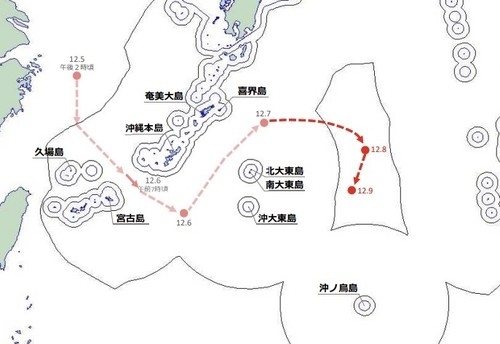
China's first aircraft carrier, the Liaoning, is conducting military exercises in the western Pacific as Chinese navy and coast guard vessels have passed through waters surrounding Japan in rapid succession, in what analysts describe as a show of force. At least 17 Chinese vessels have been spotted in the area over recent weeks, prompting Japan, the Philippines and Taiwan to heighten their alert postures.
According to Japan's Defense Ministry on Wednesday, four Chinese vessels — including warships and a coast guard ship — passed through the Osumi Strait, south of Kagoshima Prefecture in Kyushu, at around 10 a.m. and entered the Pacific.
The vessels identified were three ships belonging to the Eastern Theater Command's navy: the Type 055 destroyer Dongguan, the Type 052D destroyer Baotou and the Type 054A frigate Xuzhou — along with coast guard vessel No. 2307.
Japan's Defense Ministry said the Maritime Self-Defense Force confirmed the movements of the Chinese navy and coast guard vessels and deployed patrol aircraft and escort ships to monitor them.
It was the first time Japan's Defense Ministry had officially announced that Chinese navy and coast guard vessels had passed through waters near Japan together.
Other Chinese navy vessels also passed through waters near Japan on the same day. The Defense Ministry said the Type 052D destroyer Xining and the Type 054A frigate Yancheng sailed southeastward through the waters between Okinawa's main island and Miyakojima.
A separate Chinese naval formation — the destroyer Fushun and the comprehensive supply ship Kekexili — was also confirmed to have moved in the same direction.
China's state-run Global Times, citing Japanese government announcements, reported that at least 17 Chinese navy and coast guard vessels had been spotted in the area over recent weeks, of which more than 12 were naval ships.
The successive movements of Chinese vessels have come after the Chinese navy announced on Oct. 14 that the Liaoning carrier battle group would conduct exercises in the western Pacific.
Japan has been particularly watchful of the expanding coordination between China's coast guard and navy.
The Yomiuri Shimbun reported that the Chinese coast guard vessel that passed through the Osumi Strait appeared to be equipped with a cannon. Under China's coast guard law, which took effect in 2021, the coast guard is authorized to use weapons when it determines that China's sovereignty has been violated.
The Osumi Strait is classified as international waters under international law, however, meaning there is no legal obstacle to foreign warships passing through it.
China has been displaying its naval capabilities by deploying its latest destroyers as part of the Liaoning battle group.
The Global Times, citing Chinese military expert Song Zhongping, described the carrier battle group's composition as "top-tier."
Song said the Type 055 destroyer is expected to become the core asset for future Chinese carrier escort missions.
Song added that the Type 055 is equipped with air defense, anti-submarine and surface-to-ground strike capabilities, and could take over some of the roles currently handled by the Type 052D destroyer.
China currently operates 10 Type 055 destroyers, and analysts say they could also be deployed for blue-water escort missions in areas such as the Gulf of Aden.
The deployment of the Liaoning battle group to the western Pacific comes about four months after the Chinese navy conducted more than 40 days of exercises in the South China Sea and western Pacific between May and June.
China has maintained that the exercises are routine military activities not directed at any specific country or target.
Neighboring countries, however, have expressed concern over the expansion of China's maritime military activities.
Japanese Defense Minister Koizumi Shinjiro held bilateral talks with US Defense Secretary Pete Hegseth on Wednesday on the sidelines of the 13th ASEAN Defence Ministers' Meeting Plus in Cebu, the Philippines.
The two defense ministers agreed that China's military influence is expanding in the East China Sea and other areas, and reaffirmed US-Japan security cooperation aimed at strengthening deterrence against China.
The Philippine military also said it had spotted and tracked the Liaoning battle group as it passed through waters near the Zamboanga Peninsula on Monday.
According to the Global Times, it was the second time the Liaoning had passed through waters in the central Philippines, following a previous transit in 2024.
Taiwan also strongly criticized China's carrier battle group exercises.
Wu Chao-hsieh, secretary-general of Taiwan's National Security Council, said Wednesday on social media that the Liaoning battle group was conducting large-scale maritime exercises in waters east of the First Island Chain.
The First Island Chain is a maritime defense line stretching from Okinawa, Japan, through Taiwan and the Philippines to the Strait of Malacca.
"It is clear that this simultaneously threatens Taiwan, Japan and the Philippines," Wu said.
sjy@heraldcorp.com




