Electric bicycles with motors illegally modified to bypass speed limits
Police to conduct safety checks and sobriety tests at cycling paths
Campaign to continue at Ttukseom Hangang Park on Friday
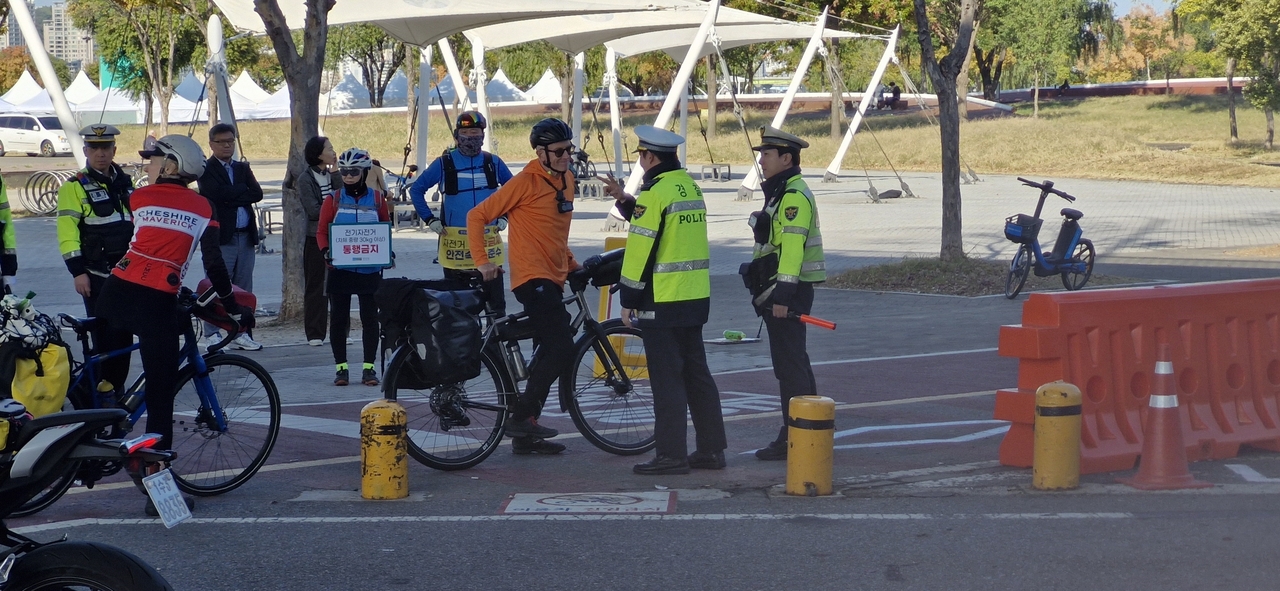
The Seoul Metropolitan Government announced Monday it is moving to eliminate so-called "jatobai" — bicycles that fail to meet safety requirements — from cycling paths in Han River parks.
The term refers to electric bicycles whose motors have been illegally modified to remove speed limiters, as well as heavy, motorcycle-style bikes that run primarily on motor power rather than pedaling.
Electric bicycles weighing 30 kilograms or more, or capable of traveling faster than 25 kilometers per hour, are banned from cycling paths in Han River parks. Despite the prohibition, heavy and high-speed e-bikes have continued to enter and ride on the paths, drawing complaints from park visitors.
In response, the city conducted a joint enforcement campaign Friday at Banpo Hangang Park, one of the most popular cycling destinations along the river, in cooperation with the Seocho Police Station and the Han River Bicycle Patrol Volunteer Corps.
Officers at the scene stopped riders on bicycles that appeared to violate safety requirements and used breathalyzers to check for alcohol consumption among suspected offenders. The Han River Bicycle Patrol Volunteer Corps distributed safety information to cyclists, urging them to observe the 20-kilometer-per-hour speed limit on Han River park paths, refrain from riding under the influence and wear helmets.
Under the applicable regulations, riding a non-compliant electric bicycle on a cycling path carries a fine of 40,000 won ($30). Cycling under the influence — with a blood alcohol concentration of 0.03 percent or higher — is subject to a penalty of 30,000 won, or 100,000 won for refusing a sobriety test. Illegally modifying an electric bicycle can result in up to six months in prison or a fine of up to 5 million won.
The city plans to hold another campaign at Ttukseom Hangang Park on Friday, this time with the Gwangjin Police Station and the Han River Bicycle Patrol Volunteer Corps.
"Han River Park is a shared space not only for cyclists but also for families," said Park Jin-young, head of the Seoul Metropolitan Government's Future Han River Headquarters. "We hope this campaign will help reduce dangerous behavior such as riding non-compliant bicycles and cycling under the influence, and make the Han River a safer place for everyone."
ikson@heraldcorp.com