
Seo-hae-gu and Geomdan-gu clash over 64.8 billion won settlement, forcing city mediation
Jeomulpo-gu and Yeongjong-gu also mired in scholarship asset and debt disputes
Administrative boundaries redrawn, but fiscal and asset succession remains unresolved
Tensions are rising over Incheon's administrative restructuring. Four newly established autonomous districts that launched in July under the current ninth elected city administration — a project initiated under the eighth — are struggling with fiscal and other unresolved issues. This is the first of a two-part series examining the situation on the ground.
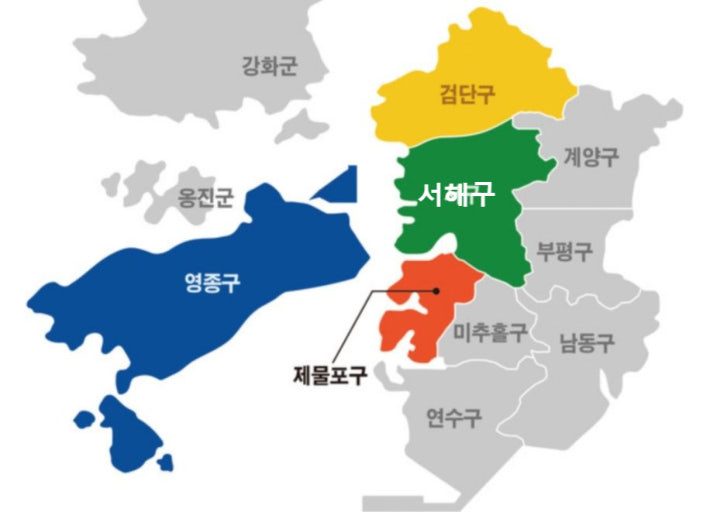
Incheon's sweeping administrative restructuring — the first redrawing of the city's administrative map in 31 years — is showing signs of strain from the very start.
The newly created districts are being destabilized by unresolved disputes over fiscal settlements and asset succession.
The four new autonomous districts were launched under the eighth elected city administration, which promoted the reform as a way to align administrative services with residents' actual living zones and tailor development strategies to each area's characteristics.
But since the new administrative structure took effect, conflicts have erupted repeatedly over cost-sharing and the succession of assets and liabilities between the affected districts.
The fiscal settlement dispute between Seo-hae-gu and Geomdan-gu has emerged as a defining example of whether the restructuring's follow-up measures were adequate.
The two sides have been unable to narrow their differences over the settlement amount and the methodology used to calculate it, pushing the matter into a formal dispute mediation process with Incheon city. Seo-hae-gu has also requested emergency fiscal support, warning that delays could disrupt payments for essential operating expenses.
In Jeomulpo-gu and Yeongjong-gu, disputes over the distribution of scholarship assets and the allocation of inherited debt remain unresolved.
With the costs of running temporary offices and building new district halls piling on top of these disputes, the fiscal burden on the newly created districts has become one of the central challenges of the entire restructuring effort.
Seo-hae-gu and Geomdan-gu clash head-on over 64.8 billion won settlement
At the heart of the conflict is the fiscal settlement dispute between Seo-hae-gu and Geomdan-gu.
According to Seo-hae-gu, revenue from the Geomdan area in the first half of this year totaled about 38 billion won ($28.7 million), while expenditure reached about 102.9 billion won. Seo-hae-gu argues that the former Seo-gu initially covered the roughly 64.8 billion won gap between the two figures, and that Geomdan-gu must settle that amount following the district split.
The settlement figure was revised upward — from about 58.1 billion won to about 64.8 billion won on Oct. 6 — and Geomdan-gu has questioned both the circumstances behind the revision and the reliability of the underlying data.
Seo-hae-gu, for its part, says the adjustment reflects differences in the reference point used for the settlement calculation and the scope of revenue and expenditure data included. It has called on Geomdan-gu to submit a specific counter-figure with supporting documentation if it disputes the amount.
With neither side backing down, the settlement has stalled. Seo-hae-gu has since filed for mediation with Incheon city's dispute mediation committee.
Seo-hae-gu has warned that if the settlement is not resolved soon, available funds could run short from mid-November onward, making it difficult to cover essential operating expenses.
The district has urged Geomdan-gu to pay at least the portion of the settlement it does not dispute, while separately asking Incheon city for swift mediation and emergency fiscal support.
The roughly 64.8 billion won figure, however, is Seo-hae-gu's demand — it has not been finalized through mutual agreement or a mediation ruling.
A verification process to assess the appropriateness of the settlement amount and the methodology behind it is needed, but the longer that process takes, the greater the strain on the districts' fiscal management.
The dispute cannot be viewed simply as an accounting disagreement between two districts. Without clear principles governing how revenues and expenditures incurred before the split are to be divided — and how far newly created districts are responsible for costs the original district absorbed — similar conflicts are likely to recur.
Jeomulpo-gu and Yeongjong-gu bogged down by scholarship assets and debt
Asset and liability succession disputes are also a pressing issue between Jeomulpo-gu and Yeongjong-gu.
A prominent example is the dispute over distributing the roughly 14.9 billion won in core assets held by the Woldi Scholarship Foundation. The two districts have been unable to agree on a distribution formula, putting the foundation's succession process on hold and casting uncertainty over the timeline for selecting scholarship recipients and disbursing funds.
Scholarship assets are not merely accounting entries. Until ownership and operational responsibility are determined, the continuity of the scholarship program is at risk — and the burden ultimately falls on students waiting to receive support.
The allocation of debt inherited from the former Jung-gu is another unresolved issue. Yeongjong-gu has agreed to repay about 18.1 billion won in advance to prevent additional costs from accruing interest.
Disagreements remain, however, over how the debt burden should be shared with Jeomulpo-gu — specifically, which projects the borrowed funds were used for and what share each district should bear.
Compensation for victims and bereaved families of the Inhyeon-dong fire disaster has also been cited as a matter requiring clear determination of responsible parties and cost-sharing arrangements.
Observers note that administrative and fiscal responsibility for harm that occurred before the redistricting must not be left ambiguous simply because jurisdictional boundaries have changed.
What these cases share is that the settlement of asset and liability succession remained unfinished even after the new districts launched. If the administrative restructuring was planned in advance, a thorough prior inventory of assets, liabilities, related projects and obligations — along with agreed distribution principles — should have been in place before launch.
From temporary offices to new district halls, fiscal pressure mounts
The question of district office facilities is another challenge the newly created districts must confront.
Jeomulpo-gu is using the former Jung-gu and Dong-gu office buildings, while Yeongjong-gu and Geomdan-gu began operations out of temporary facilities. These were unavoidable stopgap measures to prevent administrative disruption, but constructing permanent new district halls and expanding administrative facilities will be necessary over the longer term.
Building a new district hall involves a complex sequence of steps: securing a site, conducting feasibility studies, passing investment reviews, and completing design and construction. The process requires substantial funding and takes years, making it impossible to resolve quickly.
A building alone does not complete a district hall. Public service counters, meeting spaces, information systems, communications networks and administrative equipment must all be set up and integrated with existing administrative frameworks.
If temporary office running costs and new hall construction costs arise simultaneously, the fiscal burden on the newly created districts could grow considerably heavier.
Ultimately, the office facility problem is both separate from and intertwined with the fiscal settlement disputes. If operating and facility costs run short from the very start, the stability of administrative services to residents will also be affected.
Geomdan-gu is relatively better positioned — it has already secured a site, meaning construction can proceed once funding is in place. Yeongjong-gu, by contrast, has not yet secured a site at all, leaving it facing an even steeper climb: it must find land before it can even begin planning a new hall. Among the newly created districts, Yeongjong-gu faces the most difficult situation.
Redistricting complete — fiscal and asset succession still a work in progress
Incheon's administrative restructuring was launched to deliver services better aligned with residents' daily lives and to pursue development strategies suited to each area's characteristics. But redrawing administrative boundaries and stably separating administrative functions are two entirely different challenges.
If disputes over assets, liabilities, revenues, expenditures and public facility operating costs persist after the launch, the practical benefits of the restructuring will inevitably be limited. If settlement delays affect essential expense payments or scholarship programs, the costs of the restructuring could end up being borne by residents themselves.
Incheon city, which drove the restructuring, is facing calls to do more than leave inter-district disputes to the parties involved — it must provide objective settlement standards, cost-sharing principles and an active mediation role.
Above all, there is a need to examine why disputes over asset and liability succession and launch costs were not resolved before the districts opened, and what standards and verification procedures were in place during the preparation phase.
The success of the administrative restructuring will not be determined simply by the fact that new districts have been established. It can only be judged a success when fiscal resources, assets, facilities and administrative functions are stably transferred — and when residents can feel the difference in their daily lives.
gilbert@heraldcorp.com




