
Seoul sets 2027 budget at 55.74 trillion won
'Budget secured through state support to go toward fire facilities'
'Not adding debt tied to political, administrative philosophy'
'Debt rose sharply under predecessor'
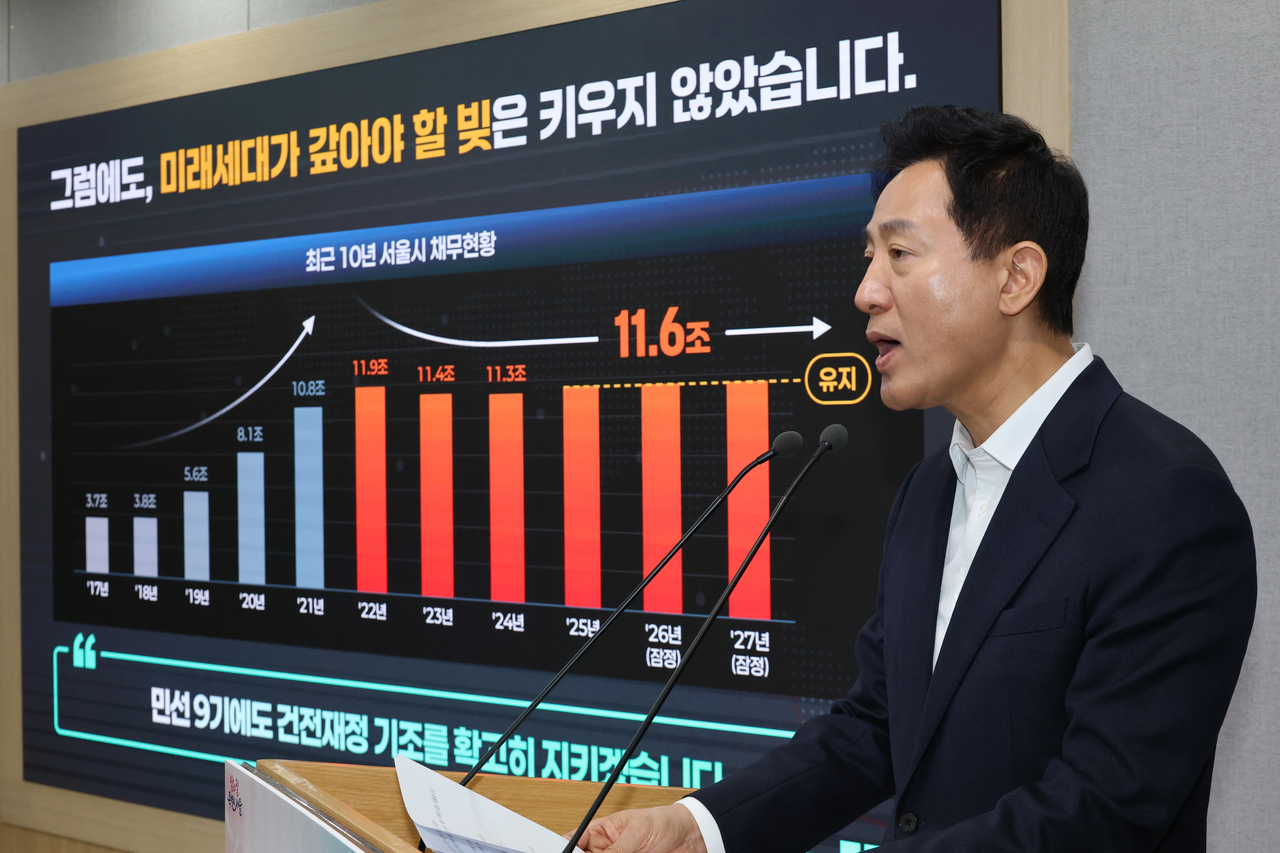
Seoul Mayor Oh Se-hoon acknowledged Thursday that fire department funding places a heavy burden on local governments, but said Seoul accepts it as an unavoidable responsibility. On how the city would use any fiscal relief from increased central government support for firefighter personnel costs, Oh said the freed-up funds would go toward expanding fire facilities and upgrading fire equipment.
Oh made the remarks after announcing Seoul's 2027 budget proposal at City Hall, responding to reporters' questions about the city's fire department budget, its fiscal burden, and how additional resources would be used if central government support were expanded. The comments came amid a recent controversy in which Gyeonggi Province Governor Choo Mi-ae used the phrase "fiscal straw" to describe fire department finances during a national audit of the Ministry of the Interior and Safety. Choo later apologized for the remark on multiple occasions.
"We also put in about 1 trillion won for the fire department budget," Oh said, adding that a review of the figures showed central government support accounts for just 3 to 4 percent of that total. Oh said it was a clear principle that once firefighters were reclassified as national civil servants, the central government should bear the costs — yet the financial burden had been left with local governments. "Every time we draw up the budget, it is genuinely burdensome," Oh said. "But because it is paid with taxes that citizens have contributed, we accept it as Seoul's destiny. We do, however, continue to request that the central government increase its share of funding." Oh added that expanded national support for firefighter personnel costs appeared possible in the future, and that any fiscal relief would be channeled entirely into fire facility expansion and equipment upgrades — such as installing sprinklers in rental housing and modernizing fire apparatus.
On the city's policy of expanding the overall budget without increasing debt, Oh said it was "a matter of principle tied to my political and administrative philosophy."
"If you look at Seoul's fiscal graph over roughly the past 20 years, debt did not increase during my first five-year term either — I pay very close attention to debt management," Oh said. "The graph for the past five years also runs flat." By contrast, Oh said, the graph for the intervening decade — under previous mayors — showed a steep upward climb. "This is a matter of will," Oh said.
Oh noted that fixed expenditures and welfare spending — including the four major social insurance programs — were rising sharply, and that much of the spending was tied to matching funds from the central government, making debt management an enormous challenge requiring extraordinary effort. "There are in fact many strains," Oh said. "Even so, we must improve quality of life and invest in future competitiveness. The budget office is walking on thin ice."
The 2027 Seoul budget proposal Oh announced Thursday totals 55.74 trillion won ($40.6 billion), up 8.3 percent, or 4.27 trillion won, from this year's original budget. City-funded spending matched to central government grant programs — driven by expanded initiatives including reforms to marriage and child-rearing support — will increase by 1.17 trillion won from the previous year. Despite the rise, the city plans to keep its debt balance at the end of next year at this year's level, maintaining its commitment to fiscal soundness.
cook@heraldcorp.com




