
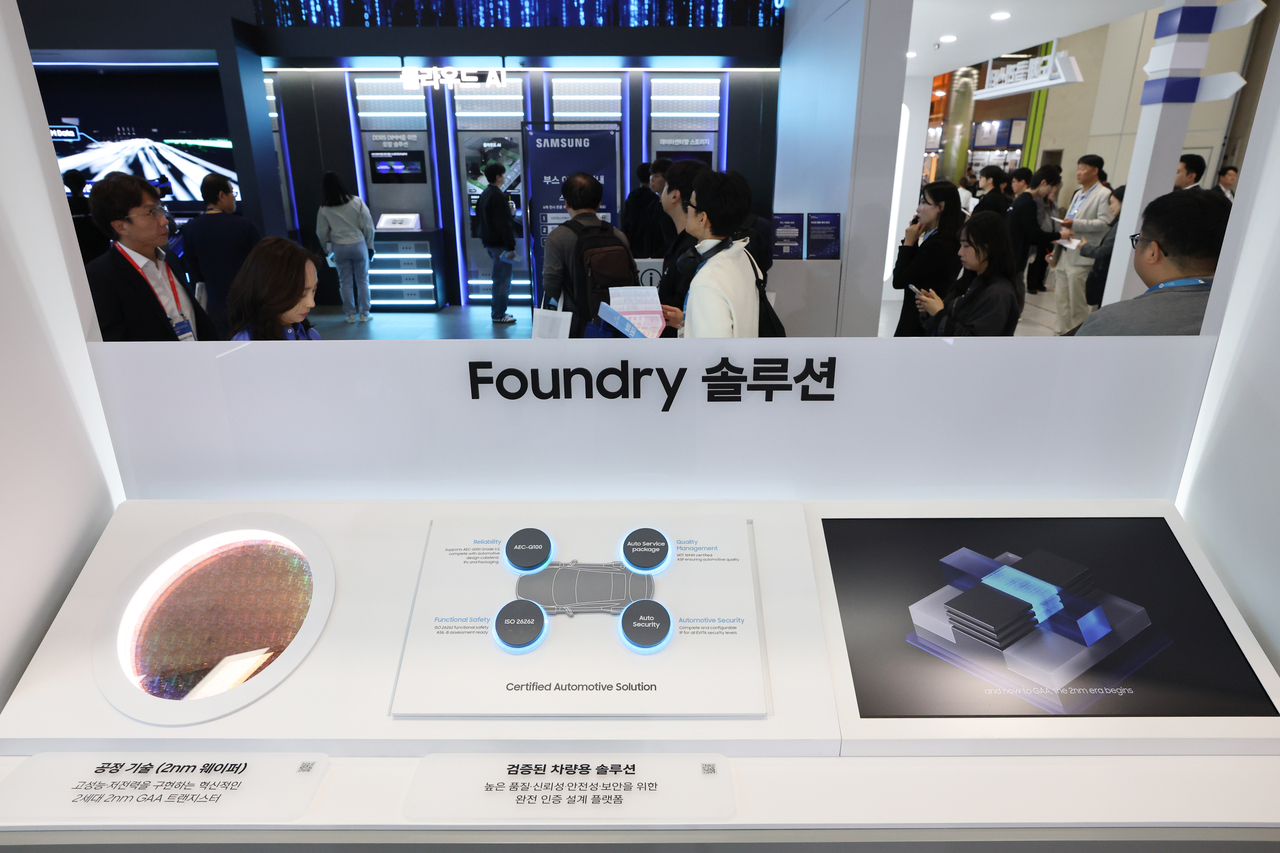
Samsung Electronics said the number of 2nm foundry orders secured by its foundry division this year will more than double compared with a year ago.
Kang Seok-chae, executive vice president of Samsung Electronics' foundry division, made the announcement Thursday during a conference call for the company's third-quarter earnings. "In the third quarter as well, we secured 2nm project orders from major CSP (cloud service provider) customers and AI and HPC (high-performance computing) clients," Kang said.
Samsung's foundry division posted significant improvements in both sales and profitability in the third quarter compared with the second, driven by growth in HBM4 base-die sales produced on its 4nm process and stronger sales of leading-edge process products to global customers.
In the fourth quarter, the division plans to begin mass production of the Exynos 2700 mobile application processor, based on its second-generation 2nm process, and to ramp up full-scale mass production of NPU products for a major 4nm customer.
Order momentum also remains strong. Samsung said it continues to expand orders, centered on 2nm HPC customers including major hyperscalers, and offered an upbeat outlook.
"Next year, HPC will account for more than 50 percent of total foundry sales," Kang said. "We will continue to expand new orders, focusing on leading-edge processes going forward."
Supply capacity is expected to keep pace with the order growth, as Samsung's first factory in Taylor, Texas, begins operations.
Kang also signaled plans to strengthen technological competitiveness by stabilizing 2nm yields while simultaneously developing next-generation processes.
"We plan to concentrate our efforts on developing next-generation base dies optimized for AI memory," Kang said, "and in mature processes, we will expand into high-value specialty areas such as silicon photonics and high-capacity silicon capacitors to improve profitability."
"We will also continue to strengthen our advanced packaging capabilities, including the development of 3D stacking technology," Kang added.
joze@heraldcorp.com




