
'One household, one vote' practice limits women's voice in village leadership
Gokseong-gun's Samtae village rewrites rules to give every resident a vote
Ministry of Agriculture moves to spread gender-equality models nationwide
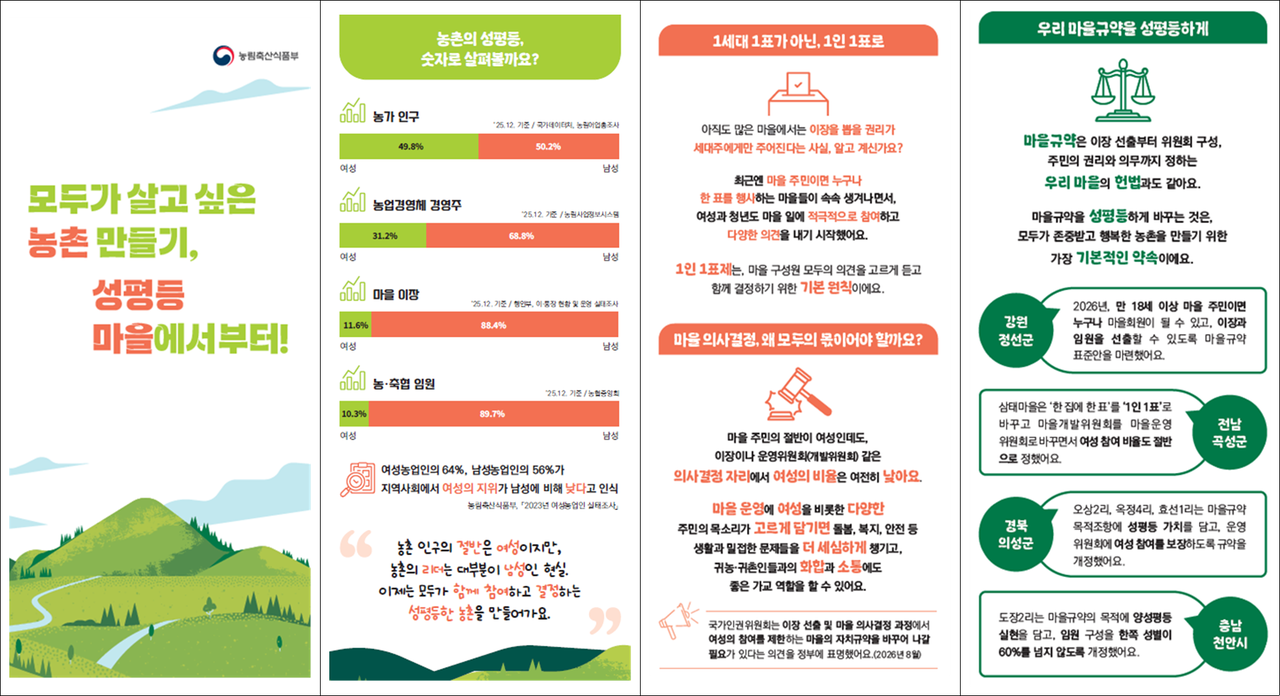
Women account for nearly half of South Korea's rural population, yet only about one in 10 village chiefs is a woman. A longstanding practice in some rural communities — giving each household a single vote, rather than each resident, when electing village chiefs — has been identified as a key barrier to women's participation in local decision-making. The government said it will promote cases where villages have already switched to a one-person, one-vote system as a model for expanding women's representation.
The Ministry of Agriculture, Food and Rural Affairs announced Thursday that it will compile gender-equality best practices from rural villages into leaflets and card-format news content and distribute them to towns and townships across the country.
Women make up 49.8 percent of the farming household population. Yet as of last December, women held only 11.6 percent of village chief positions — a stark contrast to urban neighborhoods, where women account for 76.3 percent of neighborhood unit leaders.
The "one household, one vote" system used in some rural villages to elect chiefs has been singled out as a factor limiting women's participation in community decision-making. By granting voting rights to only one person per household, the practice has drawn criticism for effectively sidelining women.
The National Human Rights Commission of Korea also weighed in last August, conveying to related ministries — including the Ministry of Interior and Safety, the Ministry of Agriculture, Food and Rural Affairs and the Ministry of Gender Equality and Family — that the gender imbalance in rural decision-making structures needed to be addressed.
Some villages have already acted. Samtae village in Gokseong-gun, South Jeolla Province, revised its community charter to shift voting rights from one per household to one per resident, extending decision-making power to individual community members rather than family units.
In Geumak-ri, Jeju, a women's association led a revision of the village charter requiring that appointed members of the village management committee be composed of equal numbers of men and women.
The Jeju Gender Equality Village Project Group has proposed a set of model charter provisions that other villages can adopt. The template calls for a one-person, one-vote principle for all village voting rights and requires that at least 40 percent of appointed committee members be women.
Some villages have also moved to break down gendered divisions of labor at community events. In Cheongchon village in Damyang-gun, South Jeolla Province, and in Hyogye 1-ri in Cheonan, South Chungcheong Province, men and women now share all tasks — from food preparation to cleanup.
The Ministry of Agriculture, Food and Rural Affairs plans to distribute the leaflets and card-format content through local governments and farming organizations down to the township level. The materials cover the current state of gender equality in rural areas, the case for one-person, one-vote systems, and examples of women who have been elected and served as village chiefs.
The materials also include a self-assessment checklist that villages can use to gauge their own gender-equality practices, along with information on how to apply for rural-specific gender-equality education programs. A campaign video to promote a culture of gender equality is also planned for release before the end of the year.
The initiative is part of the ministry's effort under the Sixth Basic Plan for Fostering Women Farmers (2026–2030) to spread more equitable methods for selecting village leaders. Rather than mandating changes from above, the government said it is focused on supporting residents in voluntarily revising their own village charters.
Yun Won-seup, the ministry's agricultural policy director, said the UN-designated Year of Women in Agriculture makes this the right moment to strengthen the practical standing and representation of women farmers. "We will continue to provide active support so that women farmers' voices are fully reflected in local decision-making and we can build gender-equal rural communities," Yun said.
adastra@heraldcorp.com




