
Population strategy must shift from quantity to quality
Fundamental redesign of social and economic systems needed
Minister stresses intergenerational, regional burden-sharing
Minister of Planning and Budget Park Hong-keun said Thursday that South Korea must actively harness advanced technologies, including AI, and realistically overhaul immigration policy to address the gaps created by population decline.
Park made the remarks in an opening address at a joint seminar co-hosted by the Ministry of Planning and Budget and the National Assembly Future Research Institute at the National Assembly Members' Office Building in Yeouido, Seoul. The seminar was held under the theme "Demographic Change: South Korea's Future and the Direction of Response."
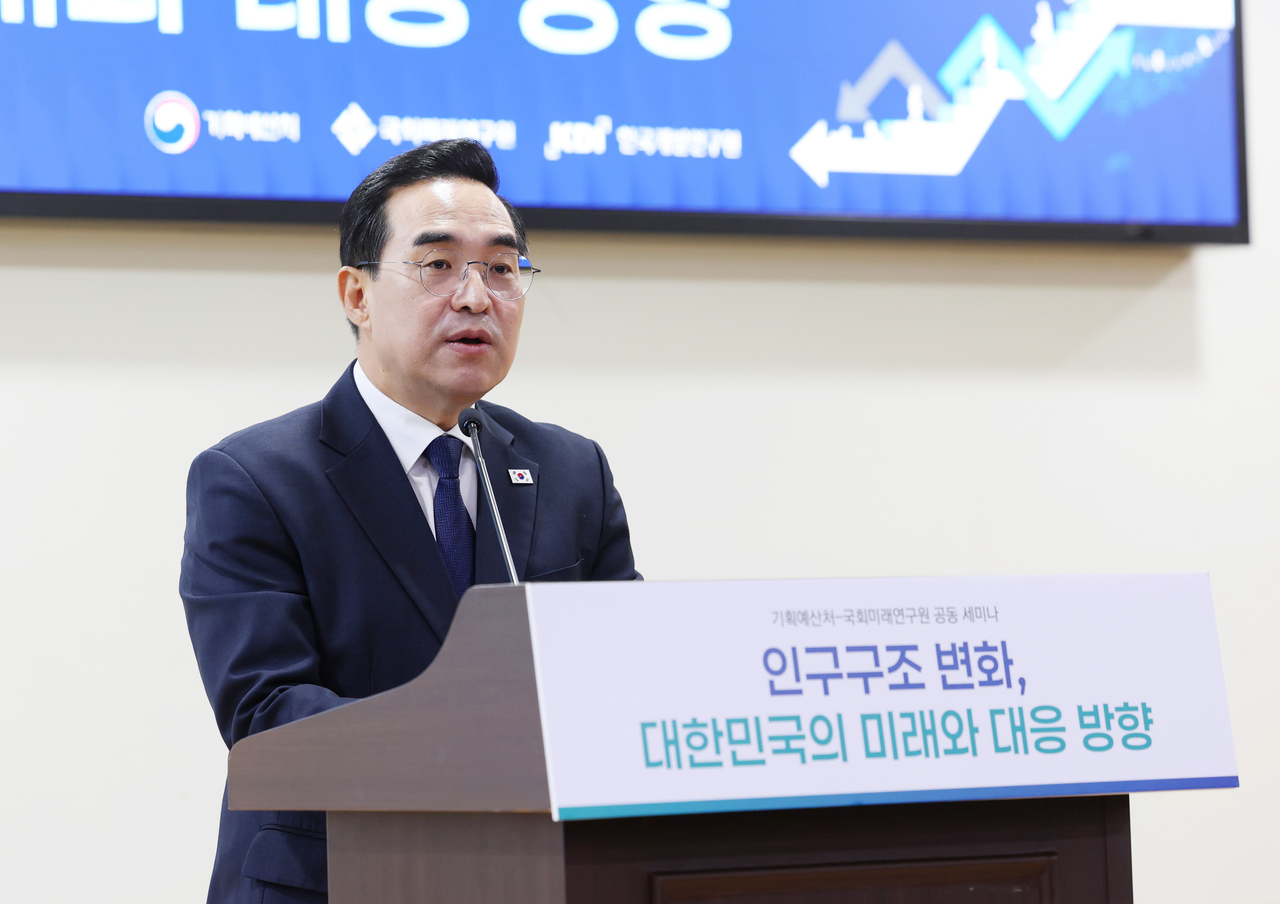
Park pointed to the urgency of responding to demographic shifts, noting that annual births — which exceeded 1 million in 1970 — have plummeted to around 250,000, and that by 2045 one in three South Koreans is projected to be 65 or older.
"Demographic change is not mere uncertainty — it is a 'foreseeable future,'" Park said. "We need a fundamental shift in population strategy, moving beyond quantitative growth focused simply on expanding population size and centering instead on qualitative growth."
Park also said institutions and practices built on the assumption of a growing population must be reexamined. "Even as the working-age population shrinks, we must sustain economic vitality, and even as the elderly population grows, every generation must be able to live a stable life," Park said.
"To that end, we will fundamentally redesign the social and economic systems across every sector that affects people's lives," Park added.
Park said childbirth and child-rearing must not remain a burden borne solely by family members, and that an environment must be created in which older citizens can continue to play an active role in society.
"Demographic change affects each generation, social class and region differently, and can at times give rise to conflicts of interest," Park said. "We must build social consensus so that the burdens of change are shared fairly and its benefits and opportunities are enjoyed together."
National Assembly Speaker Jo Jeong-sik and National Assembly Future Research Institute President Kim Gi-sik attended the seminar. Min Bo-gyeong, head of research planning at the institute, researcher Ahn Su-ji, and Kim Ji-un, a professor at Hongik University, presented on demographic change and response strategies, while experts from the National Assembly, government and academia took part in a panel discussion.
y2k@heraldcorp.com




