
Party-government consultation... businesses with 100-plus workers first in 2028
Minister pledges to improve contract-type pension returns
About 12 billion won in fiscal support for small businesses
Trustee corporation types to be classified with strict liability rules
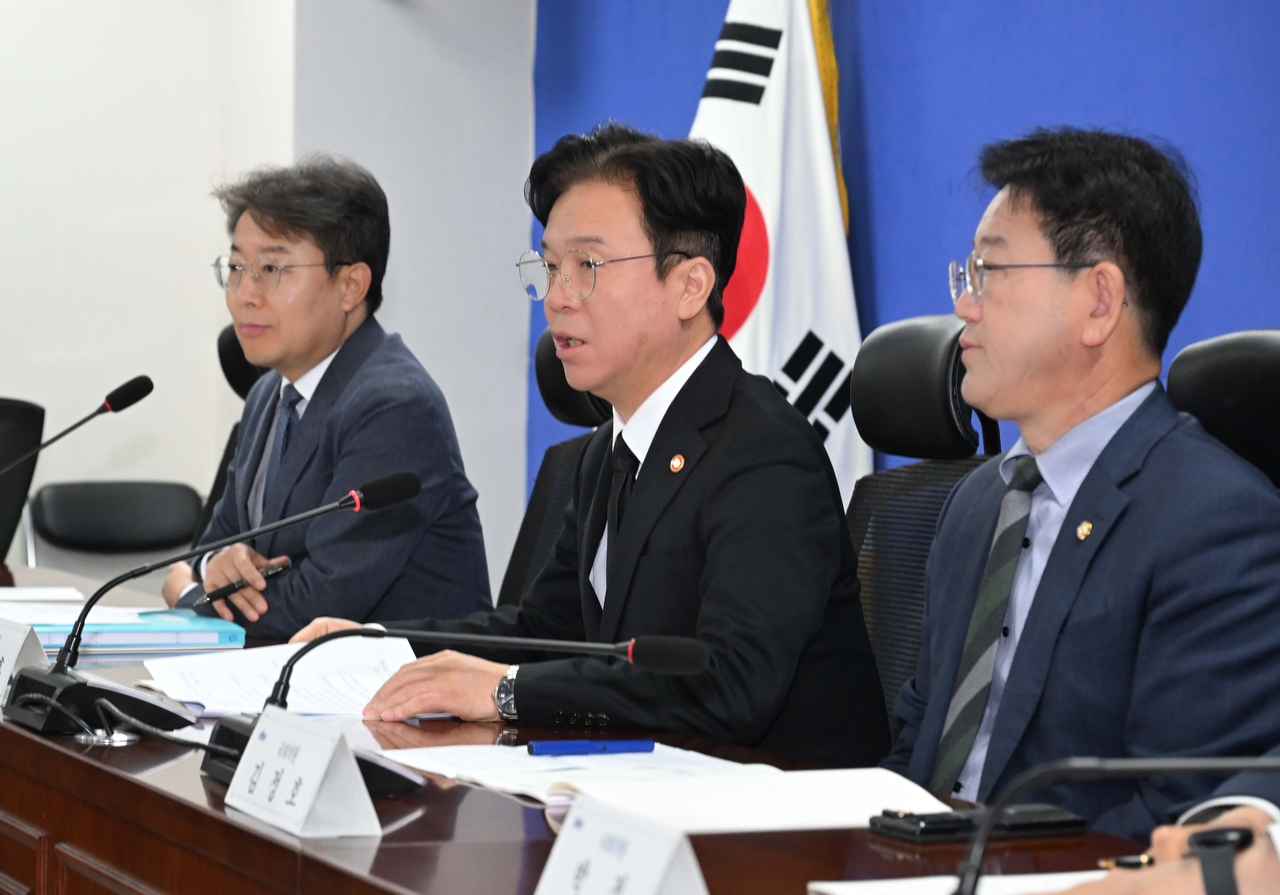
Minister of Employment and Labor Kim Young-hoon said Thursday the government will strengthen the retirement pension system by making external reserves of retirement benefits mandatory at all workplaces by 2030. The ministry plans to classify and evaluate the types of entities eligible to establish trustee corporations for fund-type retirement pensions in order to protect workers' pension entitlements. Kim also announced plans to support long-term accumulation under contract-type retirement pensions and to pass an amendment to the Act on the Guarantee of Workers' Retirement Benefits within the year.
Speaking at a party-government consultation held at the National Assembly, Kim said the government must develop the retirement pension system — which holds more than 500 trillion won ($378 billion) in assets — into a genuine income-security framework for workers.
"Starting with workplaces with 100 or more employees in 2028, we will make external reserves of retirement benefits mandatory at all workplaces by 2030 to reduce the risk of wage arrears for workers," Kim said. "Taking into account the difficulties faced by small businesses, we will provide about 12 billion won in fiscal support in parallel."
Kim said the ministry has classified the entities that may establish trustee corporations for fund-type retirement pensions into three categories, each designed to reflect its distinct characteristics. "Since the accumulated funds represent workers' retirement income, we have set strict trustee liability rules with the protection of pension entitlements as the top priority," Kim said.
To become a trustee corporation for a fund-type retirement pension, an entity must pass a review by an authorization committee composed of labor and management representatives, experts and government officials, and then receive authorization from the minister of employment and labor. The authorization process will be structured in two stages and divided into human, physical and financial requirements. A minimum capital requirement will also be set as a financial safeguard.
The government will also improve contract-type retirement pensions, including by raising their returns. Kim said the ministry will provide comparative data on lump-sum versus annuity payouts to encourage workers to accumulate retirement funds over the long term and receive them as a pension, and will also review measures such as strengthening awareness education and offering tax incentives. "We will work closely with the National Assembly to prepare an amendment to the retirement benefits act as soon as possible and ensure it passes within the year," Kim added.
Kim Jeong-ho, a Democratic Party lawmaker who chairs the National Assembly's Climate, Energy, Environment and Labor Committee, said improving the retirement pension system is an urgent task that can no longer be delayed. "There are still details of the system design and implementation to be worked out," Kim Jeong-ho said, "but since labor, management and government have reached a broad agreement, the ruling party and the government must cooperate closely to address concerns on the ground and ensure the system takes root in a stable manner."
Meanwhile, the party-government consultation also covered major legislative initiatives by the Ministry of Employment and Labor in the second half of this year and the ministry's 2027 budget proposal. The ministry's budget for next year has been set at 38.95 trillion won, a 3.4 percent increase from this year.
Kim said prompt action is needed to address pressing labor market challenges — including youth employment, the widening gap between employment types and firm sizes, and the shift driven by AI transformation — and that the ministry plans to channel resources secured through spending efficiency into focused investment in three areas: the future, inclusion and security.
Specific measures mentioned include expanding work-experience opportunities for youth and supporting career entry, development and job retention; extending social insurance protections for non-employee workers and providing tailored support for vulnerable groups such as people with disabilities and foreign nationals; and enacting a basic law on the rights of working people, introducing a worker presumption system, and passing legislation to revitalize regional employment.
addressh@heraldcorp.com




