
Dollar loan balances rise as exchange rate falls
Balances up 20% from $7.54 billion in September
Lower borrowing costs, FX hedging demand drive surge
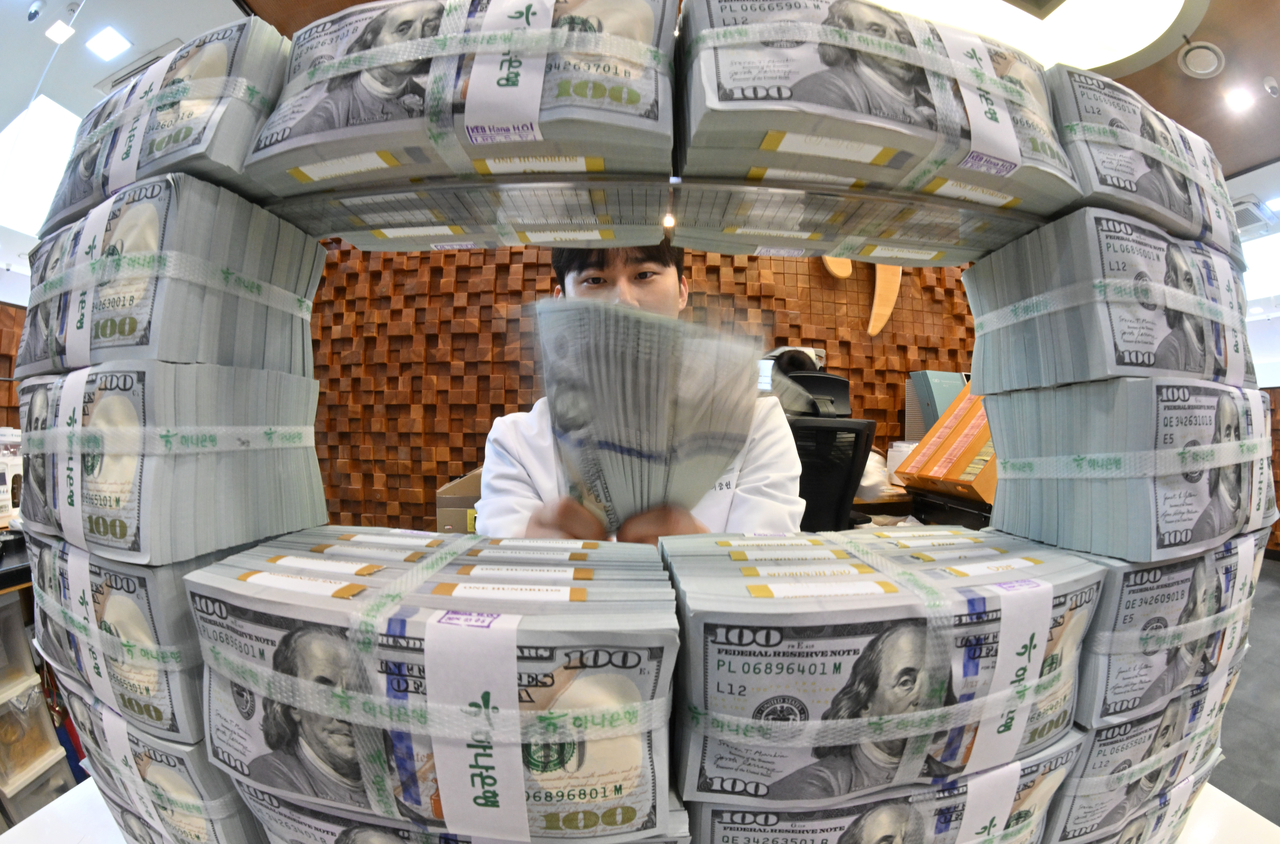
Dollar-denominated loans at major South Korean banks are rising rapidly as the won-dollar exchange rate falls into the low 1,300-won range. Banks say the trend reflects lower dollar-borrowing costs amid the won's appreciation and growing corporate demand for foreign-currency funding to cover import payments and currency hedging.
Dollar loan balances at the five major banks — KB Kookmin, Shinhan, Hana Bank, Woori and NH NongHyup Bank — reached $9.06 billion as of Friday, the highest monthly level this year, according to the banking industry. That marks a $1.52 billion, or 20.2 percent, increase from $7.54 billion at the end of September.
Dollar loan balances have fluctuated throughout the year amid sharp swings in the exchange rate. The combined balance at the five banks fell from $7.87 billion at the end of May to $7.35 billion at the end of June, a period during which the won-dollar rate climbed from 1,507.9 won on May 29 — the last trading day of the month — to 1,549.4 won at end-June. When the rate dropped sharply to 1,424.0 won at end-July, balances rebounded to $8.69 billion. By end-August the rate had fallen further to 1,368.6 won, but balances pulled back to $7.73 billion, and at end-September the rate stood at 1,352.8 won with balances at $7.54 billion. As the rate eased to 1,324.6 won on Friday, dollar loans crossed back above $9 billion.
Banks say the recent won strength has reduced the cost of dollar funding for companies, stimulating demand for foreign-currency loans.
Companies that need to pay for imports or purchase overseas raw materials and equipment can borrow in dollars directly rather than converting won. Borrowers who expect the exchange rate to fall further can take out dollar loans now and repay them later at a lower rate, reducing their won-equivalent repayment burden. The timing of payments, foreign-currency cash flows and exchange-rate expectations all factor into corporate decisions about when to raise foreign-currency funding, and those decisions are reflected in loan balances.
An expansion in the permitted uses of foreign-currency loans has also supported dollar demand. Resident foreign-currency loans have traditionally been restricted to overseas end-use purposes, but the Bank of Korea last year allowed export companies to use such loans for domestic facility investment and from Feb. 27 this year extended that permission to domestic working capital as well. Export companies can now raise working capital for domestic use in foreign currency, within the limits of their export performance.
"As exchange rate volatility has increased, demand for foreign-currency funding — particularly from import-oriented companies seeking to hedge currency risk and secure payment funds — has continued," a banking industry official said. "The increase in foreign-currency loans appears to reflect a combination of changing dollar-funding conditions tied to expectations that the US benchmark interest rate will remain on hold, and shifts in corporate treasury strategies."
Yen-denominated loans have also reversed a recent declining trend. The combined yen loan balance at the five banks fell for three consecutive months, from 75.32 billion yen ($477 million) at end-May to 74.65 billion yen at end-June, 73.66 billion yen at end-July and 72.26 billion yen at end-August.
The balance then rose 5.4 percent in a single month to 76.17 billion yen at end-September, and edged up further to 76.49 billion yen on Friday — an increase of 4.23 billion yen, or 5.8 percent, from end-August. The gains came as the won-yen cross rate fell to 843.79 won per 100 yen on Friday, sustaining demand for yen-denominated payments on Japanese raw materials and equipment as well as appetite for funding in relatively low-rate Japanese yen.
Meanwhile, resident foreign-currency deposit balances at domestic foreign-exchange banks reached $154.71 billion at end-September, the highest since the Bank of Korea began compiling the data in June 2012, according to the central bank's resident foreign-currency deposit report. Balances rose $14.09 billion from the previous month-end figure of $140.62 billion, extending a record-high streak to three consecutive months.
The monthly increase was the third-largest on record, behind $15.88 billion in December last year and $15.01 billion in July this year.
Resident foreign-currency deposits cover foreign-currency accounts held domestically by Korean nationals, domestic companies, foreigners who have resided in Korea for at least six months, and foreign companies operating in the country.

rim@heraldcorp.com




