
Over 20 clinicians from Europe, Asia-Pacific attend
Latest research on lupus, Sjögren's syndrome presented
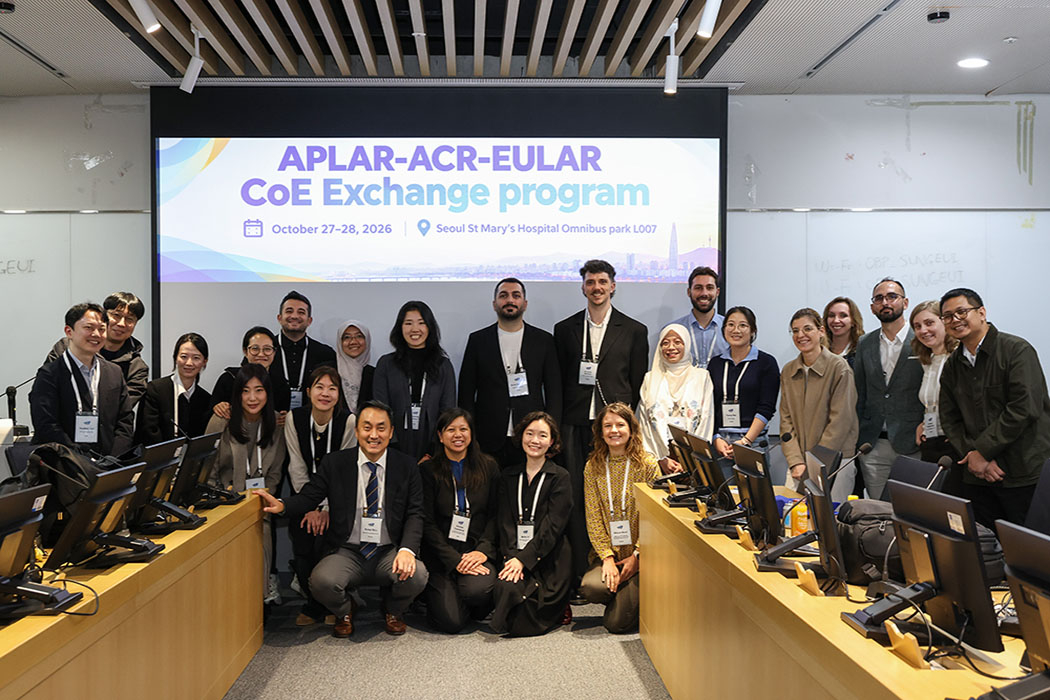
The Catholic University of Korea Seoul St. Mary's Hospital hosted an international training program to share domestic rheumatic disease research with young medical professionals from around the world, introducing the latest treatment research on autoimmune diseases and giving participants access to advanced medical research facilities.
The hospital's Rheumatology Center announced Thursday that it held the program Tuesday and Wednesday at the hospital's Omnibus Park for medical professionals attending the Asia Pacific League of Associations for Rheumatology, known as APLAR.
More than 20 young rheumatologists and postdoctoral researchers from Europe — including the United Kingdom, Italy, Turkey, Romania and Ukraine — as well as from the Asia-Pacific region took part in the program.
APLAR represents approximately 25,000 rheumatologists across the Asia-Pacific region and is considered one of the world's three leading rheumatology associations, alongside the American College of Rheumatology and the European Alliance of Associations for Rheumatology.
The Seoul St. Mary's Hospital Rheumatology Center was designated an APLAR Center of Excellence in 2016, the first in South Korea. The designation is awarded to institutions that meet standards across three areas: research, patient care, and education and training. This year marks the 10th anniversary of the designation.
The program featured presentations on the latest research findings for major autoimmune diseases, including lupus, Sjögren's syndrome and systemic sclerosis.
Professor Kwak Seung-ki presented research on disease mechanisms and therapeutic targets through the lupus microbiome, while Professor Lee Ju-ha shared findings from a cohort study analyzing the clinical characteristics of Korean patients with Sjögren's syndrome.
Professor Joo Ji-hyun outlined strategies for bridging academic research and industry in the rheumatology field, and Professor Cho Mi-ra introduced the current status of STAT6-targeted therapy development for systemic sclerosis treatment.
Professors Kwak and Joo are each conducting international joint research with American institutions, backed by government research grants of up to 7 billion won ($5.29 million) each.
Kwak's research team is working with Harvard Medical School to develop targeted therapies for rheumatoid arthritis and inflammatory bowel disease that simultaneously target interleukin-6 and interleukin-23. Joo's team is collaborating with Stanford University School of Medicine to develop universal cell therapies based on hypoimmunogenic induced pluripotent stem cells.
Participants also toured the hospital's Rheumatology Research Center, the Institute for Induced Pluripotent Stem Cell Application Research, and the Good Manufacturing Practice facilities at the Catholic Cell Therapy Center.
The program also included an abstract presentation session in which participants shared their own research findings, followed by a general discussion and a dinner reception.
Rheumatology Center Professor Kwak Seung-ki said the direct exchange with young rheumatologists from Europe, the Americas and the Asia-Pacific region — sharing the latest research and clinical experience as an APLAR Center of Excellence — is meaningful in expanding the academic reach of Korean medicine into the Asia-Pacific region.
Meanwhile, Seoul St. Mary's Hospital launched a clinical study last April — the first in South Korea — administering CAR-T cell therapy to patients with refractory lupus. A research team comprising Rheumatology Center professors Joo Ji-hyun and Lee Bong-woo, along with Hematology Hospital Professor Yoon Jae-ho, administered the CAR-T therapy to a patient in her 40s who had not responded to conventional treatments. No acute side effects were observed following administration, and lupus-related indicators showed signs of improvement.
woo@heraldcorp.com




