Group sets 6 trillion won sales target for 2032, activating growth strategies across affiliates
Guatemala, Uzbekistan production sites to strengthen supply chain competitiveness
AI platform investment and shareholder returns to drive profitability recovery and future growth
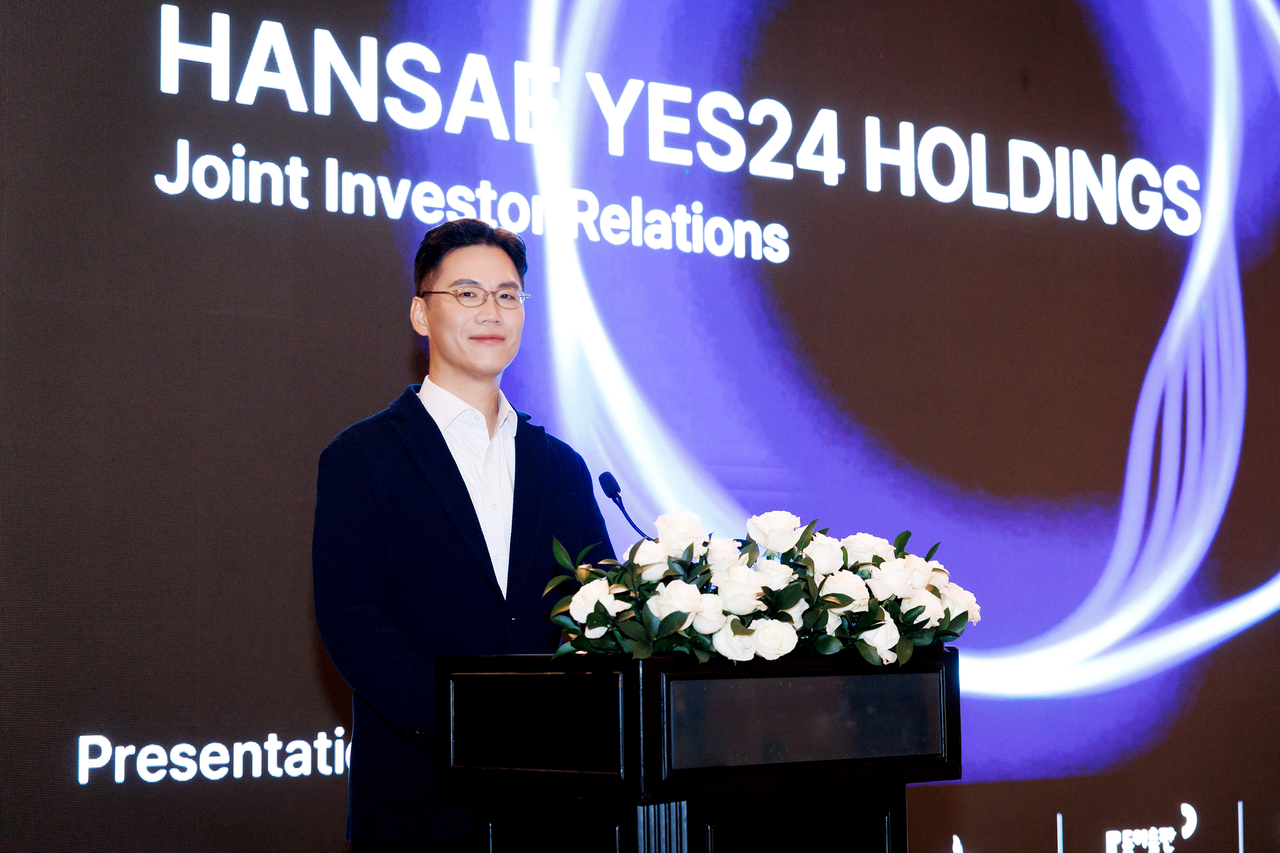
Hansae YES24 Holdings Vice Chairman Kim Seok-hwan unveiled a vision to achieve consolidated sales of 6 trillion won ($4.53 billion) by 2032, with affiliate-specific growth strategies spanning fashion, culture, education and mobility driving the expansion.
Kim announced the 2032 sales target Wednesday at the group's 2026 Global IR event in Ho Chi Minh City, Vietnam. He said the group has secured supply chain stability amid a rapidly shifting trade environment, thanks to a dense network of sales, production and R&D bases across four regions — Asia, the Americas, Central and South America, and Europe — spanning 16 countries, anchored by its South Korean headquarters.
"Following our successful entry into the 3 trillion won annual sales era last year, consolidated sales for the first half of this year rose 6.9 percent year-on-year to 1.77 trillion won, sustaining solid growth," Kim said. "Driven by Hansae's expansion of high-value-added products, Hansae Mobility's return to profitability, and the new-title effect at Dong-A Publishing, consolidated operating profit rose 40.3 billion won year-on-year to 61.6 billion won in the first half — marking the beginning of a profitability recovery."
Kim also emphasized the group's commitment to shareholder returns and sustainable management. "We have paid dividends for 17 consecutive years since the holding company's launch," he said. "From 2026 to 2028, we will enhance shareholder predictability through a medium- to long-term policy of distributing at least 40 percent of affiliate dividend income and maintaining a minimum dividend of 500 won per share."
For Hansae, the focus is on vertical integration of the production process and strengthening product categories. Hansae Vice Chairman Kim Ik-hwan said the company had already established a vertical integration foundation in Asia — from fabric to sewing — through the 2013 acquisition of Vietnamese fabric company C&T. "With the full-scale launch of the Central America Guatemala project in the fourth quarter of this year, vertical integration covering the entire process — from yarn and knitting through dyeing, finishing and sewing — will be complete," he said. "Building on this, we will further strengthen our global supply chain responsiveness and competitiveness in delivery and cost, securing a differentiated infrastructure edge."
Hansae also plans to expand product categories including activewear. Sales for the first half of this year rose 9.2 percent year-on-year to 1.03 trillion won, with operating profit reaching 46.5 billion won. The company also plans to enhance shareholder returns by raising the minimum dividend to 600 won per share for 2026 through 2028.
Dong-A Publishing and YES24 presented blueprints for evolving into platform companies built on edtech and AI infrastructure, leveraging the vast data and expertise each has accumulated.
Dong-A Publishing holds a commanding market position — 95.4 percent of middle school students nationwide use its textbooks, and it ranks first in middle school English and mathematics under the new curriculum. The company outlined three strategies: reinforcing its textbook market leadership, nurturing leading reference book brands, and accelerating digital transformation.
Dong-A Publishing CEO Lee Uk-sang said the company expects education content sales to surpass 120 billion won this year, and plans to develop subject-specific leading brands including "Ppajak," which has sold about 4 million copies, and "Hi-Top," which has sold about 5 million copies.
YES24 is pursuing a similar path, using 27 years of accumulated data and its own AI tools to sharpen customer targeting. The newly opened Paju logistics center is also expected to bolster delivery service competitiveness. The company projected sales of around 620 billion won for this year.
YES24 CEO Choi Se-ra said the company will open a smart logistics center in the second half of this year with one of Asia's highest levels of automated processing, handling more than 30 million logistics orders annually to maximize delivery competitiveness. "We will build our own foundation model to lead AI commerce — including persona-based hyper-personalized recommendations — and by year-end successfully launch a digital reference book platform that integrates an AI tutor into Dong-A Publishing's study guides," she said.
Hansae Mobility is also pursuing new global customers through new factory openings. The company is accelerating its localization strategy through the expansion and relocation of its Chesterfield plant in North America and the establishment of a new subsidiary and factory in Uzbekistan. Sales for the first half of this year reached 254.4 billion won, up 13.4 percent year-on-year, with profitability improving significantly.
Hansae Mobility President Seong Nak-gon said the company will pursue growth by strengthening leading technological competitiveness and expanding its global customer base. "Drawing on 40 years of accumulated experience and expertise in mass production of core components, we are also reviewing entry into the robotics business," he said.
Hansae Mobility completed construction of its wholly owned subsidiary Turan factory in Fergana, Uzbekistan, on Oct. 13. The move marks a full transition to local production for its automotive parts supply business serving UzAuto, a relationship spanning more than 30 years. The factory, built on a 20,000-square-meter site, will assemble and supply braking and steering components for locally produced models — the Damas, Labo and Cobalt — at a capacity of 310,000 units per year.
siuu@heraldcorp.com