FSS holds meeting with chairs of 8 bank holding company boards
Lee Chan-jin calls for stronger independence, accountability of outside directors; CEO selection process also reviewed
Financial sector says transparency of deliberation process matters more than vote outcomes
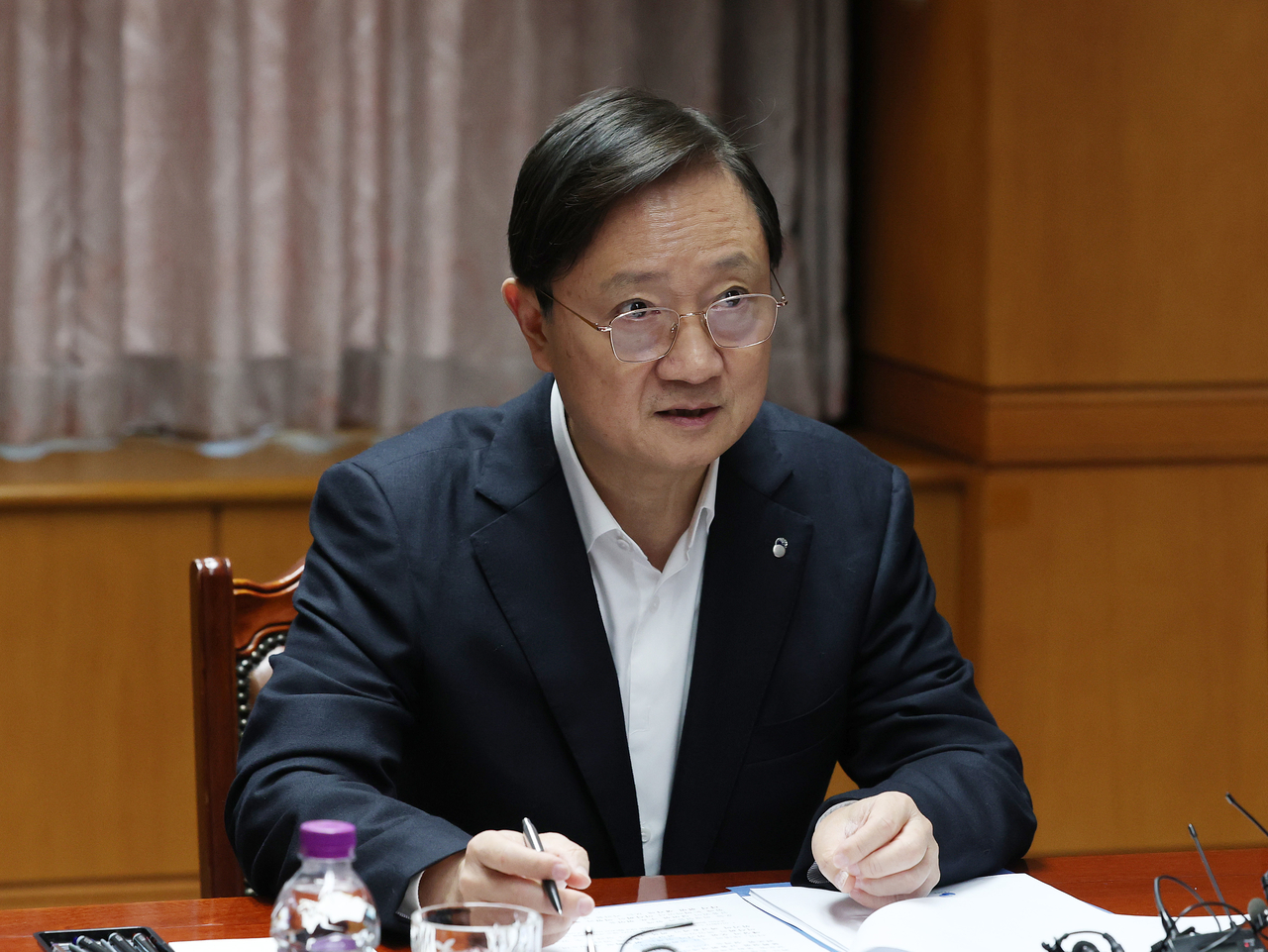
Financial Supervisory Service Director General Lee Chan-jin has called on bank holding company boards to strengthen their independence and improve transparency in CEO succession procedures, ahead of year-end executive appointments at financial holding subsidiaries. He also said boards must break from the practice of rubber-stamping proposals submitted by management.
The financial sector broadly agrees that boards need stronger oversight functions and that succession processes should be made more transparent. However, some voices within the industry warn that regulatory pressure on the selection process is intensifying without clear institutional standards to back it up.
Speaking at a meeting with the board chairs of eight bank holding companies held Wednesday at the FSS headquarters in Yeongdeungpo-gu, Seoul, Lee said boards should "make continuous efforts to establish fair and transparent governance." The meeting was attended by the board chairs of KB, Shinhan, Hana, Woori, NH NongHyup, BNK and iM Financial Group, as well as an outside director representing JB Financial Group.
Lee placed particular emphasis on the boards' role in providing substantive checks on management. Financial authorities are also reviewing measures to enhance board independence and accountability and to tighten oversight of CEO succession procedures as part of broader governance reform discussions. "The governance improvement plan currently being developed includes discussions on ensuring that outside directors have the authority and conditions needed to faithfully carry out their oversight role," Lee said. "For these institutional changes to translate into genuine governance improvements, they must be backed by the appropriate expertise and sense of responsibility."
Lee also directly raised the high rate at which bank holding company boards pass agenda items without modification. According to the FSS, of the 993 agenda items voted on by the boards of the eight major bank holding companies last year, only nine were passed with amendments and one was deferred — the rest were approved as originally proposed.

Lee said directors should "fulfill their duty of care by actively requesting materials and drawing on outside experts to scrutinize agenda items in depth, rather than relying solely on information provided by management." He also called on boards to make decisions that serve the long-term interests of the company and its shareholders on key management issues such as business diversification and executive compensation and performance evaluations.
With subsidiary CEO appointments set to get underway in earnest at year-end, Lee urged holding companies to improve the transparency and fairness of their succession procedures. "Please further strengthen the transparency and fairness of subsidiary CEO succession procedures in a way that fully reflects the intent of the governance improvement plan," he said. The FSS has said transparency must be raised across the entire succession process — from candidate pool selection and vetting to the maintenance of related records.
Financial holding companies are already revising their succession procedures. Shinhan Financial Group this year began having its bank's executive candidate recommendation committee directly deliberate on and recommend candidates for bank president. It also required the committee chair to participate in the final interview conducted by the holding company's subsidiary CEO candidate recommendation committee — a move that expanded the subsidiary board's role in a process that had previously been driven by the holding company.
However, some in the financial sector view it as excessive to single out the rate of unmodified approvals when the governance improvement plan has yet to be enacted into law. Because outside directors and management typically exchange materials and iron out differences before an agenda item is formally submitted, they argue it is difficult to judge a board's oversight function based solely on the final vote tally.
"It is hard to assess a board's independence simply from the fact that a proposal passed as originally submitted," one financial industry official said. "Ultimately, what matters is reducing information asymmetry by making sufficiently public what kind of discussion and review led to a given conclusion." Another industry official said the remarks were understood not as a call to increase dissenting votes, but as an appeal "to raise transparency so that the review process and the views expressed by directors can be verified from the outside."

Both inside and outside the financial sector, observers say that for the regulator's demands to translate into genuine governance improvements, clearer standards are needed on what must be disclosed and to what degree in CEO succession and board operations. Given that financial firms vary in how much of their board deliberations and annual governance reports they make public, establishing common standards for candidate vetting, board discussions and record-keeping should come before any simple comparison of for-and-against vote counts.
Related regulatory reform remains at the discussion stage. The Financial Services Commission launched a "governance advancement TF" in January, bringing together the FSS, academics and legal experts, with a stated goal of discussing ways to strengthen board independence and improve the fairness and transparency of CEO appointments — and of producing a reform plan and amendments to the Act on Corporate Governance of Financial Companies by March. However, the specific content of the governance improvement plan and its release schedule have yet to be finalized.
rim@heraldcorp.com