Bae says Korea ranks No. 1 in Asia, No. 4 globally in Global Innovation Index for second consecutive year
Inter-ministry cooperation to drive 7 SEED projects
Public-private 'Frontier Board' platform to incorporate industry demand
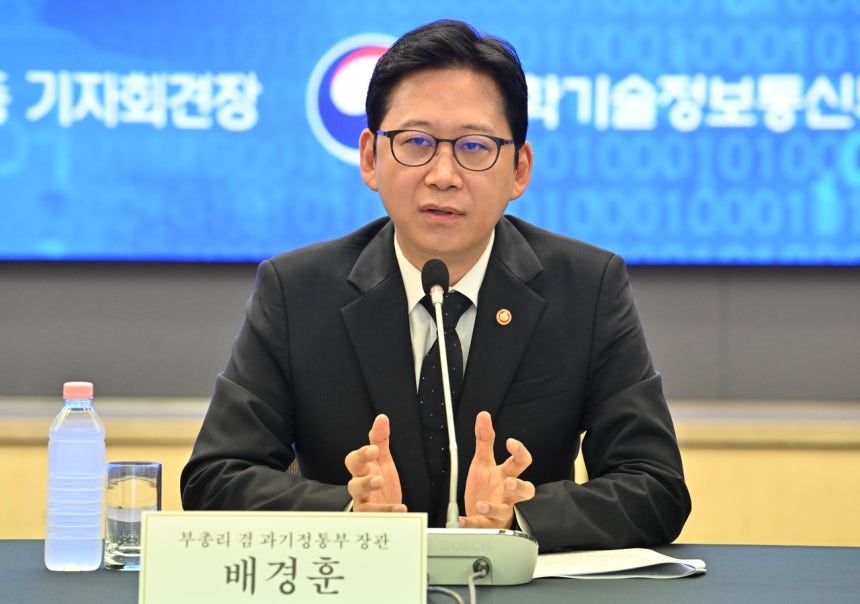
Deputy Prime Minister and Minister of Science and ICT Bae Kyung-hoon said Wednesday that South Korea's AI competitiveness has placed the country among the world's top-tier "AI-leading nations."
The government plans to press ahead with securing future technologies through the 7 SEED Projects, with detailed implementation plans to be finalized by year's end and full-scale ecosystem development set to begin next year. As part of that effort, the government will establish a public-private joint platform called the Frontier Board.
Speaking at a joint session of the Economic Ministers' Meeting and the Science and Technology Ministers' Meeting at Government Complex Seoul on Wednesday, Bae said South Korea had recently been included in the top-tier group of "AI-leading nations" alongside the United States and China. He added that the country had ranked first in Asia and fourth in the world in the Global Innovation Index for two consecutive years.
"South Korea's AI and science and technology competitiveness is receiving high international recognition," Bae said, adding that the achievement was "a valuable result built together through the government's strategic investment and the private sector's relentless innovation and drive."
Bae said close inter-ministry cooperation was essential for translating these advances into new industries and markets. "We will bring together the capabilities of science and technology and economic policy to create new engines of growth," he said.
He also stressed the need to focus full effort on securing future technologies through the 7 SEED Projects. "We must accelerate the national AI transformation so that the results lead to improvements in people's quality of life, and we must also press ahead with securing future core technologies through the 7 SEED Projects," Bae said.
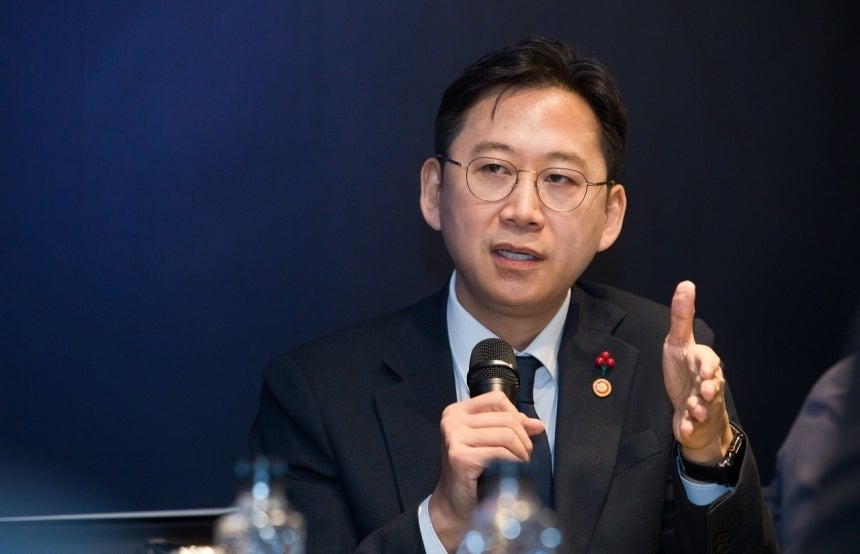
The 7 SEED Projects, which Bae identified as a key pillar of future competitiveness, is a pan-government initiative covering seven fields: small modular reactors, nuclear fusion, renewable energy, quantum technology, aerospace, advanced biotech and advanced supply chains. The government has drawn up plans to allocate about 4 trillion won ($3.02 billion) in next year's budget to develop these advanced technologies into future growth engines.
Wednesday's meeting laid out the direction for inter-ministry cooperation in advancing the 7 SEED Projects. Specific implementation plans are to be finalized by year's end, with full execution set to begin next year.
The core of the approach is to move away from managing individual projects in isolation and instead build a coordinated framework that strategically links each ministry's projects and investments around key missions — with the aim of hitting target milestones set for 2030 and 2035 across all seven SEED areas.
As part of this process, the government plans to form the public-private joint Frontier Board platform to reflect industry demand. Inter-ministry cooperation will also be strengthened across the full pipeline from technology development through demonstration and commercialization. The goal is to jointly resolve key prerequisites — including regulation and licensing — to build out the technology and industry ecosystem in earnest.
sjpark@heraldcorp.com