Two-day event runs Friday and Saturday; AI-integrated autonomous driving category debuts
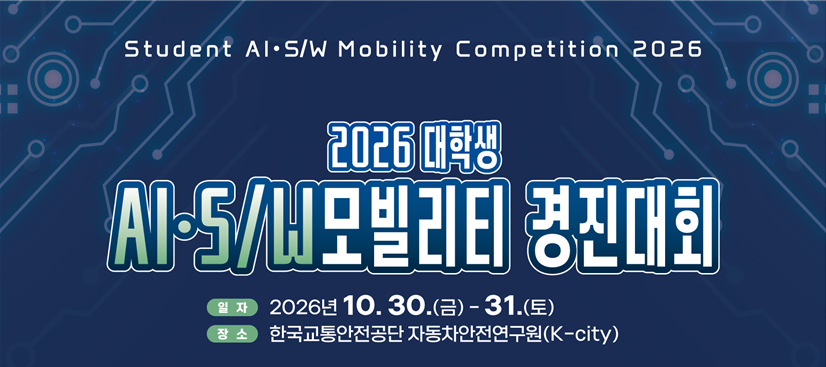
The Ministry of Land, Infrastructure and Transport will host the "2026 College Student AI·SW Mobility Competition" at the Korea Transportation Safety Authority's Automotive Safety Research Institute in Hwaseong, Gyeonggi Province, from Friday through Saturday, aiming to identify and cultivate talent to lead the future of the autonomous driving industry.
Now in its 17th year, the competition will bring together about 500 students from 50 teams, who will put their self-developed autonomous driving technology to the test across a range of driving challenges — including navigating signalized intersections, responding to visual distortions caused by fog and changing light conditions, and avoiding sudden obstacles in GPS dead zones.
The event is divided into two categories: "self-built autonomous vehicles," in which teams race custom-built cars on a real road course with actual intersections and obstacles, and "AI-integrated autonomous driving," in which participants compete using autonomous driving software in a virtual environment that precisely replicates K-City.
The newly introduced AI-integrated autonomous driving category focuses on building software development capabilities in line with the trend toward AI-driven advancement in autonomous driving technology. It also lowers the cost and equipment burden of vehicle construction to broaden participation, allowing students to concentrate on algorithm development and performance improvement.
Top teams, selected based on their autonomous driving task success rate and completion time, will receive a total of 14 awards — including the Minister of Land, Infrastructure and Transport Award — along with prize money totaling 23 million won ($17,400).
To help all participants sharpen their skills, the ministry provided foundational autonomous driving and simulation training as well as expert technical consulting from the preparation stage onward. It also opened a practice facility at the research institute free of charge so students could test and refine their technology ahead of the competition.
The event will also feature a demonstration of next-generation Vehicle-in-the-Loop Simulation (VILS) technology, which verifies autonomous driving performance by linking road communication infrastructure with a virtual environment in real time. The competition will be livestreamed on YouTube so members of the public who cannot attend in person can follow the students' autonomous driving technology and their progress through the challenges.
Park Jun-hyung, director general of the ministry's Mobility and Automobile Bureau, said nurturing talent with AI and software capabilities must go hand in hand with building autonomous driving demonstration cities and supporting technology development if those efforts are to translate into stronger industrial competitiveness. "I hope this competition serves as an opportunity for college students to implement, verify and grow through the knowledge they have acquired," he added.
Meanwhile, the 2025 College Student Creative Mobility Competition held last year drew 42 teams competing in autonomous driving performance. A team from Seoul National University of Science and Technology took the grand prize in the self-built autonomous vehicle category, while a team from Korea University of Technology and Education won in the unmanned mobility category.
smh@heraldcorp.com