Sinwol Siyeong in Yangcheon-gu to be rebuilt as 3,000-unit complex
Young dual-income newlyweds with combined salaries of 120–130 million won moving in
Nearby new builds approaching 1.3 billion won as market prices rise
Experts warn buyers to factor in contribution costs and long-term investment risks
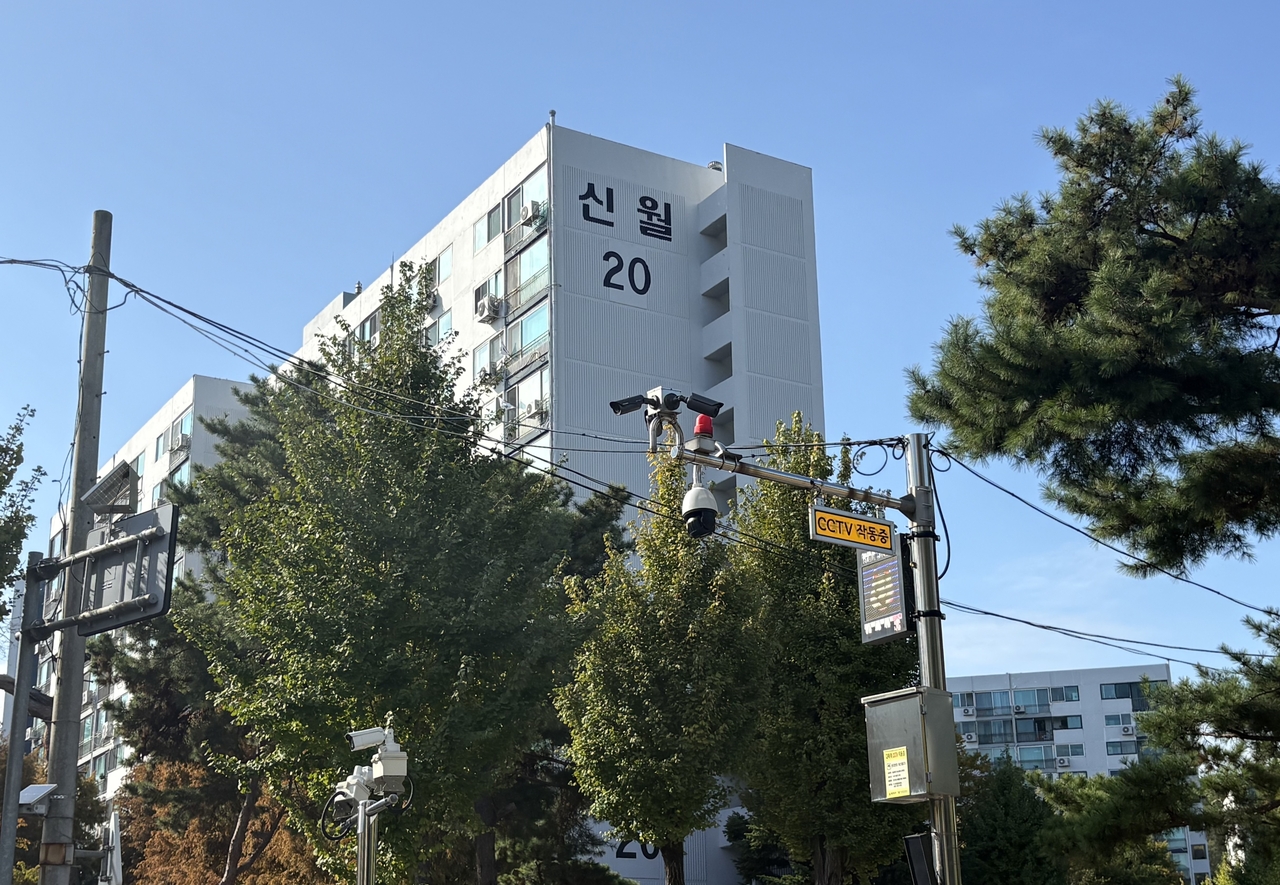
One owner listed the unit at 870 million won, but their children said prices would keep rising and told them to hold off — or just wait for the move-in rights. Even at a price several tens of millions of won above the previous record high, we got quite a few inquiries from buyers.
Record-high transactions are piling up at Sinwol Siyeong, an aging large-scale apartment complex in Sinwol-dong, Yangcheon-gu, Seoul, as demand from buyers in their 20s and 30s pursuing reconstruction "bodytec" — a strategy of living in an aging apartment while waiting for it to be rebuilt — continues to flow in. Some owners have begun pulling their listings off the market, betting that prices will climb further.
Real estate agents near the complex said Monday — the day a contractor selection tender was held — that both market prices and asking prices had risen sharply compared with the start of this year. The head of a local agency in Sinwol-dong said that despite the complex having more than 2,000 units, only about 10 listings were currently available. "Every time one sells, the price goes up," he said.
Completed in 1988, Sinwol Siyeong is an aging complex of 2,256 units rising 12 stories above ground. It was designated a reconstruction improvement zone in August 2025, and Korea Real Estate Investment & Trust was named project operator that November, accelerating the timeline. The complex is slated to be redeveloped into a new development of up to 21 stories with 3,155 units. Daewoo Engineering & Construction was the sole bidder in Monday's contractor selection tender.
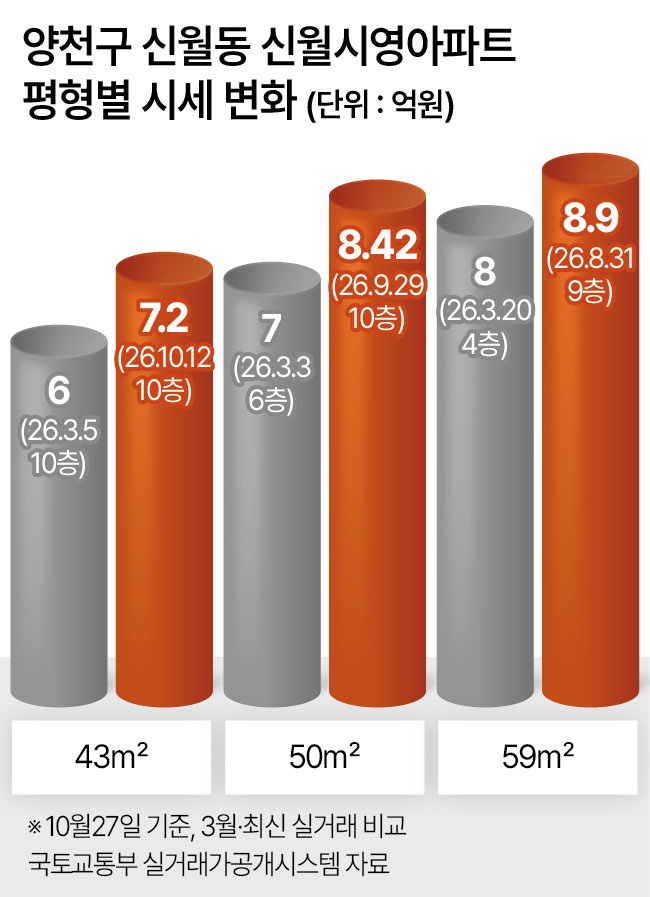
According to the Ministry of Land, Infrastructure and Transport's actual transaction price disclosure system, a 43-square-meter unit (all figures refer to exclusive use area) sold for 720 million won on Oct. 12, setting a new record. As recently as March, a unit of the same size on the same floor in the same building had changed hands for 600 million won — a jump of 120 million won in roughly six months.
A 50-square-meter unit hit a record 842 million won ($637,000) on Sept. 29. About three months earlier, on June 30, a comparable mid-floor unit had sold for 740 million won — a rise of more than 100 million won in just three months. A 59-square-meter unit also set a record when it sold for 890 million won on Aug. 31.
The head of the local agency said a buyer who signed a contract on a 50-square-meter unit in late June came back recently to pick up the title deed and was thrilled. "They bought it and the price went up 100 million won not long after — they got in at a great time," he said.
According to local agents, asking prices by unit size have risen between 100 million and 150 million won compared with the start of this year. Current listings are priced at around 750 million won for 43-square-meter units, 820 million to 850 million won for 50-square-meter units, and 900 million to 930 million won for 59-square-meter units.

The price surge has been driven largely by young end-users. People at the scene said inquiries from newlywed and soon-to-be-married couples in their 30s have been coming in consistently. With all of Seoul now designated a land transaction permit zone — requiring buyers to actually live in properties they purchase — demand from so-called "bodytec" buyers willing to reside in an aging apartment while waiting out the reconstruction process has been particularly visible.
The head of another local agency said the buyers coming in are young dual-income newlywed couples with stable jobs and combined annual salaries of around 120 million to 130 million won. "They try to keep loans below 400 million won given high interest rates, and they put together the rest by liquidating savings or stocks, or through family gifts," he said.
Another agent said that while the 59-square-meter units used to be the most sought-after because of lower additional contribution costs, demand has recently shifted toward 50-square-meter units due to limited supply. "For the 43-square-meter units, I have two or three buyers on a waiting list who've asked me to call them if something decent comes up in the low 700 million won range," the agent added.
The agent went on to say that nearby new apartment buildings, which had been listing 82-square-meter units in the 1.2 billion won range, have now moved up to around 1.3 billion won as that inventory has been absorbed. "We expect Sinwol Siyeong to reach a similar price level in 10 years," the agent said.

Among older owners, however, concerns about additional contribution costs ran high. With construction costs rising, the financial burden on union members could increase further, and the long wait before move-in has led a significant number of longtime residents to sell rather than hold out for a new apartment.
A local agent said the incoming buyers are so young that they will still only be in their early to mid-40s by the time the new complex is ready for move-in. But the complex also has original residents in their 80s and 90s who have lived there since it was first built. "Some of the older owners feel there is little point in waiting a decade for a new apartment and would rather sell and move closer to where their children live," the agent said.
Experts advised caution when buying into aging complexes earmarked for reconstruction. Ham Young-jin, head of the real estate research lab at Woori Bank, said the bodytec approach aims to reduce upfront costs while eventually securing move-in rights and capital gains, but warned that additional contribution costs for smaller units can turn out to be far higher than expected.
Ham added that once a reconstruction association is formally established, union membership cannot be transferred upon move-in, meaning buyers could find themselves locked into a long-term investment with no exit. "Buyers should fully account for the volatility between signing a contract and actually moving in," he said.
shy@heraldcorp.com