- Clustering 3–4 ruthenium atoms maximizes reactivity, matching performance of commercial platinum catalysts
- Performance degradation halved after 500 consecutive hours of operation, raising hopes for lower green hydrogen production costs
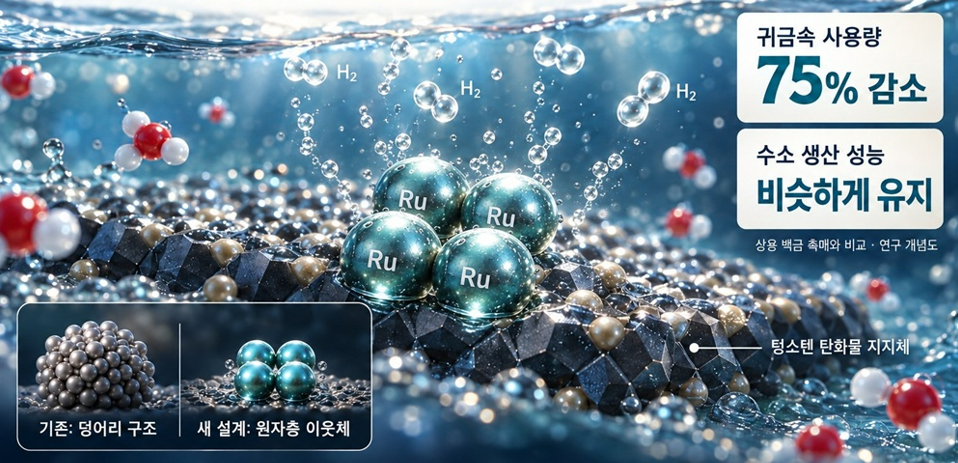
Researchers have developed a technology that cuts the use of expensive precious metals needed for hydrogen production by 75% while delivering performance comparable to existing commercial catalysts.
KAIST announced Wednesday that a research team led by Professor Lee Jin-woo of the Department of Biological and Chemical Engineering had jointly developed a high-performance water electrolysis catalyst using precious-metal ruthenium atoms, in collaboration with the Korea Research Institute of Chemical Technology, the Korea Basic Science Institute and Konkuk University.
Water electrolysis uses electricity to split water into hydrogen and oxygen. When powered by electricity generated from renewable energy sources such as solar and wind, it can produce green hydrogen with reduced carbon emissions. However, the need for costly precious metals to drive the hydrogen production reaction has long been cited as a barrier to economic viability.
Conventional precious-metal nanoparticle catalysts clump atoms together in bulk, preventing interior atoms from participating effectively in reactions. Single-atom catalysts, which isolate atoms individually, have their own limitation: they struggle to improve performance in reactions that require cooperation between atoms.
To address both problems, the research team created an "atomic-layer cluster" structure in which three to four ruthenium atoms are arranged in a single atomic layer. The key design principle was to prevent the atoms from aggregating into large clusters while enabling them to work cooperatively to accelerate the hydrogen production reaction.
The team also used a tungsten carbide support to stably anchor the ruthenium atoms and improved the connectivity of water molecules surrounding the catalyst, further accelerating the hydrogen generation reaction.
Performance tests confirmed the results. When applied to an anion exchange membrane water electrolysis device, the catalyst recorded a high current density of 9.82 amperes per square centimeter (A/cm²) at 2.0 volts.
The catalyst achieved hydrogen production performance comparable to commercial platinum catalysts while using 75% less precious metal. Catalytic performance per unit weight of precious metal was roughly four times higher.

The catalyst also demonstrated strong durability. In a 500-hour continuous operation test, performance degradation was half that of conventional platinum catalysts — suggesting the technology could reduce not only precious metal consumption but also catalyst replacement and maintenance costs.
The research team expects the technology to simultaneously improve the economic viability and durability of green hydrogen production facilities. However, additional verification under long-term operation and real industrial conditions will be needed before large-scale commercialization.
"By clustering just a few precious-metal atoms and improving the reaction environment of surrounding water molecules, we achieved high hydrogen production performance and durability with minimal precious metal use," said Kim Sung-bin, a research professor at KAIST. "We expect this to be used in reducing precious metal consumption in hydrogen production devices and enhancing the performance of various catalysts going forward."
The findings were published in the Sept. 22 online edition of Nature Communications.
nbgkoo@heraldcorp.com