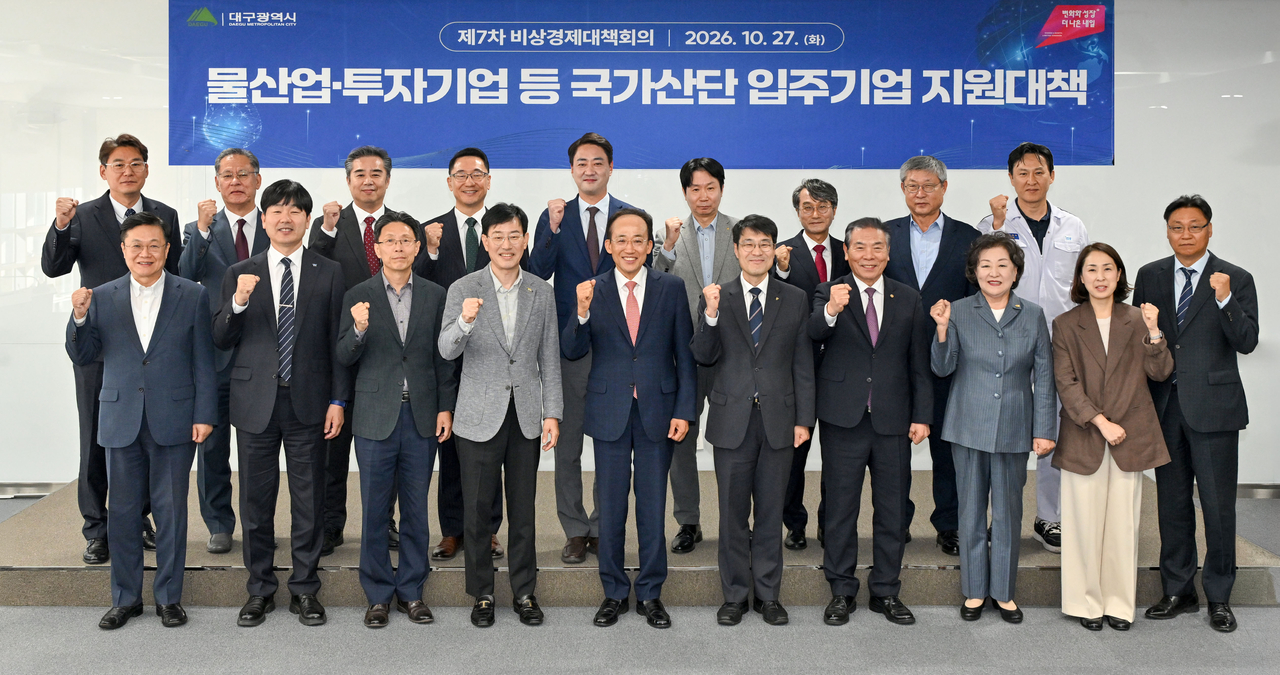
Daegu held its seventh emergency economic policy meeting Tuesday at the National Water Industry Cluster in Guji-eup, Dalseong-gun, with Mayor Choo Kyung-ho presiding. The city announced a package of measures to foster its water industry and support companies at the Daegu National Industrial Complex.
Daegu has been developing its water industry around the National Water Industry Cluster, established in 2019. As of 2024, 162 companies operating at the cluster employ more than 5,000 workers and generate combined sales of 1.39 trillion won ($1.05 billion).
Sales and exports at the cluster fell roughly 3 percent and 43 percent, respectively, from the previous year, prompting the city to expand support measures to restore competitiveness.
As a first step, the city set a public procurement target for cluster products of more than 21.5 billion won by 2027 — a 24 percent increase from the five-year average of 17.3 billion won.
The water industry development budget will also rise 178 percent, from 2.05 billion won this year to 5.7 billion won, to support technology development, commercialization and overseas market expansion.
The city plans to invest 12 billion won over five years in joint research and development and AI adoption among water companies, and allocate an additional 1 billion won over five years to support joint overseas market entry.
Daegu also intends to pursue designation as an opportunity development zone to strengthen its investment appeal, and will work to attract key institutions including the Korea Water Industry Promotion Agency and an NSF Asia-Pacific research and testing laboratory.
To expand the foundation for advanced industry investment, the public wastewater treatment facility at the national industrial complex will double its daily processing capacity from 5,000 tons to 10,000 tons.
The city plans to pursue a revision to the master plan in November and will seek central government funding to complete the 49.1 billion won facility by 2030.
Daegu will also recommend that the central government reform the investment subsidy system — specifically, to allow companies to apply for follow-on subsidies before settling prior ones, and to extend eligibility to equipment investment at existing facilities directly linked to new investment sites.
To improve transportation access to the industrial complex, the city will launch three demand-responsive transit routes starting in April 2027.
The routes will connect residential areas to key points within the complex and link outlying areas of the complex to stops on the No. 2 express bus line, cutting public transit travel times by more than 30 minutes.
"We will monitor progress every step of the way to ensure that our support measures are felt on the ground and drive a genuine revival of the water industry," Mayor Choo said. "We will create conditions where businesses can invest with confidence and grow sustainably, bringing new vitality to the local economy."
kbj7653@heraldcorp.com