Takes effect Oct. 31
The South Jeolla Province-Gwangju Integrated Special City will overhaul its city bus network starting Saturday, the city announced Tuesday.
The first major route restructuring in nine years, the overhaul focuses on building a bus system that reflects changes in the city's urban structure and residents' travel needs.
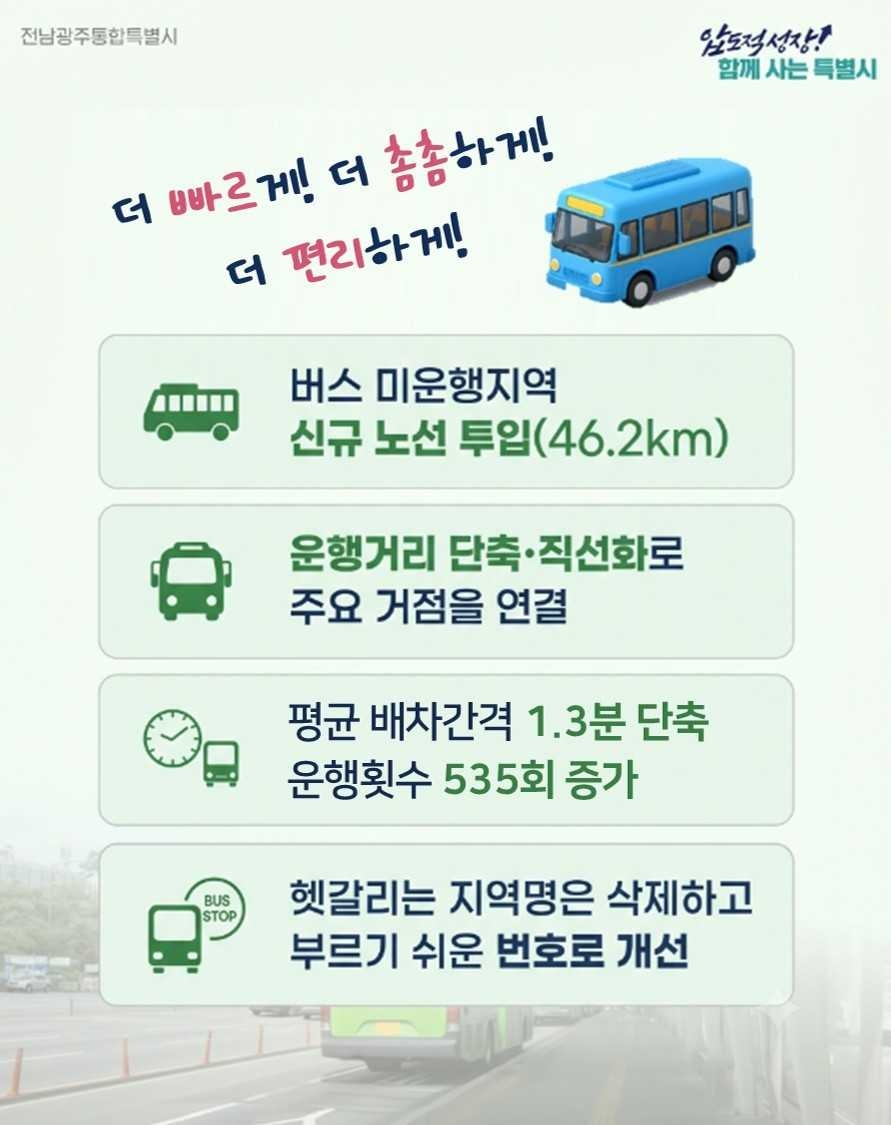
The number of bus routes will increase from 103 to 115, and the total number of daily trips will rise by 535.
Key changes include shorter travel times between major hubs, expanded service to underserved areas, more wide-area and express routes, and simplified route numbering.
Routes connecting major destinations such as universities and bus terminals will be straightened. Six high-demand, long-distance routes will adopt an express format that stops only at key hubs, improving travel convenience.
A total of 46.2 kilometers of new routes will be added across 19 transportation-underserved areas, including newly developed residential complexes in Sinyong-dong, Yongdu-dong and Cheomdan District 3, as well as areas where village bus services have been discontinued.
Wide-area and express routes toward Naju Innovation City and Hwasun will expand from one to three, strengthening connections between neighboring areas.
Route numbers will largely remain unchanged, but regional name prefixes will be dropped to make them easier for residents to recognize.
Updated route information will be available from Saturday on the Gwangju Bus Information System (bus.gwangju.go.kr), Naver Maps and Kakao Map. Real-time bus arrival information by stop will also be provided.
Passengers can look up the new routes in advance by scanning QR codes posted inside buses and at stops. For residents without internet access, printed route maps are available at district offices and community service centers.
To minimize confusion during the initial rollout, the city will operate a "route overhaul situation room" from Saturday through Nov. 6. The team will monitor bus operations and passenger complaints and respond quickly to problems as they arise.
Kim Young-sun, head of the integrated transportation bureau at the South Jeolla Province-Gwangju city government, said the changes are aimed at "redistributing a limited number of buses more efficiently to improve travel convenience," adding that the city will "minimize inconvenience for residents in the early stages and address any shortcomings by incorporating actual usage data and on-the-ground feedback."
sij@heraldcorp.com