KAIDA releases findings from import car purchase journey survey
Those considering a purchase prioritize value for money
Vehicles under 50 million won favor economy; those above 70 million won favor driving performance and technology
The Korea Automobile Importers & Distributors Association (KAIDA) announced Tuesday that a survey on import car purchase journeys found that repeat buyers — those who had previously purchased an imported vehicle — ranked driving performance and technology as their top selection criteria, while first-time buyers prioritized safety and quality.
The survey was conducted among 2,200 men and women between the ages of 25 and 59 who had purchased or considered purchasing an imported vehicle within the past three years.
Repeat buyers showed a relatively stronger tendency to value brand and to use brand- and model-specific online communities as well as showroom visits and test drives. Selection criteria also varied by price range: economy was the dominant factor at lower price points, while driving performance, technology, design, and brand image and prestige stood out at higher price points.
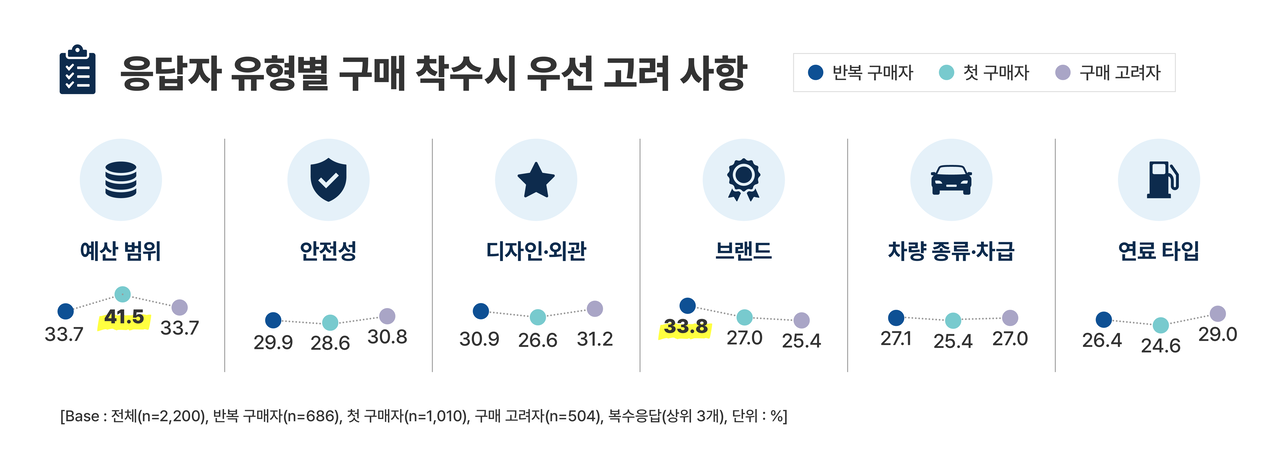
Respondents were divided into three groups: repeat buyers with prior import car purchases, first-time buyers, and those who considered but did not make a purchase. At the initial review stage, repeat buyers cited brand (33.8%) as their top consideration, while first-time buyers cited budget range (41.5%).
When it came to the factors that ultimately clinched the purchase decision, repeat buyers most frequently chose driving performance and technology (42.7%), while first-time buyers selected safety and quality (40.3%). Among those who considered but did not buy, fuel efficiency and running costs — broadly, economy — carried a relatively higher weight (36.3%).
The three groups also differed in how they gathered information. Showroom visits and test drives were the most common experience across all three groups, but first-time buyers had the highest rate of using online sources, social media and personal referrals (66.5%), while prospective buyers who did not purchase led in financial and quote-comparison tools (56.9%) and AI-based searches (29.6%).
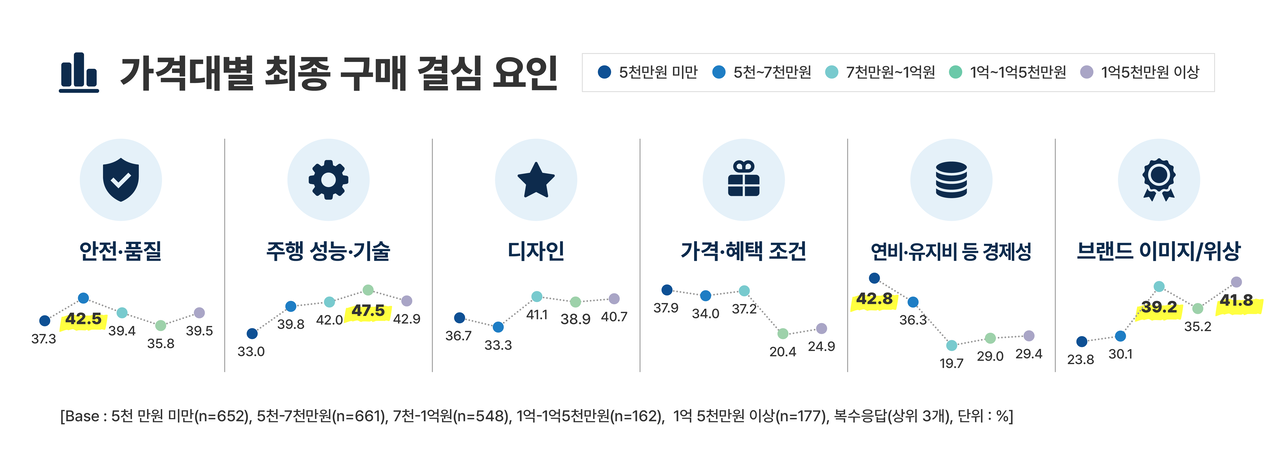
The factors driving the final purchase decision also varied by vehicle price. For vehicles priced under 50 million won ($37,800), economy was the primary criterion, while for those priced at 70 million won or more, driving performance and technology, design, and brand image and prestige emerged as the key deciding factors.
Breaking it down by price band, the largest share of respondents in the under-50-million-won segment cited economy — fuel efficiency and running costs — (42.8%) as their deciding factor, while those in the 50-million-to-under-70-million-won range most often chose safety and quality (42.5%). Across all three price groups at 70 million won and above, driving performance and technology ranked first, and the share citing brand image and prestige was also higher than in the sub-70-million-won segments.
Information-gathering channels showed little variation across price ranges. YouTube usage was highest among those who purchased or considered vehicles priced between 50 million won and under 70 million won (68.8%), while price-comparison and quote sites were used most by those in the 150 million won or above segment (43.9%).
Selection criteria differed sharply by vehicle segment. Design and budget were prominent for compact and mid-size sedan buyers, brand stood out for mid- and full-size sedan buyers, and vehicle class, fuel type and interior space ranked highly for SUV buyers.
In the early consideration stage, compact and mid-size sedan buyers placed relatively greater emphasis on budget range (42.3%) and design and exterior image (39.4%), while mid- and full-size sedan buyers prioritized brand (39.1%). Compact and mid-size SUV buyers focused on vehicle type and class (35.9%) and fuel type (32.6%), while pickup and minivan buyers prioritized fuel type (36.2%) and interior and cargo space (29.8%).
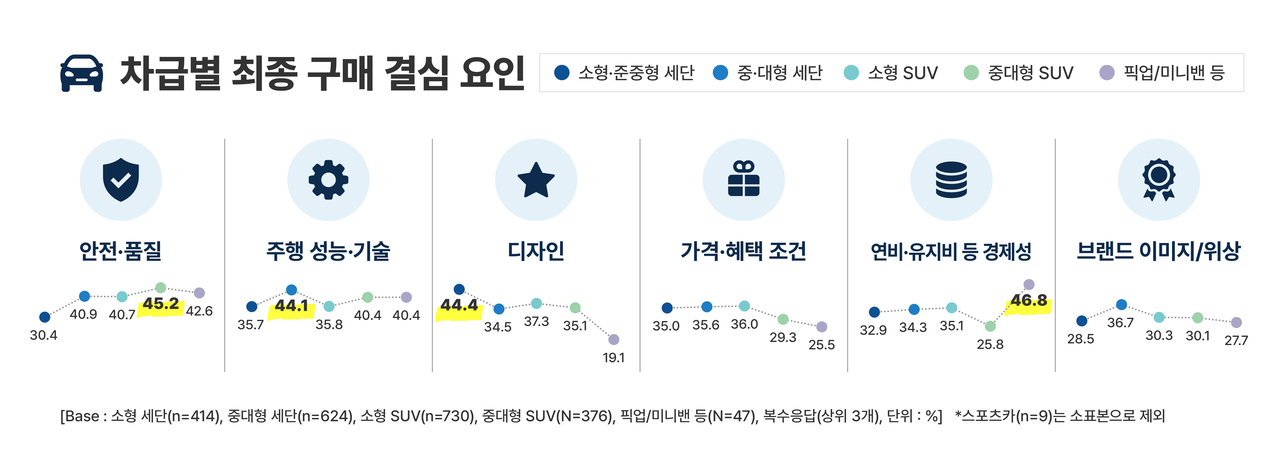
At the final purchase decision stage, design was the top factor for compact and mid-size sedan buyers (44.4%), driving performance and technology led among mid- and full-size passenger car buyers (44.1%), and safety and quality came first for SUV buyers — 40.7 percent for compact and mid-size, 45.2 percent for mid- and full-size. Pickup and minivan buyers cited economy, including fuel efficiency and running costs, as their most important deciding factor (46.8%).
"Understanding shifts in the automotive market requires a close look at consumers' voices and their actual purchase experiences," said Jeong Yun-young, vice chairman of KAIDA. "We will continue to conduct research and provide information that examines the market from multiple consumer perspectives, and we will work to advance the domestic mobility market and improve consumer satisfaction."
Meanwhile, KAIDA reported that a total of 95,697 imported passenger cars were newly registered in South Korea from July through September this year — 30,976 in July, 29,817 in August and 34,904 in September.
Of that total, Tesla alone registered 33,009 vehicles in the third quarter, with monthly figures rising from 10,237 in July to 10,400 in August and 12,372 in September — surpassing 10,000 units for three consecutive months. Tesla accounted for 34.5 percent of all imported car registrations in the third quarter, meaning more than one in three imported vehicles sold was a Tesla.
likehyo85@heraldcorp.com