- Korea Institute of Oriental Medicine identifies antifungal mechanism of yeast found on persimmon calyx
- Fungal growth suppressed by 65%; lesion size on persimmon fruit reduced by 44%
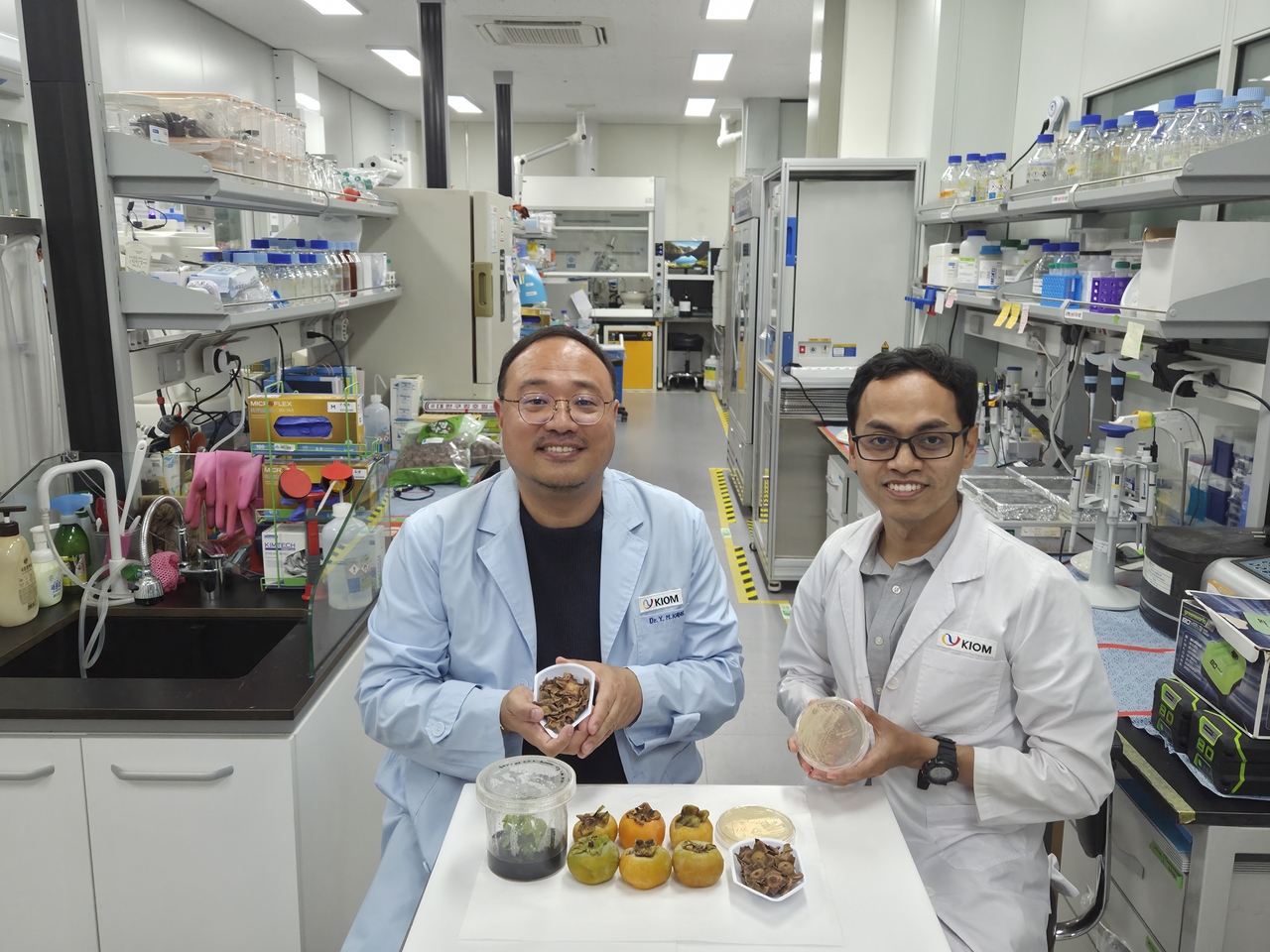
Persimmon calyxes — the small, leafy tops typically discarded after harvest — have shown potential as the basis for an eco-friendly alternative to chemical pesticides. Researchers have found that a yeast naturally occurring on the calyx can suppress the growth of the fungus responsible for persimmon anthracnose, a disease that causes significant damage to persimmon crops.
The Korea Institute of Oriental Medicine said Tuesday that a research team led by Kang Young-min, head of the institute's Herbal Medicine Resources Application Research Laboratory, had used genomic and metabolomic analysis to identify the mechanism by which the yeast Metschnikowia persimmonesis, isolated from persimmon calyxes, inhibits persimmon anthracnose.
Persimmon anthracnose is caused by Colletotrichum fungi that infect the fruit, leaves and branches of persimmon trees, producing black spots. In severe cases, fruit drops prematurely, causing serious losses for farmers. To prevent this, growers sometimes apply chemical pesticides more than 10 times a year, but concerns over pesticide residues and fungicide resistance have consistently been raised.
The research team focused on the persimmon calyx — a traditional herbal medicine ingredient that appears in the classic Korean medical text "Dongui Bogam" — and analyzed how the yeast strain Metschnikowia persimmonesis KIOM_G15050, found naturally on the calyx, suppresses anthracnose fungi.
The analysis showed that the yeast absorbs iron — an element essential for fungal growth — before the pathogen can, thereby inhibiting its development. The yeast also produces enzymes that break down fungal cell walls and forms a thin biofilm on surfaces, preemptively occupying space that would otherwise be colonized by the pathogen.
Volatile compounds produced by the yeast suppressed fungal growth by up to 65 percent without any direct contact with the pathogen.
When the research team wounded persimmon fruit and treated it with both the anthracnose fungus and the yeast, the lesion size after seven days shrank from 0.78 centimeters in the untreated control group to 0.44 centimeters — a reduction of about 44 percent. The infection rate also fell 30 percentage points, from 100 percent to 70 percent.
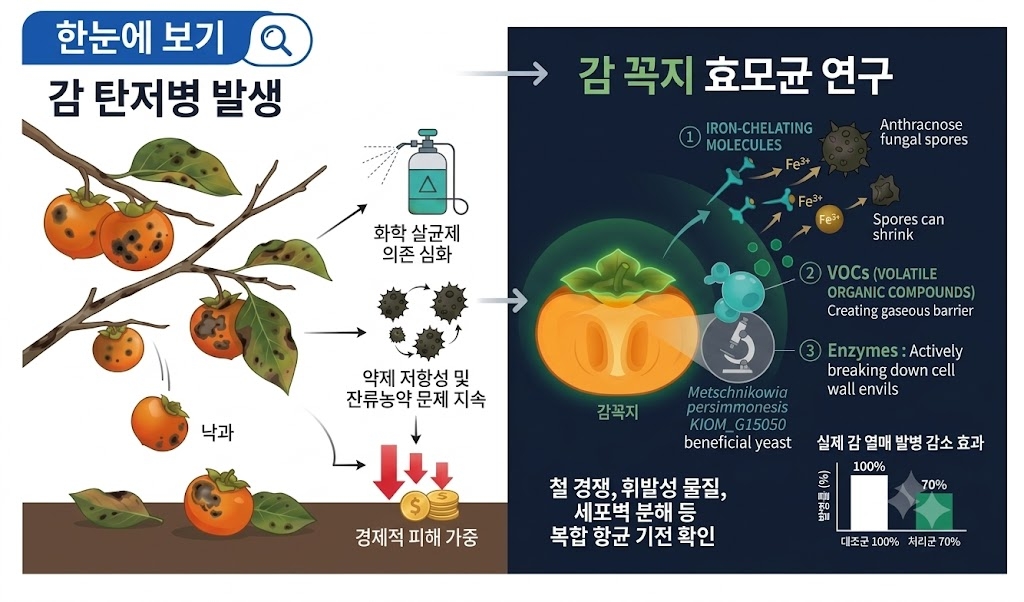
The findings suggest that the calyx-derived yeast could serve as a biopesticide material capable of reducing reliance on chemical pesticides. However, its efficacy and safety under actual farming conditions would need to be verified before it could be applied in the field.
The research team has filed two patents related to the disease-control technology. The findings were published in the international journal Applied Microbiology and Biotechnology.
The team also identified seasonal variations in the antioxidant compounds found in persimmon leaves.
An analysis of leaves from four persimmon varieties found that flavonoid-related compounds peaked in May, condensed tannins in October, and non-condensed tannins in April. By contrast, both flavonoid and tannin levels were at their lowest in August, when temperatures and humidity are highest.
The results are expected to help producers of persimmon leaf-based teas and cosmetics choose the optimal harvest time depending on which active compounds they need. That research was published in the international journal Applied Biological Chemistry.
"This research is significant in that it has identified the mechanism of a microbial agent capable of controlling persimmon anthracnose in an eco-friendly way," Kang said. "We will continue with field application trials and research into standardizing persimmon leaf raw materials."
nbgkoo@heraldcorp.com