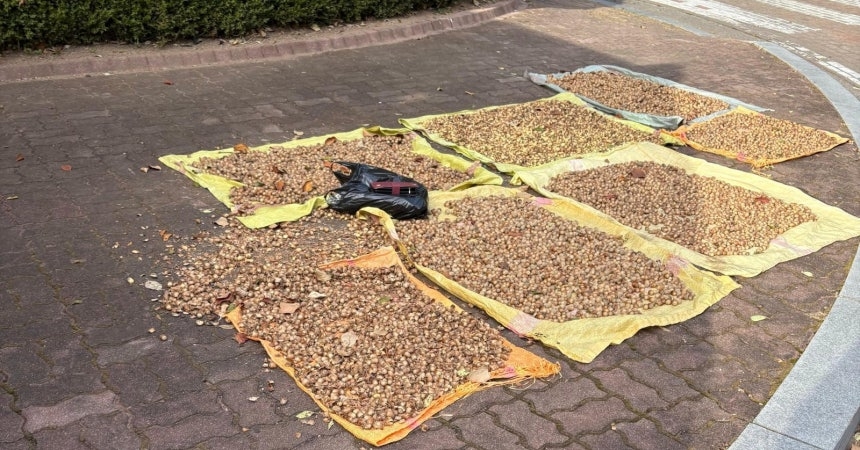
Photos of a resident piling seven sacks of acorns in an apartment parking lot have drawn widespread criticism online, reigniting concerns about the indiscriminate harvesting of wild animals' winter food supply during autumn.
The images were posted to an online community Monday, showing a large mound of acorns being dried in an apartment complex.
In the photos, acorns are heaped high across seven large sacks, suggesting the resident had hauled a substantial quantity down from a nearby mountain.
The user who shared the photos wrote that the resident had spread the acorns out in the complex while her husband shelled them by rubbing them underfoot with his sneakers, adding, "What are the animals on the mountain supposed to eat?"
Other users were quick to condemn the act. "This has gone too far," one wrote. "It looks like they stripped an entire mountain clean — please leave some food for the animals this winter," said another. A third commented, "Humans have plenty to eat. Did they really need to take that much?"
Acorns that fall in the mountains during autumn are a critical food source for wildlife. Squirrels, birds and other animals that face food shortages may not survive the winter.
When people strip forests of large quantities of fruit and nuts, wildlife may be forced to descend into urban areas or residential neighborhoods in search of food.
In response, the Korea Forest Service has been conducting a 48-day crackdown on illegal activities in forests nationwide, running from Sept. 14 through Oct. 31.
The enforcement targets include the illegal digging and harvesting of forest products such as medicinal herbs and mushrooms, unauthorized collection within state-owned forest land designated for free transfer, and trespassing in restricted mountain zones.
Collecting forest products from general forest land without the owner's consent can constitute theft and is punishable under the Forestry Resources Act by up to five years in prison or a fine of up to 50 million won ($37,800).
Collection of plants or forest products is also prohibited throughout national parks. Violations of the Natural Parks Act carry penalties of up to three years in prison or a fine of up to 30 million won.
According to the Korea Forest Service, the number of people criminally prosecuted for illegal forest product collection has been on the rise: 138 people (118 cases) in 2016, 138 people (103 cases) in 2017, 152 people (104 cases) in 2018, 220 people (158 cases) in 2019, and 233 people (170 cases) in 2020.
bbo@heraldcorp.com