Strong semiconductor exports and rising equipment investment drive growth
Private consumption dip seen as temporary, with rebound expected in Q4
Improved terms of trade boost real income growth
The government said South Korea is on track to achieve annual economic growth in the mid-3 percent range this year, with solid momentum continuing despite a high base effect from strong first-half growth. It also projected that if fourth-quarter growth comes in around 0.5 percent, the full-year growth rate could reach 3.7 percent.
Nominal GDP growth for the year is expected to exceed 20 percent, surpassing the government's earlier forecast of 12.3 percent, and per capita gross national income is now virtually certain to cross the $40,000 mark, the ministry said.
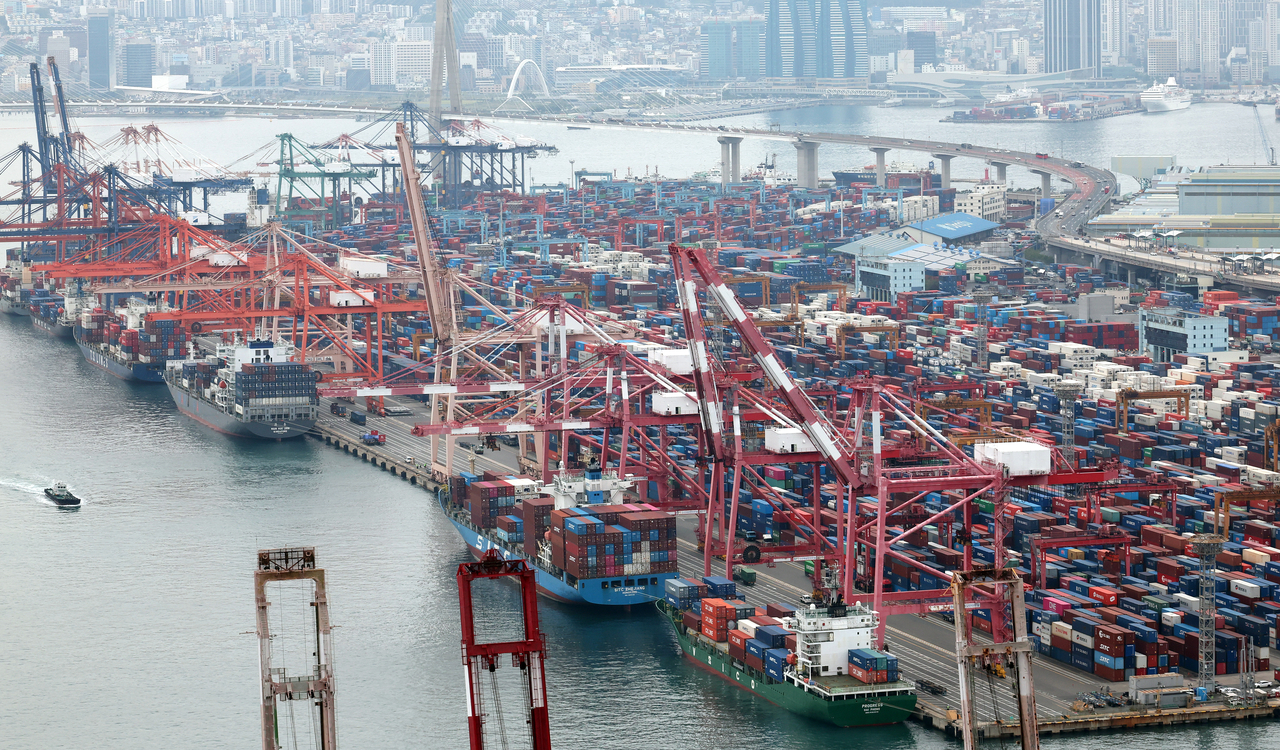
The Ministry of Economy and Finance offered the assessment Tuesday in response to the Bank of Korea's advance estimate of real GDP for the third quarter of 2026.
Real GDP grew 1.0 percent quarter-on-quarter in the third quarter. After expanding 1.8 percent in the first quarter, growth slowed to 0.6 percent in the second quarter before picking up again in the third. Year-on-year growth came in at 3.4 percent.
The ministry said the reacceleration of growth in the third quarter — despite the high base from strong first-half performance — supports the view that full-year growth in the mid-3 percent range is achievable. The year-on-year rate eased from 3.7 percent in the second quarter to 3.4 percent in the third, reflecting a base effect from last year's back-loaded growth pattern, but the economy has now maintained growth above 3 percent for three consecutive quarters.
"Even if fourth-quarter growth comes in at zero, the full-year rate would still be 3.6 percent, and if it reaches around 0.5 percent, we could see 3.7 percent," a ministry official said. The official added, however, that a negative fourth-quarter reading could push the annual figure below 3.6 percent, while noting that the third-quarter results had reinforced confidence in the mid-3 percent scenario.
Deputy Prime Minister and Finance Minister Lee Hyung-il said at a press briefing in Bangkok, Thailand, on Oct. 16 (local time) that growth in the mid-3 percent range — specifically "3.4, 3.5 or 3.6 percent" — was possible for the year, barring any major new external shocks.
The ministry said exports continued to perform strongly while investment, led by equipment spending, accelerated and drove growth. Equipment investment rose 4.1 percent quarter-on-quarter in the third quarter, driven by semiconductor manufacturing equipment, a sharp pickup from the 0.2 percent gain in the second quarter. Exports grew 2.3 percent.
Private consumption, however, swung from a 0.4 percent increase in the second quarter to a 0.2 percent decline in the third. The ministry attributed the pullback to one-off factors including a drop in stock trading volume since July, a strike in the auto industry, and base effects from last year's high-oil-price victim support fund payments and home-appliance rebate programs.
The ministry said the underlying recovery in consumption remains intact and expects private spending to return to positive growth in the fourth quarter. Cash dividends from chipmakers, performance bonuses due in the first quarter of next year, and a boost to consumption from a weaker exchange rate are all seen supporting the rebound.
A further correction in the stock market, however, was flagged as a downside risk to the consumption recovery. "It is true that both upside and downside factors are present," a ministry official said. "But assuming the stock market holds at current levels, we see more upside surprises, and we expect private consumption to turn positive in the fourth quarter."
Government consumption rose 1.9 percent, supported by expanded fiscal spending. Construction investment turned positive, rising 0.7 percent as supply-chain and execution bottlenecks eased. Investment in intellectual property products also grew 2.3 percent, driven by semiconductor research and development and software related to data centers and cybersecurity.
The ministry projected that solid growth will continue next year, with strong exports and equipment investment persisting and the expansion gradually spreading to domestic demand.
The semiconductor industry is expected to remain buoyant next year, with volume growth taking over from this year's price-driven gains as the main driver.
"Experts expect prices to soften at some point next year, but volumes are seen rising further than this year," a ministry official said. Risks to the semiconductor outlook include funding constraints at global AI companies and intensifying competition from China.
Real gross domestic income also surged, boosted by improved terms of trade. Real GDI rose 18.8 percent year-on-year in the third quarter, up from 15.7 percent in the second quarter — the highest growth rate since the fourth quarter of 1977, when it reached 19.0 percent, a gap of 48 years and nine months.
The ministry said nominal GDP also expanded sharply in the third quarter, putting full-year nominal GDP growth on course to exceed 20 percent, well above the original forecast of 12.3 percent. Nominal GDP had already risen 21.9 percent year-on-year in the first half of this year. The IMF has projected nominal GDP growth of 21.7 percent for South Korea this year.
Per capita GNI, which crossed the $30,000 threshold in 2014, is now virtually certain to surpass $40,000 this year for the first time in 12 years, the ministry said.
Assuming the average exchange rate of 1,463 won per dollar recorded through September holds through year-end and nominal GDP grows at the IMF's projected 21.7 percent, the ministry estimated per capita GNI would reach $43,500. If the won strengthens to the 1,300-won range, the figure could climb as high as $44,000.
The IMF has projected South Korea's per capita GDP at $44,000 this year, rising to $49,000 in 2027 and $52,000 in 2028.
The ministry cautioned, however, that despite the stronger growth momentum, cost-of-living pressures remain and structural challenges such as widening inequality across sectors persist. The semiconductor boom has been concentrated in exports and equipment investment, and its benefits have not yet spread broadly enough to the wider domestic economy.
Within construction investment, non-residential building — including semiconductor factories — is performing well, but residential construction remains sluggish. In consumption, the recovery in neighborhood commercial districts and regional areas outside the Greater Seoul area is lagging behind that of department stores and the capital region.
The ministry said it would "press ahead with efforts to stabilize livelihoods and ease polarization so that the warmth of growth can reach the lives of all citizens."
y2k@heraldcorp.com