- Korea Institute of Civil Engineering and Building Technology develops hollow precast concrete column method
- Standard cranes sufficient for installation; seismic performance maintained
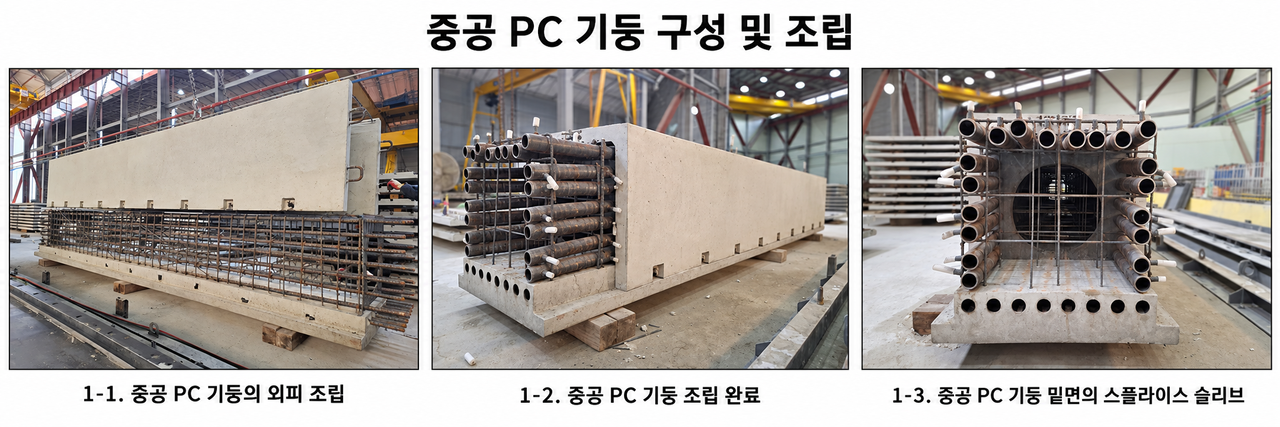
South Korean researchers have developed a new concrete column construction technology that can cut construction time at large industrial facilities — including semiconductor factories and data centers — by up to 30 percent. The columns hollow out roughly 60 percent of their interior to reduce weight while matching or exceeding the seismic performance of conventional solid columns.
The Korea Institute of Civil Engineering and Building Technology announced Tuesday it had developed a "hollow precast concrete column method" designed to build large industrial facilities such as semiconductor factories and data centers more quickly and safely.
Large industrial facilities like semiconductor factories require wide column spacing and high floor-to-ceiling heights to accommodate production equipment, which in turn demands columns that are large and heavy.
Conventional cast-in-place reinforced concrete methods are time-consuming, requiring formwork installation, rebar assembly and concrete curing. Factory-fabricated full columns have their own drawbacks: a single member can weigh tens of tons, necessitating specialized equipment for transport and installation.
To address these problems, a research team led by Lee Sang-seop at the institute's Building and Urban Research Division developed a new method in which only the outer shell of the column is manufactured at a factory — with the interior left hollow — before being assembled on site and filled with concrete.
The key innovation is hollowing out about 60 percent of the column's cross-section, dramatically reducing weight during transport and installation. This allows standard construction-site cranes to handle the columns in place of large specialized equipment.
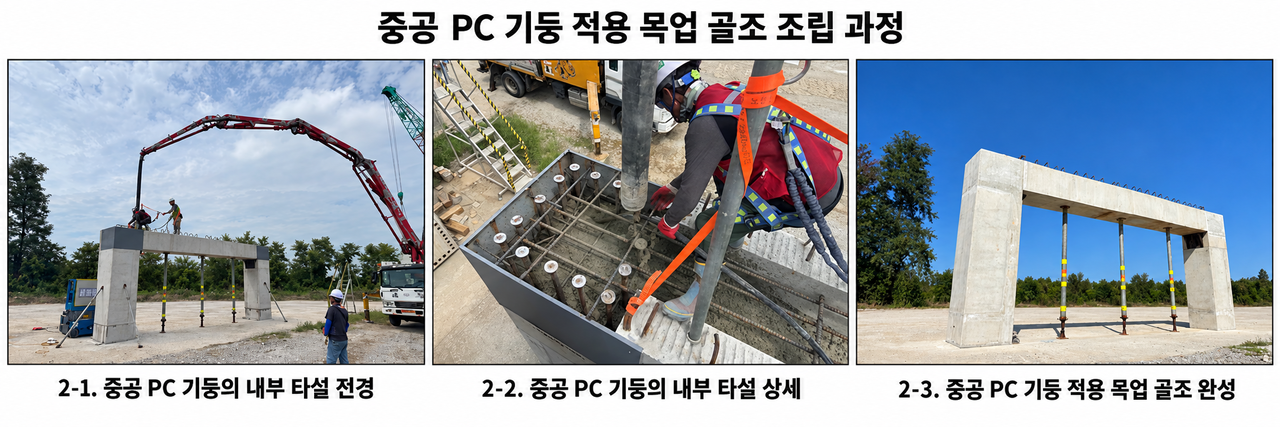
The columns meet all rebar placement requirements under South Korea's concrete structural design standards while achieving seismic performance equal to or greater than that of conventional solid concrete columns.
The research team developed an assembly method for columns with a 1-by-1-meter cross-section, combining flat cover plates with U-shaped outer shells. The process simplifies column fabrication and minimizes the risk of structural performance degradation. The team has also registered two patents for the underlying technology.
The technology is designed to cut construction time by up to 30 percent compared with conventional methods, depending on site conditions. However, the actual reduction in construction time will need to be verified through future field demonstrations.
The team produced full-scale prototypes to confirm factory production feasibility. It plans to expand the technology's application beyond semiconductor factories to data centers, logistics centers, large warehouses, plants and parking towers.
The technology is also expected to be cost-competitive with existing steel-based composite columns in terms of both material and construction costs.
The technology is set to be transferred to domestic construction firm Camus Engineering & Construction.
"This technology reduces both weight and construction time while maintaining the safety of large columns," said Park Seon-gyu, president of the Korea Institute of Civil Engineering and Building Technology. "We will continue to advance construction technology so that the infrastructure underpinning the nation's key industries can be built safely and swiftly."
nbgkoo@heraldcorp.com