Consumer protection clauses added to vendor renewal contracts
Priority contract eligibility expanded to veterans' spouses
Evidence found of deleted emails linked to winning-ticket placement
Lotto outlets will no longer be allowed to refuse purchases made by bank transfer or lottery exchange vouchers without legitimate cause. Donhaeng Bokwon, the lottery operator found to have concealed the winning-ticket placement structure of the instant electronic lottery "Triple Luck" from regulators and deleted related emails, has been hit with an additional penalty of 30 million won ($22,700).
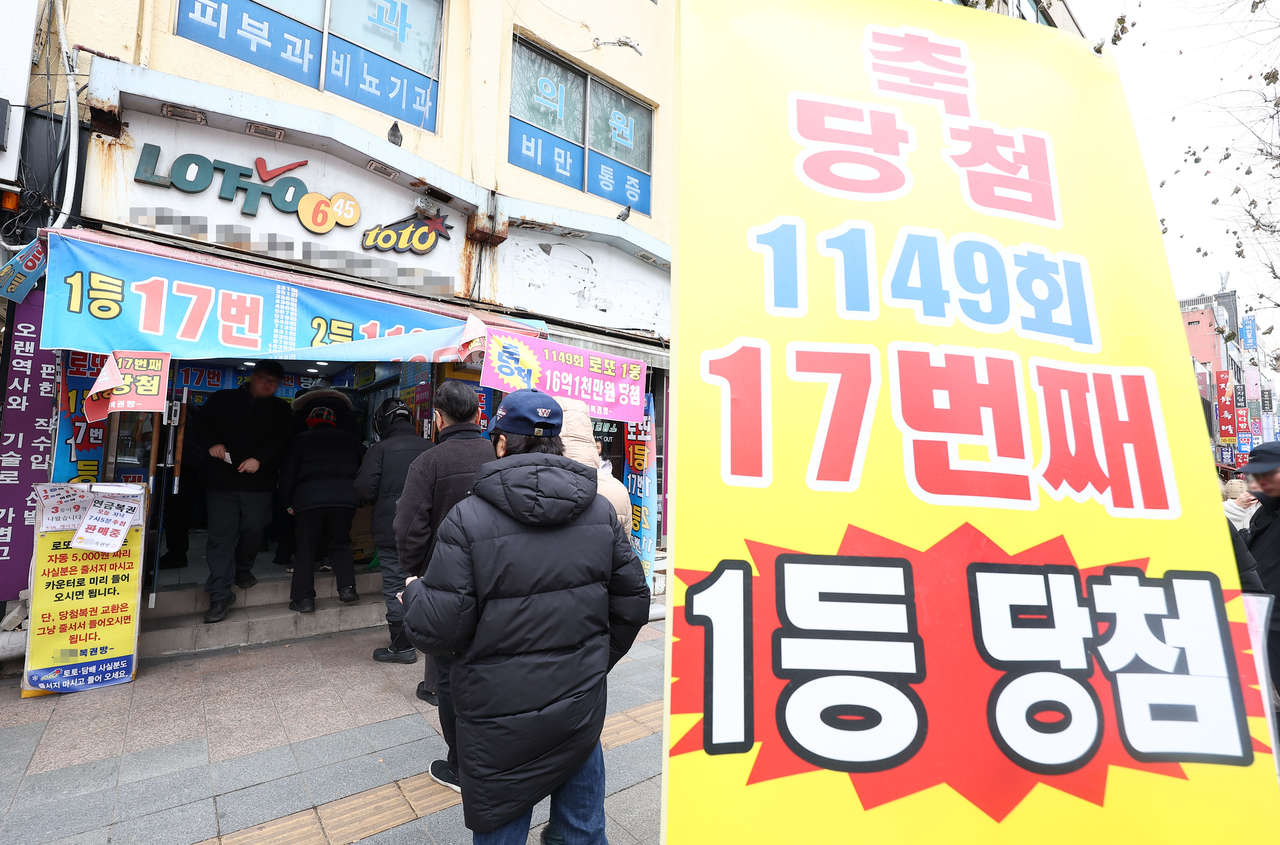
According to the Ministry of Planning and Budget, the Lottery Committee held a plenary session Monday and deliberated on and approved four agenda items, including a plan to renew contracts with online lottery vendors for 2027 and a proposal to impose a penalty on the lottery operator.
A total of 9,169 online lottery vendors are up for contract renewal next year, with the contract period running from Jan. 1 to Dec. 31, 2027.
The renewal plan includes newly added provisions to protect buyers' payment convenience. Vendors will be prohibited from refusing, without legitimate reason, a buyer's request to pay by bank transfer or lottery exchange voucher. Lottery tickets cannot be purchased by credit card, but bank transfers are permitted.
A single refusal will not, however, result in immediate contract termination. "Violations will be categorized into blue, yellow and red ratings and managed under a cumulative point system — repeated violations can lead to warnings, suspension of operations and ultimately contract termination," a government official said.
Accountability requirements for outlet owners and staff will also be tightened. Grounds have been established for contract termination when conduct undermining the integrity of the lottery business occurs. A government official cited examples such as involvement in serious crimes like fraud or making sexually harassing remarks to customers, adding that whether to impose sanctions will be decided on a case-by-case basis.
In addition, the Lottery Committee plans to strengthen the link between the automatic unclaimed-prize payment service — launched Aug. 18 via a mobile payment app — and "Haengundeokhagi," a prize-draw event for non-winning tickets, to boost uptake of the service. Registrations for the automatic unclaimed-prize payment service stand at about 50,000 per week.
Vendors notified of adverse actions such as a sales suspension or contract termination may file an objection within 14 days. The operator must notify the vendor in writing of the outcome within 30 days of receiving the objection. A clause that had barred vendors from seeking damages if acquitted after a contract was terminated for a lottery law violation has also been removed.
The Lottery Committee also decided to expand the pool of vendors eligible for priority contracts. The government plans to amend the relevant enforcement decree to add about 140,000 people to the priority list — including roughly 130,000 spouses of combat veterans and about 10,000 service-disabled military and police personnel and their bereaved families. The amendment is set to be publicly announced for legislative notice by the end of this month and promulgated in February next year.
Inclusion on the priority list does not, however, guarantee the opening of a lottery outlet. The Lottery Committee plans to maintain the total number of outlets at around 9,530, taking into account that the average annual commission income per outlet is about 35 million won and that more than 80 percent of all outlets earn less than 50 million won in annual commissions.
New recruitment will accordingly be limited to replacing the roughly 400 outlets that close naturally each year. The competition ratio for outlet recruitment in 2025 reached approximately 26 to 1.
Meanwhile, the Lottery Committee decided to impose additional sanctions on Donhaeng Bokwon for failing to report the winning-ticket placement structure of the instant electronic lottery Triple Luck despite being aware of it in advance, and called for personnel action against those responsible.
Triple Luck is an electronic lottery in which four first-prize tickets worth 500 million won are included in every 15 million tickets issued. Since its launch in 2010, the 15 million tickets have been divided into four segments of 3.75 million each, with one first-prize ticket placed in each segment. The ratio of first-prize tickets relative to total issuance was one in 3.75 million — the same as now — but the placement was not fully random.
The Lottery Committee became aware of this structure in January last year and in July of that year eliminated the segment-based placement restriction, switching to a fully random method. However, a follow-up inspection in September this year confirmed that Donhaeng Bokwon had already shared the relevant information internally in July 2024 without reporting it to the Lottery Committee, and had attempted to conceal it by deleting related emails ahead of an on-site inspection in July last year.
The Lottery Committee had previously imposed a penalty of 30 million won in September last year for management duty violations including delays in system improvements. It has now imposed an additional 30 million won — the maximum amount stipulated in the entrustment contract — for the failure to report and the cover-up attempt.
"We have requested an audit by the Board of Audit and Inspection to underscore the importance of this matter and to ensure transparency in lottery issuance and management," the Lottery Committee said, adding that it plans to monitor compliance with recurrence-prevention measures and develop a reform plan for the electronic lottery system.
y2k@heraldcorp.com