Officials, lawmakers and experts weigh options for sections 2 and 5 after repeated failed bids
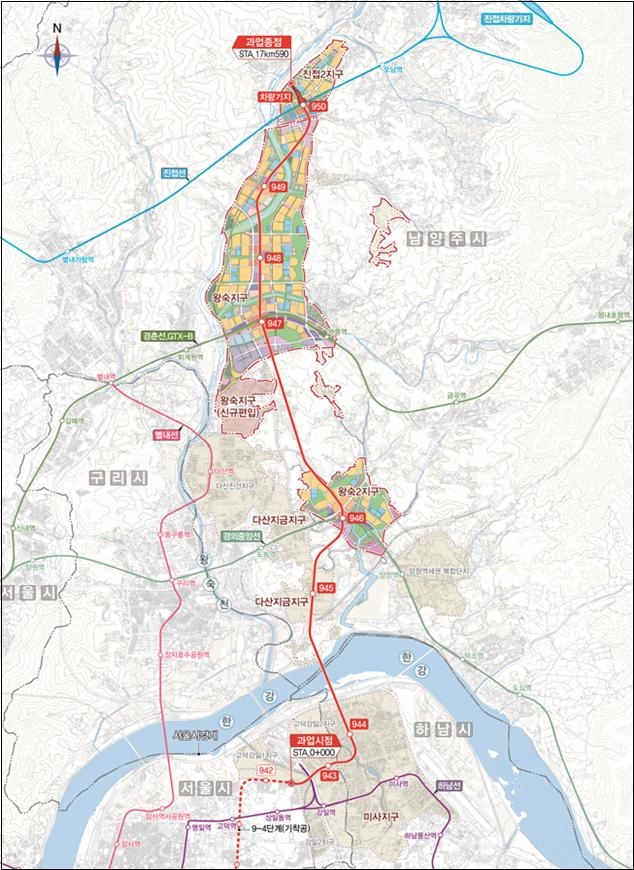
Gyeonggi Province and the Gyeonggi Provincial Assembly held a forum Monday at the assembly's northern branch to discuss contracting options for sections 2 and 5 of the Gangdong-Hanam-Namyangju metropolitan railway construction project, which have repeatedly drawn no qualified bids, in a bid to minimize further delays to the ground-breaking.
The Gangdong-Hanam-Namyangju line is a key component of the third-generation new town transportation improvement plan for the Wangseok and Wangseok 2 districts. Stretching 17.59 kilometers with eight stations from Gangdong-gu in Seoul through Hanam to Namyangju, the project carries a total budget of 2.93 trillion won ($2.22 billion).
Of the five sections Gyeonggi Province is pursuing, sections 3, 4 and 6 are currently in detailed design. Sections 2 and 5, however, have each been put out to tender four times under a turnkey bidding process, only to be voided each time after drawing just a single bid. Section 2 is budgeted at 620.3 billion won and section 5 at 386.1 billion won.
The forum brought together Assembly members representing Namyangju — Lee Dae-han, Jang Song-hoe and Jeong Hyeon-mi — along with Oh Ji-hun and Oh Min-yong from the Hanam constituency, Gyeonggi Province's director of balanced development planning Jo Jang-seok, the head of the railway policy division, Ajou University Professor Hong Sun-ho, Korea Railroad Research Institute senior researcher Kim Man-cheol, Public Finance Research Institute adviser Choi Yong-cheol, and officials from Namyangju, Hanam, LH and GH. Participants closely compared the merits and drawbacks of the two legally permissible alternatives: a turnkey contract awarded through a negotiated bid, and a separate design-and-build procurement.
The negotiated turnkey approach would allow an earlier ground-breaking and opening than the separate procurement method, reduce the likelihood of cost overruns through a fixed-price contract, and provide clearer lines of accountability. Its drawback is that additional safeguards against shoddy construction and inadequate safety management would need to be put in place.
Switching to the separate procurement method, by contrast, would ensure greater competition and fairness, but splitting the design and construction into separate contracts would push back the ground-breaking relative to a negotiated award. Participants also flagged concerns about potential cost increases from design changes down the line and indirect costs arising from scheduling mismatches with other sections.
Participants identified the urgency of the project as the central issue — specifically, the need to narrow the gap between the 2028 move-in start for the Wangseok and Wangseok 2 districts, which will provide 80,000 housing units, and the railway's opening date. They also held in-depth discussions on three post-decision concerns: ensuring procedural fairness, managing project cost risk, and preventing shoddy construction while maintaining construction safety standards.
"Minimizing delays to the ground-breaking is paramount for easing the transportation burden on residents moving into the new towns in the northeastern greater Seoul area," Assembly member Jang Song-hoe said. "I will work closely with the executive branch to ensure that the most rational and transparent contracting method — drawing on the views of the assembly, experts and local governments expressed at today's forum — is reflected in provincial policy."
Jo Jang-seok, director of balanced development planning, said Tuesday's forum had produced a reasonable degree of consensus on the urgency, economic viability and fairness of the project. "We will develop alternatives to ensure that quality and safety issues can also be thoroughly reviewed within the management framework proposed by the experts," he added.
pjh@heraldcorp.com