Daily average clearing amount rises from 300 billion to 3.2 trillion won
KOFR OIS accounts for 25% of total swap clearing, with 37 firms participating
Korea Exchange plans to extend maximum clearing maturity from 20 to 30 years
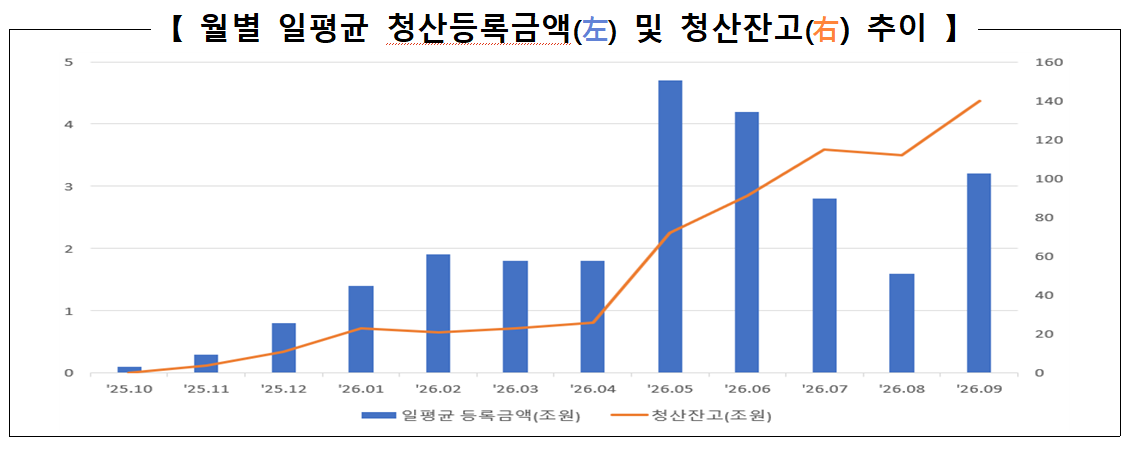
The daily average clearing amount for over-the-counter derivatives using the Korea Overnight Financing Repo Rate has surged roughly tenfold in under a year, climbing from 300 billion won ($227 million) to 3.2 trillion won. With cumulative clearing volume reaching 492 trillion won, KOFR is gaining ground in a derivatives market long dominated by the certificate of deposit rate.
Korea Exchange announced Monday that cumulative clearing volume reached 492 trillion won across 2,052 transactions from Oct. 27 last year through the end of September, marking the first anniversary of its KOFR-based OTC derivatives central clearing service. Outstanding clearing balances stood at 140 trillion won across 1,333 transactions.
The daily average clearing amount stood at just 300 billion won in November last year when the service launched, then rose to 3.2 trillion won in September. Averaged over the full analysis period, the daily figure came to 2.2 trillion won — equivalent to 33 percent of the 6.5 trillion won daily average for interest rate swaps based on the existing CD rate.
KOFR is a rate calculated from actual transactions collateralized by government bonds and monetary stabilization bonds, and is being promoted as a replacement for the CD rate. An overnight index swap, or OIS, is a derivative that exchanges fixed and floating interest rates using an overnight rate such as KOFR. Central clearing is a system in which an exchange guarantees settlement and manages risk between counterparties.
KOFR OIS accounted for about 25 percent — 492 trillion won — of total interest rate swap clearing volume, surpassing the financial authorities' first-year target of 10 percent. Of the 53 clearing members, 37, or about 70 percent, have participated in KOFR OIS clearing.
By contract maturity, one-week instruments held the largest share at 69.9 percent, with short-term contracts of one year or less making up 82 percent of the total. However, the share of longer-term contracts exceeding one year expanded from 3.3 percent at the start of the year to 18.1 percent. The share of ultra-long contracts with maturities beyond five years also more than quintupled, rising from 0.4 percent to 2.3 percent.
To support the transition to KOFR as the benchmark rate, Korea Exchange plans to extend the maximum eligible clearing maturity from the current 20 years to 30 years by the first half of next year. It will also incorporate a wider range of market conventions — including day-count methods and holiday treatment — into clearing specifications.
In addition, the exchange plans to develop a basis swap clearing framework to manage risk between existing CD rate-based interest rate swaps and KOFR OIS, and to help market participants navigate the benchmark transition. It is also reviewing a plan to unify the discount curve used for interest rate swap valuation to KOFR and to compensate for any resulting changes in valuation.
Through these improvements, Korea Exchange said it aims to invigorate long-term KOFR-based trading and help KOFR take hold as the replacement benchmark for the CD rate as quickly as possible.
KOFR adoption is also spreading beyond the derivatives market into bank lending. Industrial Bank of Korea and Korea Development Bank on Monday each launched KOFR-based loan products worth 500 billion won — 1 trillion won in total — marking the first such offerings in the banking sector. Industrial Bank of Korea will apply a preferential rate of up to 0.3 percentage points for small and medium-sized enterprises in regional areas, while Korea Development Bank will offer up to 0.65 percentage points for small, medium and mid-sized enterprises. The Financial Services Commission has been expanding KOFR adoption in line with its benchmark rate reform plan announced in March.
hajun825@heraldcorp.com