81.9% of working age; 56% concentrated in Greater Seoul
South Korea's immigrant-background population, which includes foreign nationals, naturalized citizens and second-generation immigrants, surpassed 2.8 million last year. The group now accounts for 5.4 percent of the total population — roughly one in every 18.5 people.
Among people in their 20s and 30s, the share with an immigrant background hovered around 10 percent. The group also skews younger than the general population, with a higher proportion of working-age people and a lower share of elderly residents.
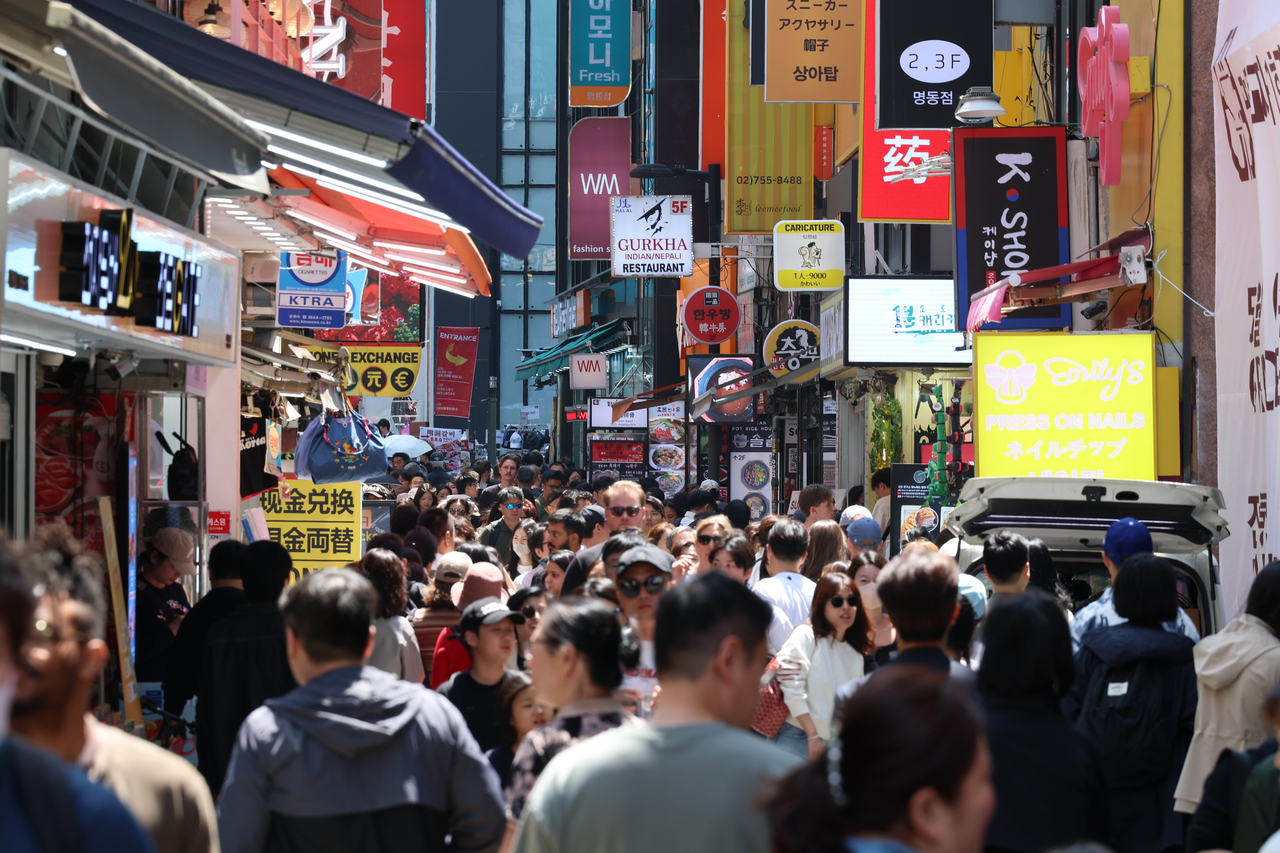
South Korea's immigrant-background population stood at 2.81 million as of Nov. 1 last year, up 95,000, or 3.5 percent, from the previous year, according to the "2025 Immigrant-Background Population Statistics" released Monday by the Ministry of Statistics.
The immigrant-background population refers to people who themselves, or at least one of whose parents, have an immigrant background. The category covers not only foreign nationals but also naturalized citizens, second-generation immigrants, Sakhalin Koreans, North Korean defectors and their children.
The survey drew on 27 types of administrative records held by 13 agencies — including the resident registration, alien registration and nationality acquisition rolls — and counted all people who had lived in South Korea for at least three months as of the reference date, using a register-based census method.
The immigrant-background population made up 5.4 percent of the total population of 51.82 million, up 0.2 percentage points from a year earlier.
Over the same period, the country's total population grew by only 12,000, while the number of Korean-born residents without an immigrant background fell by 83,000, or 0.2 percent. The growth in the immigrant-background population effectively prevented an overall population decline.
By category, foreign nationals accounted for the largest share at 2.109 million, or 75.1 percent of the total immigrant-background population. Second-generation immigrants followed at 397,000 (14.1 percent), naturalized citizens at 9.1 percent, and other categories — including nationality determination cases and North Korean defectors — at 1.7 percent.
Compared with the previous year, naturalized citizens posted the highest growth rate among all categories, rising 4.5 percent. Gyeong Eun-suk, head of the population census division at the Ministry of Statistics, said more foreign nationals who have been consistently settling in South Korea are choosing to stay permanently.
By age group, people in their 30s made up the largest share at 667,000, or 23.7 percent. Those in their 20s followed at 21.6 percent, and those in their 40s at 15.6 percent.
The sharpest growth in absolute numbers came from the 20s age group, which expanded by 36,000, or 6.4 percent, last year — the largest increase of any age group.
Those aged 70 and older grew by only 9,000 in absolute terms, but their growth rate reached 13.4 percent. Officials attributed the increase to naturalized citizens of Chinese origin who had previously acquired Korean nationality now entering old age.
In terms of age structure, people aged 15 to 64 — the working-age population — accounted for 81.9 percent of the immigrant-background group. Those 14 and under made up 12.2 percent, while those 65 and older accounted for 5.8 percent.
The working-age share of the overall population stands at 69.2 percent, meaning the immigrant-background group's working-age proportion is 12.7 percentage points higher. Conversely, the elderly share was 14.9 percentage points lower than the 20.7 percent recorded for the total population.
Among individual age groups, people in their 20s with an immigrant background accounted for 10.0 percent of all people in that age bracket, and those in their 30s for 9.5 percent — meaning roughly one in 10 people in their 20s and 30s in South Korea has an immigrant background.
"Looking at the reasons for immigration, study abroad and training programs account for a large share," Gyeong said. "Young workers are also coming in through the employment permit system and non-professional work visas, particularly in manufacturing and construction."
Some 56.0 percent of the immigrant-background population, or about 1.573 million people, lived in the Greater Seoul metropolitan area. By province and metropolitan city, Gyeonggi Province had the largest share at 32.3 percent, followed by Seoul at 17.1 percent, Incheon at 6.7 percent and South Chungcheong Province at 6.6 percent. At the city and county level, Ansan in Gyeonggi Province led with 113,000, followed by Hwaseong with 88,000 and Siheung with 82,000.
South Chungcheong Province had the highest immigrant-background share relative to its total regional population at 8.3 percent. At the city and county level, Yeongam-gun in South Jeolla Province topped the list at 22.7 percent, followed by Eumseong-gun in North Chungcheong Province at 20.3 percent and Ansan in Gyeonggi Province at 16.3 percent. A total of 21 cities and counties had immigrant-background population shares exceeding 10 percent.
The number of children and teenagers with an immigrant background also continued to rise. Those aged 24 and under living in South Korea reached 787,000, up 49,000, or 6.6 percent, from the previous year.
Children and teenagers with an immigrant background now account for 7.7 percent of all people in that age group. By the nationality of their parents, Vietnam was the most common country of origin at 28.0 percent, followed by China at 15.7 percent and ethnic Koreans from China at 11.4 percent.
y2k@heraldcorp.com