City unveils 'Incheon Future Industry Repowering' vision to restart growth engines
AI-energy park and 3GW data center planned for Yeonghungdo; biotech R&D base to expand
G20 summit bid for 2028, global expos planned; Cheongna to anchor future mobility hub
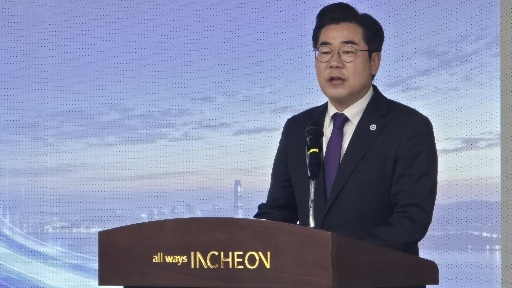
Incheon is embarking on a sweeping industrial restructuring, targeting 5 percent economic growth and 6,000 new jobs by linking biotech, AI, future mobility, logistics and clean energy.
The plan aims to shift the city's production-heavy industrial base toward high-value research and development and advanced technology, reviving its growth momentum and expanding quality employment.
Mayor Park Chan-dae unveiled the blueprint Monday at Incheon City Hall, presenting what he called the "Incheon Future Industry Repowering" vision — the industrial policy roadmap for his ninth directly elected term.
It is the third development strategy Park has announced, following the "Incheon Re-rating" vision presented at his 100-day mark and a separate urban-space innovation plan.
The core goal is to improve the city's industrial fundamentals and raise productivity, turning Incheon back into a growing city.
Park set a target of achieving an average economic growth rate of 5 percent over his term and creating at least 6,000 new jobs.
"Incheon's economic growth rate, which ranked first in the country in 2022, has fallen every year and recorded minus 0.5 percent last year," Park said. "We will restart Incheon's growth engine with our ABC+E industrial policy."
ABC+E stands for Bio, AI and Connected Mobility as the three core pillars, combined with Energy.
The strategy links advanced industry development with stable energy supply to strengthen corporate competitiveness and translate industrial growth into higher incomes and jobs for residents.
Incheon will first build energy and AI infrastructure as the foundation for nurturing future industries.
On Yeonghungdo, the city plans to transform the coal-heavy industrial structure into an "AI and Energy Park" combining clean energy with advanced technology.
The city will draw up a master plan by 2027 and establish a dedicated special purpose company in the first half of 2028 to formally launch the project.
The park will generate electricity using solar, wind and other clean energy sources alongside low-carbon energy and hydrogen power, feeding that output into AI data centers.
The city is targeting the ground-breaking of a 100-megawatt data center in 2028, with plans to begin scaling up to 1 gigawatt by 2032 and eventually expand capacity to 3 gigawatts over the long term.
Incheon will also expand its clean energy production base in offshore wind, solar and hydrogen. The city plans to develop a publicly led 1-gigawatt offshore wind project and, including private-sector projects, aims to build a total offshore wind capacity of 4.4 gigawatts over the long term.
In Ganghwa-gun and other areas, the city will expand "sunshine village" programs that let residents share in solar power revenues, while also increasing hydrogen production facilities and hydrogen vehicle distribution.
Park also flagged cuts to industrial electricity rates as a priority. On top of the central government's own rate-reduction measures, the city plans to pursue an additional reduction of 2 to 3 won per kilowatt-hour for Incheon businesses.
The city also plans to consult with the central government on supplying ultra-cold thermal energy — currently wasted at the Songdo LNG terminal — to biotech factories, semiconductor facilities and cold-storage warehouses.
The biotech sector will expand beyond production into drug development and R&D.
While Incheon already has a world-class biopharmaceutical manufacturing base, building out the research infrastructure needed to secure core technologies and drug development capabilities to lead global markets remains a key challenge.
The city will lay the groundwork for establishing the Incheon Institute of Bio Science and Technology at the Songdo Global Campus and push for the swift enactment of enabling legislation. It also plans to launch a founding committee with participation from the local community and biotech companies.
Once established, the Incheon Institute of Bio Science and Technology is expected to train around 300 master's and doctoral-level specialists each year and support new drug research and development.
The city plans to link the institute with the K-Bio Lab Hub — a 220 billion won ($166 million) facility that broke ground in Songdo last month — a 200 billion won Incheon Unicorn Fund under development, and a biotech startup investment partnership with Samsung Biologics and Eli Lilly, building an industrial ecosystem running from R&D through startup formation, investment and production.
The city will also seek to upgrade the Yeongjong biotech special zone to national industrial complex status, expand tax incentives and infrastructure investment to attract companies, and nurture bio materials, parts and equipment firms at the Namdong industrial complex.
AI-driven future mobility will be centered on Cheongna, where Park plans to use the existing Robot Land and connected-car certification and evaluation center as an anchor, clustering related companies and research facilities in the area.
The city is pursuing up to 900 billion won in future-vehicle R&D projects, securing additional industrial land and improving regulations, while also holding talks on relocating cybersecurity company headquarters and establishing research centers in the area.
Cheongna will serve as the hub of an "AI Connectivity Valley" linking the auto-parts industries of Songdo, Namdong and Bupyeong, the airport and logistics functions of Yeongjong, and the advanced industry base of Gyeyang. The city also plans to expand the existing auto-parts sector into robot components.
The logistics sector will undergo an AI transformation. The city plans to develop and pilot the technologies needed on the ground through the "Logistics AX Alliance," a consortium it formed with 37 organizations including CJ Logistics, Hanjin and Samsung SDS.
The city will also pursue a connection between the greater Seoul area and Gangwon Province via an east-west peace logistics expressway, and build an AI, semiconductor and biotech logistics network linking industrial cities along the west coast.
Building on that foundation, the city aims to secure designation as an international logistics promotion zone to obtain regulatory relief and budget support from the central government. A Logistics AX Convergence Center dedicated to researching and piloting logistics technology is being prepared for a 2029 opening.
Park has set 2028 as a turning point for the city's industrial leap and plans to expand international events and global industry exchanges.
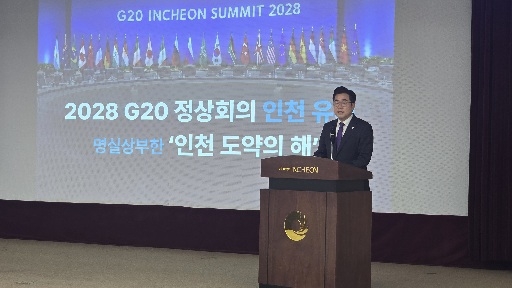
The city is pursuing a bid to host the 2028 G20 summit, and is also planning an international biotech expo, a connected mobility global expo and an international logistics event.
The city also plans to attract a major global esports tournament to draw interest from young people and international companies.
Sector-by-sector master plans will be completed by 2027, with major projects set to launch in earnest from 2028.
"The reason we are restarting Incheon's growth engine is ultimately to create good jobs for our residents," Park said. "We will nurture high-value industries — biotech R&D, future vehicles, cybersecurity and logistics technology — while simultaneously driving the AI transformation of existing industrial complexes, building a city where residents earn more."
gilbert@heraldcorp.com