Average sale price in 14 northern districts reaches 1.2 billion won
32 consecutive months of gains; up 12.91% this year
Rental market pressure drives buyers to outer districts
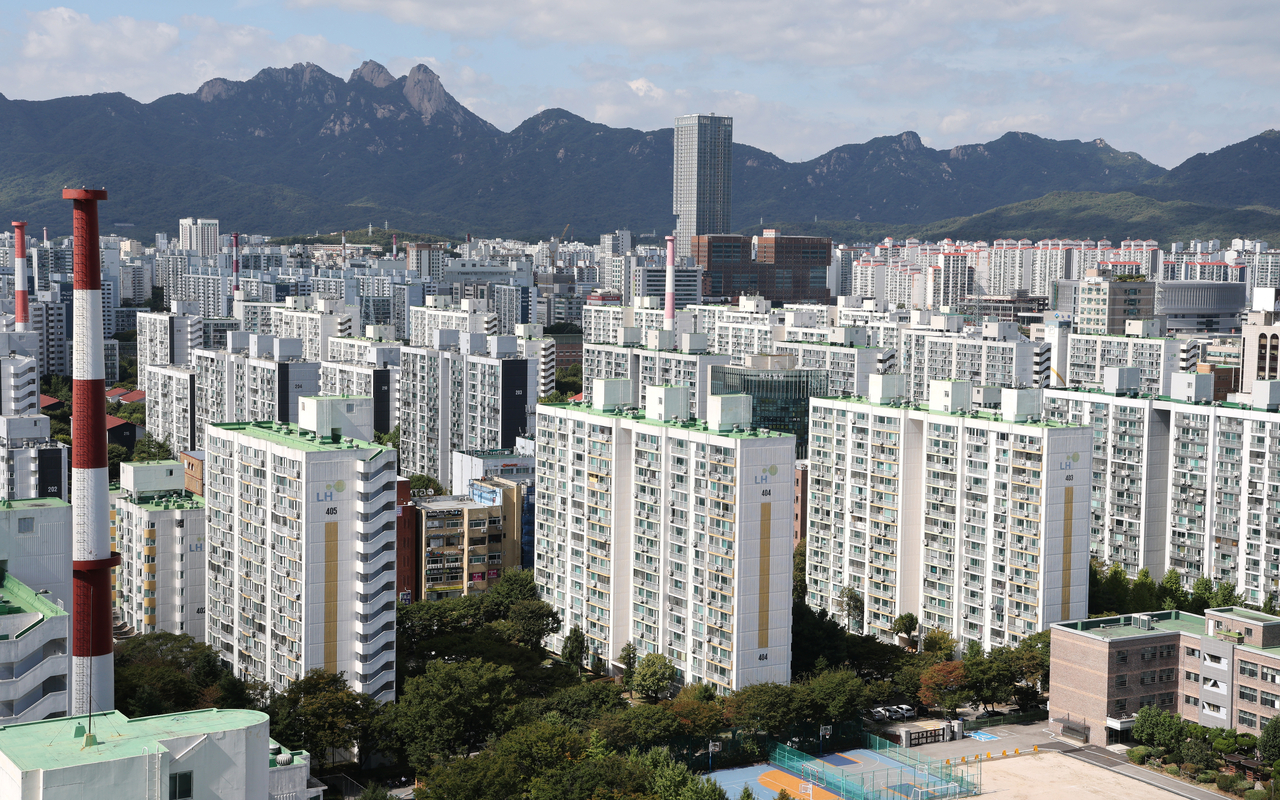
The average apartment sale price across Seoul's 14 northern districts has surpassed 1.2 billion won ($906,000) for the first time, as prices in mid-to-low-priced outer areas — including Seongbuk-gu, Nowon-gu, Dobong-gu and Gangbuk-gu — have climbed sharply, pushing the cumulative gain this year to nearly 13 percent. Analysts say that as rising jeonse and monthly rent prices push demand into the outer districts, tightening home prices combined with mortgage regulations are raising the bar for ordinary buyers looking to purchase their first home.
North Seoul apartments cross 1.2 billion won mark; prices rise in Dobong, Gangbuk flagship complexes
According to KB Real Estate's October national housing price trend report released Monday, the average apartment sale price in Seoul stood at 1.64 billion won as of Oct. 12, up 10.77 million won from 1.62 billion won the previous month. Prices have risen for 32 consecutive months since recording 1.2 billion won in March 2024.
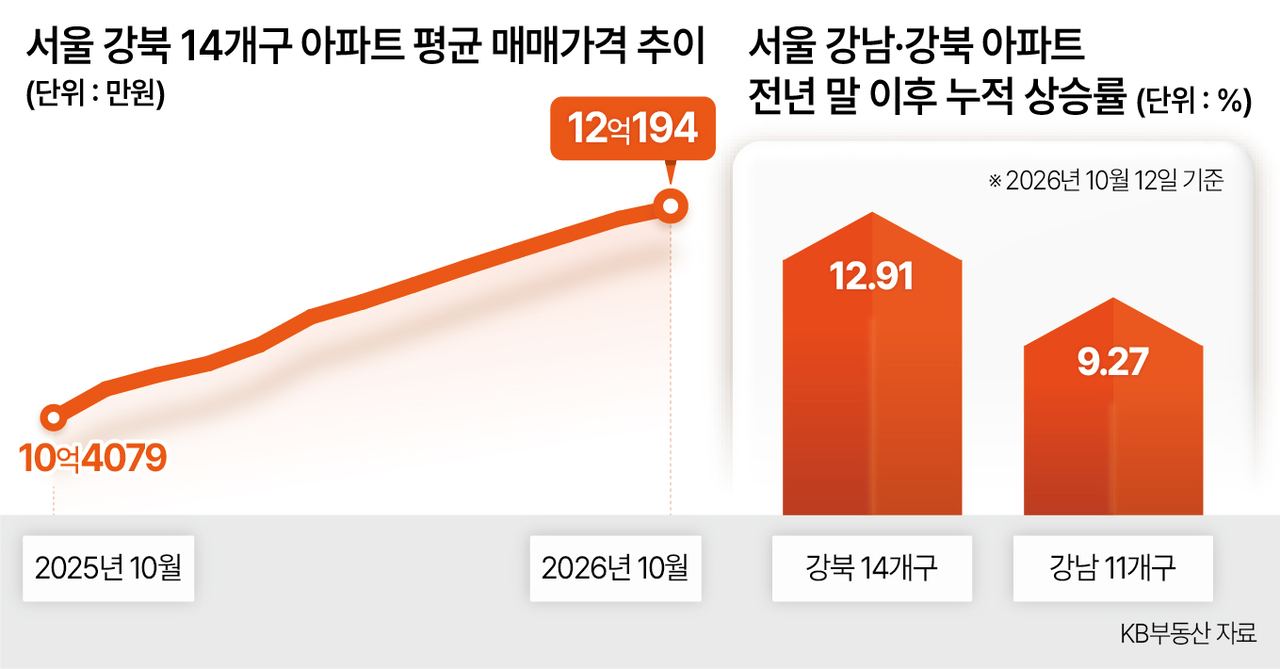
The gains were led by the northern districts. The average apartment sale price across the 14 northern districts rose 8.27 million won, or 0.7 percent, to 1.2 billion won this month from 1.19 billion won the previous month. In the 11 southern Gangnam districts, prices climbed 11.7 million won, or 0.6 percent, to 2.02 billion won from 2.01 billion won over the same period. It is the first time the average apartment price in the northern districts has entered the 1.2 billion won range.
The northern districts also outpaced the south in year-to-date gains. Apartment prices in the 14 northern districts rose 12.91 percent compared with the end of last year, while the 11 Gangnam districts posted a 9.27 percent gain — below the citywide average of 10.98 percent.
Among individual districts, Nowon-gu posted the steepest monthly gain at 1.52 percent. Jongno-gu (1.32 percent), Dobong-gu (1.29 percent), Seongbuk-gu (1.25 percent) and Jungnang-gu (1.14 percent) also recorded strong increases. By contrast, Gangnam-gu, home to the city's most expensive apartments, fell 0.3 percent for the second consecutive month, while Seocho-gu slipped 0.04 percent.
Record-breaking transactions have been piling up in mid-to-low-priced outer areas. According to the Ministry of Land, Infrastructure and Transport's actual transaction price disclosure system, an 84-square-meter unit at Dongah Cheongseol in Changdong, Dobong-gu sold for 1.24 billion won on Thursday — 3 million won above the previous record of 1.237 billion won set June 29.
An 84-square-meter unit at Samsung Raemian Tribera 2 complex in Mia-dong, Gangbuk-gu also changed hands Sept. 12 for 1.215 billion won (20th floor), surpassing the previous record high of 1.17 billion won set in May 2021.
Experts point to instability in the jeonse and monthly rental market as the main driver of rising prices in the northern districts. As rental listings shrink and rents climb, some tenants are shifting to the purchase market. Analysts say major complexes in the northern districts — where prices are relatively lower and policy-backed loans can help with financing — have emerged as an alternative for owner-occupier buyers.
Even outer Seoul apartments require at least 600–700 million won in cash
Seoul apartment jeonse and monthly rent prices have risen 9.21 percent compared with the end of last year and 10.53 percent from a year earlier. The 14 northern districts recorded a year-on-year rental price increase of 12.31 percent, outpacing the 8.95 percent gain in the 11 Gangnam districts.
The problem, analysts say, is that now that average prices in the northern districts have also crossed 1.2 billion won, the cash burden on owner-occupier buyers has grown considerably. Under the government's Oct. 15 real estate measures, the maximum mortgage loan for homes priced at 1.5 billion won or less in regulated areas of Greater Seoul is 600 million won — with a 400 million won cap for homes between 1.5 billion and 2.5 billion won, and a 200 million won cap above 2.5 billion won. With all of Seoul designated as a speculation-overheated zone and an adjustment target area, the loan-to-value ratio is generally capped at 40 percent.
For a buyer purchasing a home at the northern district average of around 1.2 billion won, the maximum loan available under a 40 percent loan-to-value ratio is about 480 million won. Even excluding concessions such as acquisition tax, the buyer would need more than 700 million won in cash. First-time homebuyers, even with a 70 percent loan-to-value ratio applied, face a 600 million won loan ceiling — meaning they must still come up with at least 600 million won of their own funds.
Jung Jae-hoon, a professor at Dankook University's Department of Urban Planning and Real Estate, said the recently debated 2026 tax reform proposal has influenced buying sentiment, pushing capital that might otherwise have gone to Gangnam into major complexes in other areas. "As a result, even first-time homebuyers must hold more than 600 million won in cash, and the barriers to market entry for ordinary people have never been higher," he said.
Jung added that addressing housing insecurity for owner-occupier buyers going forward would require carefully crafted policies to ease the concentration of capital flows and provide meaningful financial support.
hss@heraldcorp.com