Unqualified surveyors misclassify properties; dedicated civil servants in short supply
Korea Rural Economic Institute calls for standardized survey criteria
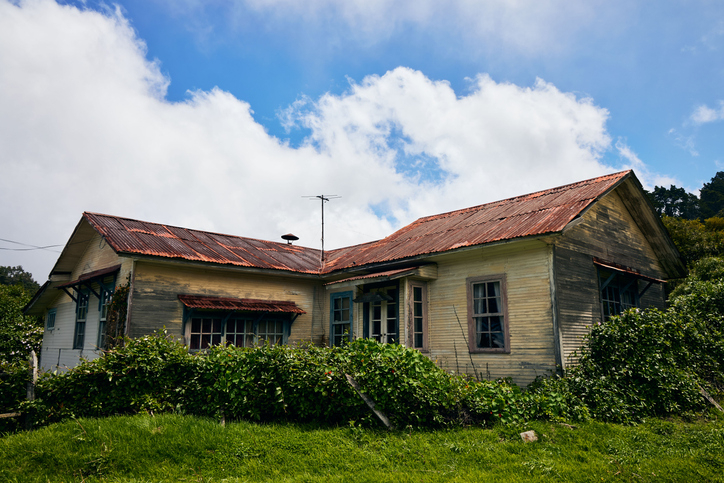
Surveys meant to help clear and repurpose vacant homes in rural and fishing communities are falling short due to a lack of qualified personnel and inaccurate property ratings, a new report has found. Surveyors have struggled to properly classify the condition of vacant homes, in some cases defaulting to a catch-all "other" category, while discrepancies between survey results and actual on-site conditions have also been documented.
According to a report released Monday by the Korea Rural Economic Institute, officials at local governments responsible for vacant-home management identified low reliability of survey results and insufficient expertise among surveyors as the top problems. The report, titled "Research on Building a Policy Framework and Institutionalization Plan for the Improvement and Utilization of Rural and Fishing Village Vacant Homes," drew on interviews and expert consultations.
The research team conducted in-depth interviews with officials from metropolitan and basic local governments as well as intermediary support organizations, and collected written responses from 33 of 40 experts who were asked for input.
Interviews with South Jeolla Province officials revealed that day laborers and village heads — neither of whom have professional qualifications — had been tasked with rating the condition of vacant homes. The resulting ambiguity in ratings left a significant number of properties classified as "other," rendering the survey data largely unusable.
Officials from Gangwon Province, South Chungcheong Province, Hongcheon-gun and Gangjin-gun similarly reported that survey results produced by outside contractors did not match the actual condition of the vacant homes.
Vacant-home ratings are used to assess the degree of deterioration and the level of safety or sanitation risk a property poses. The results feed directly into administrative follow-up actions, including designation of properties for remediation, demolition orders and the imposition of compliance fines. Inaccurate ratings from the outset can make it difficult to set remediation priorities or pursue administrative measures.
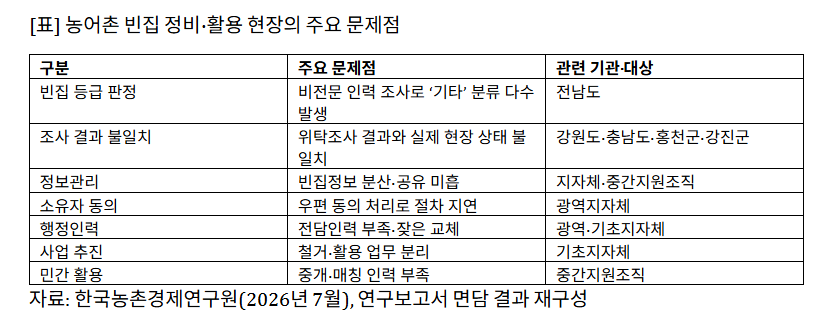
The management of survey data also drew criticism. Vacant-home information varies across local governments, is not updated in real time and is difficult to use for location-based applications. Data sharing between departments has also been slow.
The consent process required to comply with personal data protection rules was flagged as another obstacle. In some areas, officials must obtain a property owner's written consent by post before disclosing information, causing delays. The research team called for the introduction of electronic consent procedures.
Administrative staffing to translate survey findings into actual remediation projects was found to be inadequate as well. Vacant-home work spans owner identification, on-site inspection, demolition and compensation, and resident complaint handling — yet the task is frequently handed to newly hired civil servants with no dedicated team in place.
Frequent turnover among those assigned to the work has eroded expertise and continuity, and the long-term nature of the job makes it harder to secure budget allocations. The report also found that demolition and reuse functions are often split across separate departments, making it difficult to coordinate projects.
Further complications arise when property owners delay voluntary action while waiting for government-funded demolition, or when unclear ownership — due to unregistered inheritance or untraceable owners — leaves responsibility unresolved. Rural areas also lack brokers with the expertise to connect vacant-home owners with prospective users.
The research team recommended establishing quantitative rating criteria and a training system for surveyors to ensure objective assessments. It also called for standardizing the varying survey methods and information management systems used across local governments, and for improving the owner consent process.
The team further said the central government and metropolitan and basic local governments should have clearly defined roles, and that practical guidelines should be developed so that field-level civil servants can handle the full process — from survey through remediation and reuse — under a consistent set of standards.
"The vacant-home problem in rural and fishing communities cannot be solved simply by increasing demolition budgets," said Jeong Moon-su, a research fellow at the Korea Rural Economic Institute. "We need to improve the accuracy of vacant-home surveys, secure qualified personnel and establish a coherent administrative system covering everything from investigation to remediation and reuse."
adastra@heraldcorp.com