Support drops in Seoul, Incheon-Gyeonggi and Honam regions
Democratic Party at 36.0%, People Power Party at 42.6%
PPP leads DP outside margin of error for first time in 4 months since June 3 local elections
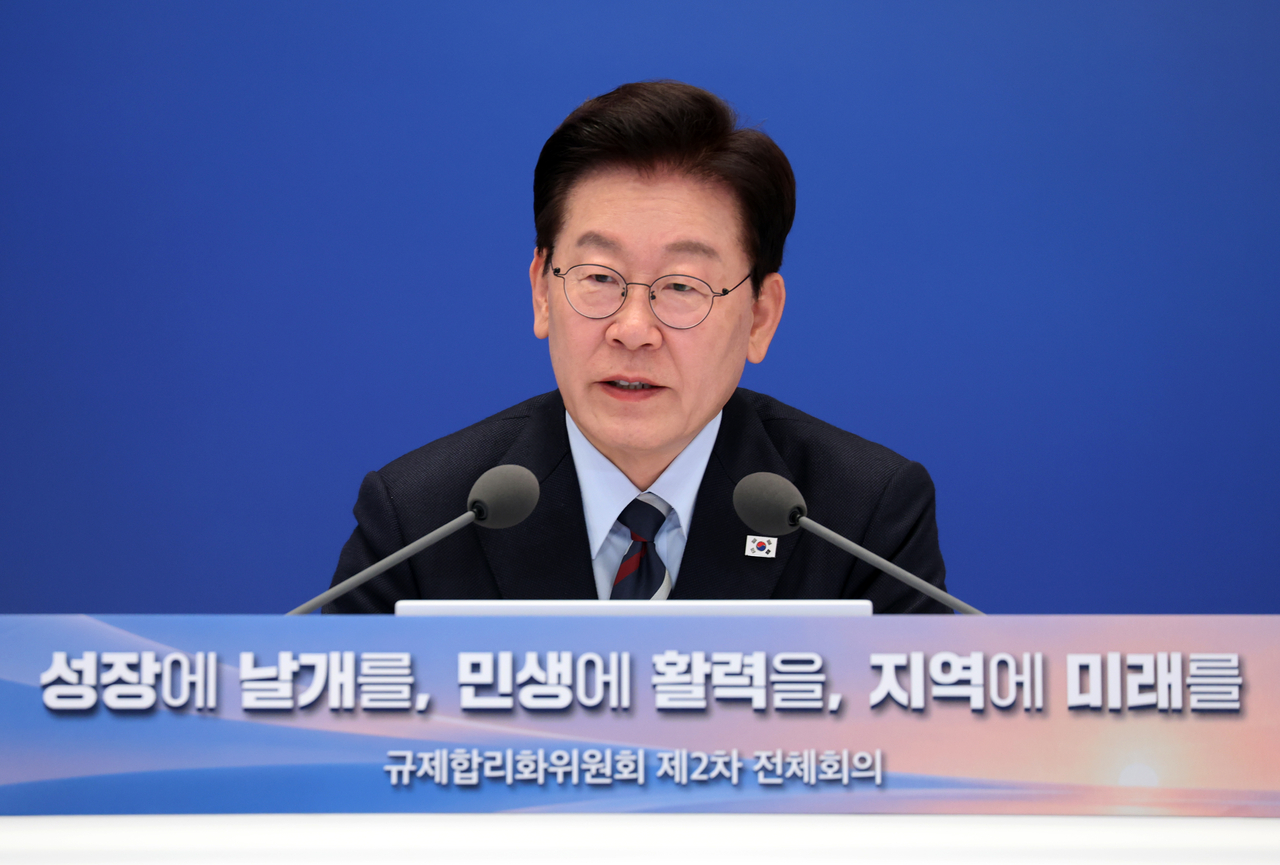
A poll released Monday showed 35.3 percent of respondents gave a positive assessment of President Lee Jae Myung's job performance — a drop of 2 percentage points from the previous survey. In party support, the People Power Party recorded 42.6 percent against the Democratic Party of Korea's 36.0 percent, marking the first time in about four months that the PPP has led the Democratic Party outside the margin of error.
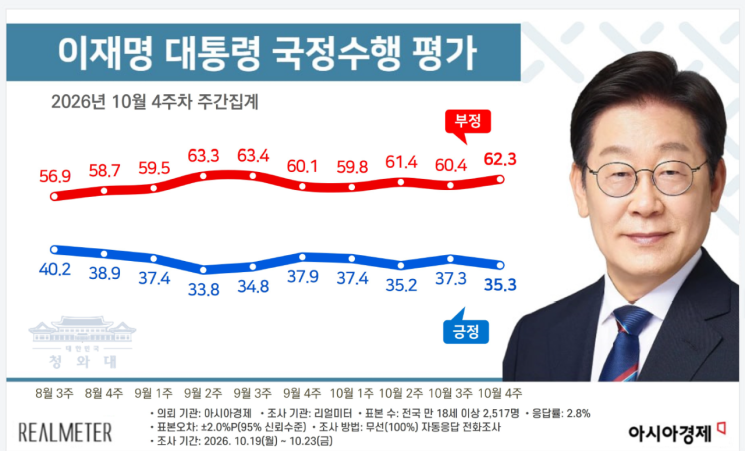
The survey was conducted by pollster Realmeter on behalf of The Asia Business Daily from Oct. 19 to Oct. 23 among 2,517 eligible voters aged 18 and older nationwide. It found that 35.3 percent gave a positive assessment of Lee's job performance, while 62.3 percent gave a negative assessment. Those who responded "don't know" accounted for 2.4 percent. The poll used an automated response method on mobile phones, with a margin of error of plus or minus 2.0 percentage points at a 95 percent confidence level and a response rate of 2.8 percent.
Compared with the previous third-week-of-October survey, the positive rating fell 2.0 percentage points while the negative rating rose 1.9 percentage points. Lee's approval had rebounded in the prior survey but reversed course within a week, settling near the 35.2 percent recorded in the second-week-of-October poll.
By region, positive ratings stood at 30.1 percent in Seoul, 34.6 percent in Incheon and Gyeonggi Province, and 52.0 percent in South Jeolla Province, Gwangju and North Jeolla Province — down 4.6, 4.4 and 2.7 percentage points, respectively, from the previous survey. Among age groups, voters 70 and older recorded the steepest decline, with their positive rating falling 7.0 percentage points to 32.8 percent. Those in their 20s dropped 3.5 percentage points to 25.2 percent, while those in their 60s fell 3.4 percentage points to 38.4 percent.
By ideological leaning, support among self-identified progressives fell 5.6 percentage points from the previous survey to 52.1 percent. Among conservatives, the positive rating edged up 0.1 percentage point to 12.7 percent, while among moderates it edged down 0.1 percentage point to 39.2 percent — both largely unchanged from the prior survey.
A Realmeter official said the week-on-week decline appeared to stem from a combination of factors eroding support among progressives and voters in the greater Seoul area: economic and real estate anxieties — including a sharp stock market drop, controversy over a proposed moratorium on national pension share sales, and a tight jeonse market — compounded by political disputes over North Korea's threat to resume loudspeaker broadcasts toward the South, the president's social media remarks, and controversy surrounding the attendance of the Serious Crimes Investigation Agency chief at a Cabinet meeting.
A separate party support survey conducted Wednesday and Thursday among 1,003 eligible voters aged 18 and older nationwide showed the People Power Party's approval rating rising 1.7 percentage points from the previous survey to 42.6 percent. The poll used an automated response method on mobile phones, with a margin of error of plus or minus 3.1 percentage points at a 95 percent confidence level and a response rate of 3.2 percent.
The Democratic Party's approval rating edged down 0.2 percentage point to 36.0 percent, putting the PPP ahead by 6.6 percentage points. It was the first time the PPP had led the Democratic Party outside the margin of error since the second week of June — about four months ago — following the June 3 local elections.
The Rebuilding Korea Party's approval rating fell 0.2 percentage point from the previous survey to 6.7 percent, while the Reform Party rose 0.8 percentage point to 2.6 percent. The Progressive Party stood at 0.8 percent and other parties at 2.4 percent. Those with no party affiliation fell 2.3 percentage points to 8.8 percent.
Realmeter attributed the PPP's rise to a convergence of factors: the easing of legal risk following Seoul Mayor Oh Se-hoon's acquittal on appeal, public demand for a harder line toward North Korea, and a spillover benefit from the president's policy difficulties — all of which, the firm said, helped consolidate support among older voters and moderates.
On the Democratic Party's slight decline, Realmeter said the fallout from remarks by South Jeolla Province Governor Choo Mi-ae and lawmaker Bu Seung-chan on fire department finances, combined with intensifying intraparty factional conflict over the push to impeach Chief Justice Jo Hee-dae and attacks over Shincheonji allegations, had kept the party's approval stuck in the mid-30 percent range for a third consecutive week.
addressh@heraldcorp.com