In-house employee loans draw scrutiny at National Assembly audit
Debate intensifies over welfare benefit vs. unfair advantage
A 1.5 billion won home: up to 1.1 billion won available via bank and company loans
First-priority mortgage lien sharply cuts additional bank borrowing
Samsung Electronics adopts lien requirement after FSC request
Financial regulators divided internally over further restrictions

"People who work at big conglomerates are so lucky. Ordinary workers like me can't even dream of buying a home because of loan limits."
Online real estate communities have been flooded lately with posts envying employees who have access to in-house corporate loans. While a typical worker can barely scrape together enough even after maxing out bank borrowing, employees at major conglomerates can borrow hundreds of millions of won from their own companies at rock-bottom interest rates. A growing sense of deprivation is spreading, with many asking whether a person's loan ceiling now depends on where they work.
The ripple effects of these in-house loans have grown larger as the real estate market overheats. Analysts have argued that so-called "semiconductor money" — in-house loans from chipmakers — is flowing into the property market and pushing up home prices across the greater Seoul area. The issue has now reached the floor of the National Assembly's national audit.
Yet in-house corporate loans are not the invincible, regulation-proof instrument they are often made out to be. Depending on the home price and loan terms, the benefit may amount to little more than a lower interest rate than a bank would offer. The Herald Business examined the reality and limits of these loans, and how far the government's regulatory discussions have progressed.
Borrowing up to 1.1 billion won for a 1.5 billion won apartment with a 500 million won company loan
An in-house corporate loan is a welfare benefit through which a company lends money directly to its employees. The funds can be used for a range of purposes including housing and living expenses, and the terms and names of the programs vary by company. A key feature is the ability to borrow between 100 million and 500 million won ($377,000) at annual interest rates of 1 to 2 percent.
At its core, it is simply an employee welfare program — a form of convenience a company provides to the people who work for it. On the surface, it is easy to ask: "It's just a company benefit, so what's the problem?"
The controversy begins when those funds are used to buy a home.
Financial regulators currently apply a debt service ratio cap to individual borrowers and a total loan volume ceiling to financial institutions — the most powerful demand-side tools the government has to cool the real estate market.
In-house corporate loans, however, fall outside these strict financial regulations. They are transactions between a company and its employees, not between a bank and a borrower, and have nothing to do with the banking system.
That means an employee can tap a corporate loan on top of a fully drawn-down bank loan, giving them access to far more capital for a home purchase than an ordinary worker. This is precisely where the fairness debate erupts.
Consider a worker buying a 1.5 billion won apartment in a speculative overheating zone in the greater Seoul area. The maximum bank loan available to that person — assuming a 40 percent debt service ratio — is 600 million won, based on a 40 percent loan-to-value ratio. The remaining 900 million won must somehow be raised through additional unsecured loans, borrowing from acquaintances, or other means.
If that same worker can also draw a 500 million won in-house loan on top of the 600 million won bank loan, the gap to fill falls to 400 million won — a combined 1.1 billion won in total financing. With the corporate loan carrying an annual rate of just 1 to 2 percent, the interest burden is also comparatively light.
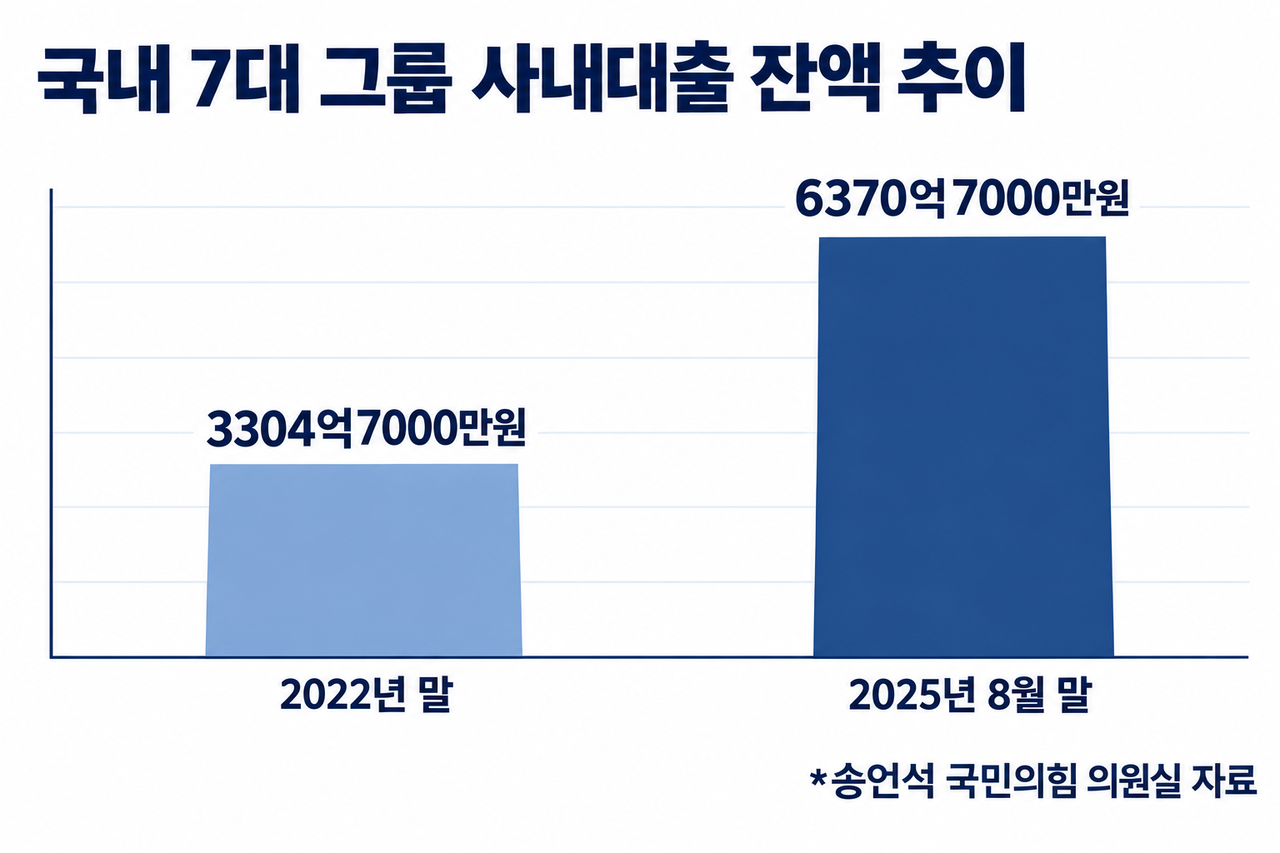
In practice, in-house corporate loans have surged this year. Data submitted by the Korea Fair Trade Commission to the office of People Power Party lawmaker Song Eon-seog, a member of the National Assembly's Political Affairs Committee, showed that the combined outstanding balance of in-house loans at seven major conglomerates — Hyundai Motor Company, SK Group, Posco, Hanwha, Lotte, LG Group and GS — stood at 637.07 billion won at the end of August, nearly double the 330.47 billion won recorded at the end of 2022.
Against a backdrop of sustained real estate investment fever, analysts say in-house loans are being used as a workaround to circumvent lending regulations. There are also growing claims that the rise in corporate loans is helping drive up home prices.
The issue was raised at the National Assembly's national audit. At a comprehensive audit of the Financial Services Commission and the Financial Supervisory Service by the Political Affairs Committee on Thursday, Song said regulators should "either lift lending restrictions on ordinary citizens or apply the same rules to in-house corporate loans."
First-priority mortgage lien requirement sharply reduces additional bank borrowing capacity
That said, in-house corporate loans cannot simply sidestep all government restrictions. Under certain conditions, borrowers may end up with a ceiling similar to what a regular bank would offer.
A prime example is when a company requires a first-priority collateral mortgage lien on the property for in-house loans used to purchase a home. Because the company secures its claim on the collateral first, the existing lien can affect how much the borrower can subsequently obtain from a bank in a mortgage loan.
In plain terms, under a first-priority lien condition, the borrower must draw the in-house loan first and then go to a bank for any remaining amount.
The order of borrowing may seem like a minor detail, but it produces a significant difference in the actual amount available.
Returning to the earlier example of buying a 1.5 billion won home in a speculative overheating zone: when the bank loan is taken first and the in-house loan follows, the borrower could access up to 1.1 billion won in total.
The picture changes when the in-house loan carries a first-priority lien requirement.
The borrower first draws the maximum in-house loan of 500 million won from the company. Although the principal is 500 million won, the registered lien is set above the principal to account for default risk and other contingencies. At the standard rate of 110 percent, the lien is recorded at 550 million won.
The borrower then visits a bank for additional financing. The bank's total mortgage ceiling on the 1.5 billion won property is 600 million won under a 40 percent loan-to-value ratio. But unlike in the earlier scenario, the full 600 million won is not disbursed. Banks calculate mortgage limits after deducting any senior liens and deposits already in place. Once the existing 550 million won lien is subtracted, the available bank loan shrinks to just 50 million won.
The combined ceiling — in-house loan plus additional bank loan — comes to 550 million won, half of what was available without the first-priority condition, and actually less than what the borrower could have obtained from a bank alone with no corporate loan at all. The one consolation is that the in-house portion was borrowed at 1 to 2 percent annually, even as bank mortgage rates push toward 7 percent.
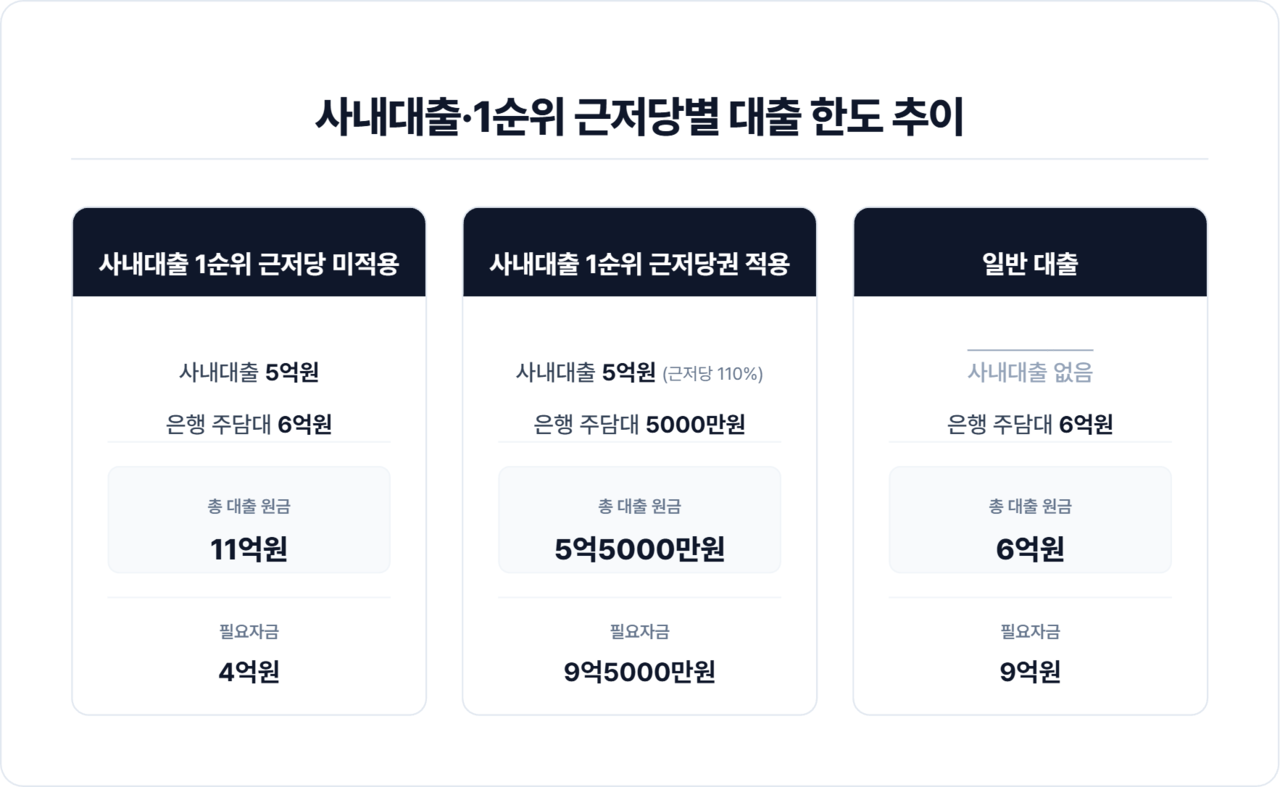
Consider another example. For a 2 billion won home in the greater Seoul area, the loan-to-value ceiling is 800 million won. After deducting the 550 million won senior lien, the borrower can obtain an additional 250 million won from a bank, bringing the total to 750 million won. Without the first-priority condition, the borrower could have combined a 400 million won bank mortgage — the cap under the Oct. 15 real estate measures — with a 500 million won in-house loan for a total of 900 million won.
Even with this handicap, it cannot be denied that in-house corporate loans remain far more favorable than ordinary loans.
Still, because adding a first-priority lien condition alone is enough to prevent loan amounts from ballooning, financial regulators have been asking companies to voluntarily adopt the requirement as part of efforts to stabilize the real estate market and manage household debt risk.
Shin Jin-chang, vice chairman of the Financial Services Commission, signaled as much at a household debt review meeting held in July, when he served as secretary general. While acknowledging that "directly applying household lending regulations to in-house corporate loans is difficult," he urged companies to voluntarily attach conditions such as first-priority mortgage liens, principal-and-interest repayment requirements, and restrictions on loans to borrowers who already own multiple homes.
The appeal appears to have had some effect. Samsung Electronics last month announced the launch of an in-house loan program for employees who do not own a home, with a ceiling of 500 million won and a first-priority lien set at 110 percent of the loan amount. With Samsung Electronics — the industry's elder statesman — having adopted the first-priority lien approach, questions are now being raised about whether other companies will follow suit.
Can in-house loans be directly regulated? Regulators concluded 'no' in July
The key question going forward is whether in-house corporate loans can be brought within the scope of financial regulation. Even with a first-priority lien in place, cases remain where enough loan-to-value headroom exists for a borrower to take out additional bank financing — which means calls may yet emerge for debt service ratio requirements to be applied on the basis of the registered lien amount.
Financial regulators have reportedly held intense internal debate over whether to regulate in-house loans directly. The conclusion reached at the household debt review meeting in July was that direct regulation is not feasible. Technical obstacles played a role, but so did the view that the government lacks sufficient grounds to intervene directly in a welfare program that companies fund and operate with their own resources. No significant further discussion on regulating in-house loans has taken place since.
Now that the issue has been raised at the national audit, however, another round of internal deliberation at the regulators appears likely.
The two heads of the financial regulatory bodies gave subtly different answers at the audit. Financial Services Commission Chairman Lee Eok-won said the agency needs to "think about how, methodologically, the regulator can step in," while Financial Supervisory Service Governor Lee Chan-jin said his agency is "in working-level discussions with the FSC" regarding the application of debt service ratio requirements to in-house loans.
The two regulators' underlying stances differ notably. The Financial Services Commission holds that it has no basis to impose mandatory rules on entities that are not financial institutions, while the Financial Supervisory Service takes a more proactive position.
Direct government intervention in a private company's welfare program is a sensitive undertaking. It is hard to predict how employees would react to such a move. Domestic companies competing with global technology giants in the AI era also have a legitimate interest in running their own in-house loan programs as a tool for attracting top talent.
At the same time, the fairness concerns surrounding in-house loans — and their impact on the real estate market and household debt — cannot be ignored. Ultimately, the outcome will depend on which side of the argument the government weighs more heavily: a question of governing philosophy.
hyuk@heraldcorp.com