A political ally of former President Kim Young-sam and a towering figure in the democratization movement, Choi is remembered for enduring torture under military rule; President Lee Jae Myung sends a condolence wreath as mourners fill the funeral hall
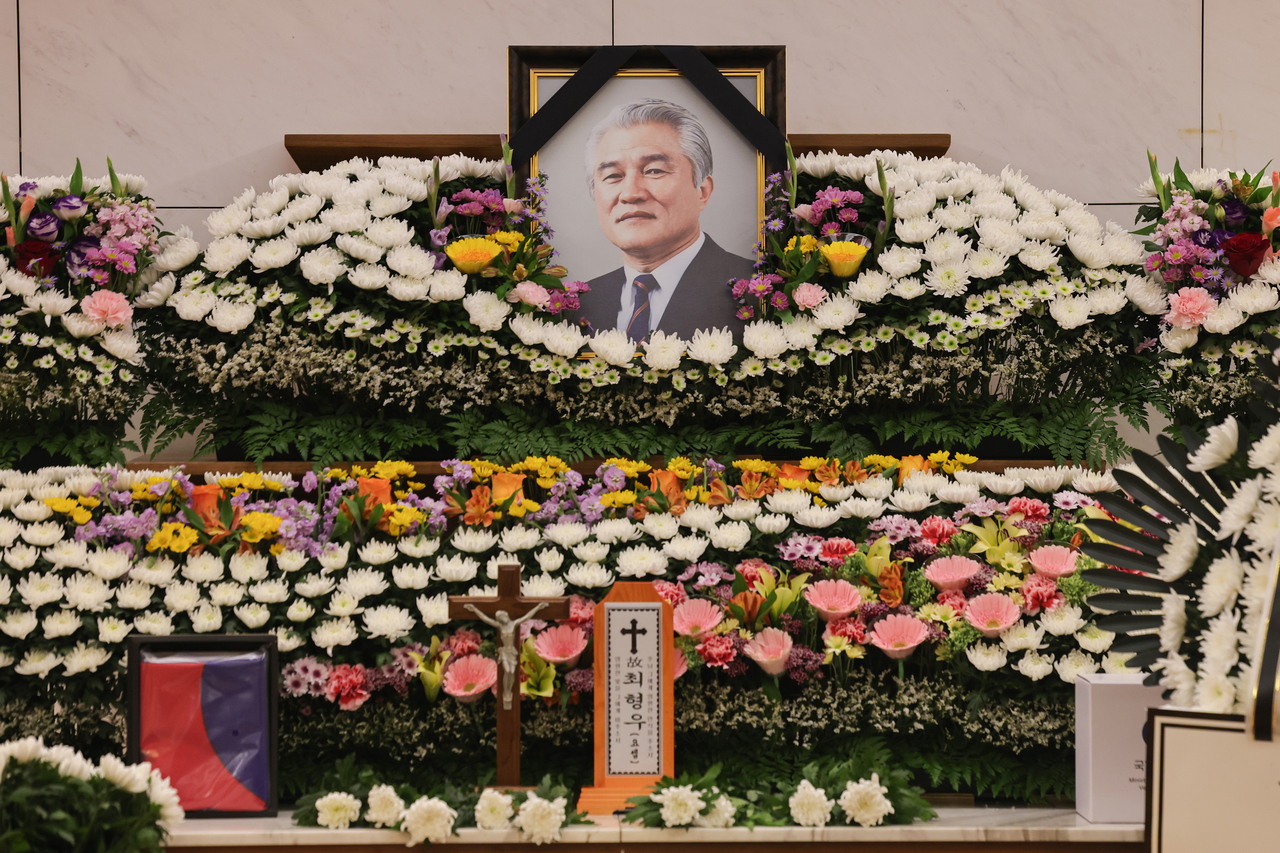
Politicians from across the political spectrum paid their respects Saturday at the funeral hall of the late Choi Hyung-woo, a former interior minister and close political ally of former President Kim Young-sam.
Kwon No-gap, chairman of the Kim Dae-jung Foundation and a leading figure of the Donggyo-dong faction, Kim Deok-ryong, chairman of the Kim Young-sam Democracy Center and a central figure of the Sangdo-dong faction, and Jeong Dae-cheol, chairman of the Korea Constitutional Association and a senior statesman of the Democratic Party, served as co-chairs of the funeral committee to honor the deceased.
The funeral hall at Samsung Medical Center was filled with condolence wreaths sent by President Lee Jae Myung, former National Assembly Speaker Jeong Eui-hwa, former Deputy Speaker Lee Seok-hyeon, former Saenuri Party leader Kim Moo-sung — who heads the Council for the Promotion of Democracy — and former Democratic Party leader Son Hak-gyu, among other elder statesmen.
Seoul Mayor Oh Se-hoon, Ministry of Planning and Budget Minister Park Hong-keun, People Power Party floor leader Jeong Jeom-sik and lawmaker Na Kyung-won also sent floral tributes to console the bereaved family.
Choi's son, Choi Je-wan, recalled his father as "a warm person who would come home after a drink, sing 'Dad's Youth' and do a funny dance to make us laugh," while noting that "as a politician and father, he raised us very strictly."
On the hardships his father endured under the Park Chung-hee and Chun Doo-hwan regimes, Choi Je-wan said: "He was probably the person who suffered the most torture among those who fought for democracy in the opposition. When he collapsed from a stroke in 1997, he was examined in Germany and doctors found his aorta had been torn. That was when we learned it was from the aftereffects of torture."
He added that during the Chun Doo-hwan era, his father was placed under house arrest. "He couldn't leave the house, so my mother ran a gukbap restaurant near Gwanghwamun to make ends meet," he said. "Detectives would come inside our home to keep watch. Even though we were struggling financially, I remember my father warmly telling them to sit down and eat."
On his father's bond with Kim Young-sam, Choi Je-wan said: "Even though he couldn't take care of himself after the stroke, he never missed paying a New Year's bow on Jan. 1 — not a single year — right up until Kim Young-sam passed away. If anyone spoke ill of Kim Young-sam, he would say, 'We don't badmouth people behind their backs.' He was someone who carried his loyalty to Kim Young-sam in his heart until the very end."
Jeong Dae-cheol, chairman of the Korea Constitutional Association, also shared a memory. "In 1978, Choi Hyung-woo called and said we should go see Cardinal Kim Su-hwan, so the three of us went — Cho Yun-hyeong, the former deputy speaker of the National Assembly, was with us," he said. "The cardinal immediately asked, 'Park Chung-hee is going to fall soon, isn't he? I've heard it won't be long — is that right?' I remember the cardinal praying for democratization."
Jeong went on to say Choi was "a truly human person who had the courage to say what needed to be said, even to Kim Young-sam, when he thought something was wrong," adding that even under the Park Chung-hee regime, Choi would say, "Park Chung-hee is going to fall soon — let's keep our confidence and push on."
Independent lawmaker Han Dong-hoon, who has publicly pledged to carry on the spirit of Kim Young-sam, also visited the funeral hall Saturday to pay his respects. Speaking to reporters, Han said Choi "was a great giant of the Republic of Korea" who "spared nothing to defend democracy in truly dark and harsh times," adding: "Without Choi Hyung-woo, our sunbae, democracy in South Korea would have come even later."
Han added that he would "work hard to learn his attitude of not putting himself first and not calculating personal gain when walking the path he believed was necessary for the country."
Democratic Party of Korea leader Kim Min-seok and People Power Party leader Jang Dong-hyeok, who are serving as co-chairs of the funeral committee, were expected to visit the funeral hall Sunday to be with the bereaved family.
The funeral will be held over three days, with the procession scheduled for Tuesday. Choi will be laid to rest at the National April 19th Democratic Cemetery.
eyre@heraldcorp.com