Korea Financial Telecommunications & Clearings Institute 2026 Payment Insight Seminar
Naver Pay, KFTC push proof-of-concept for AI-driven payments
Online brokerage Webull sees LLM-based trades reaching 20% by year-end
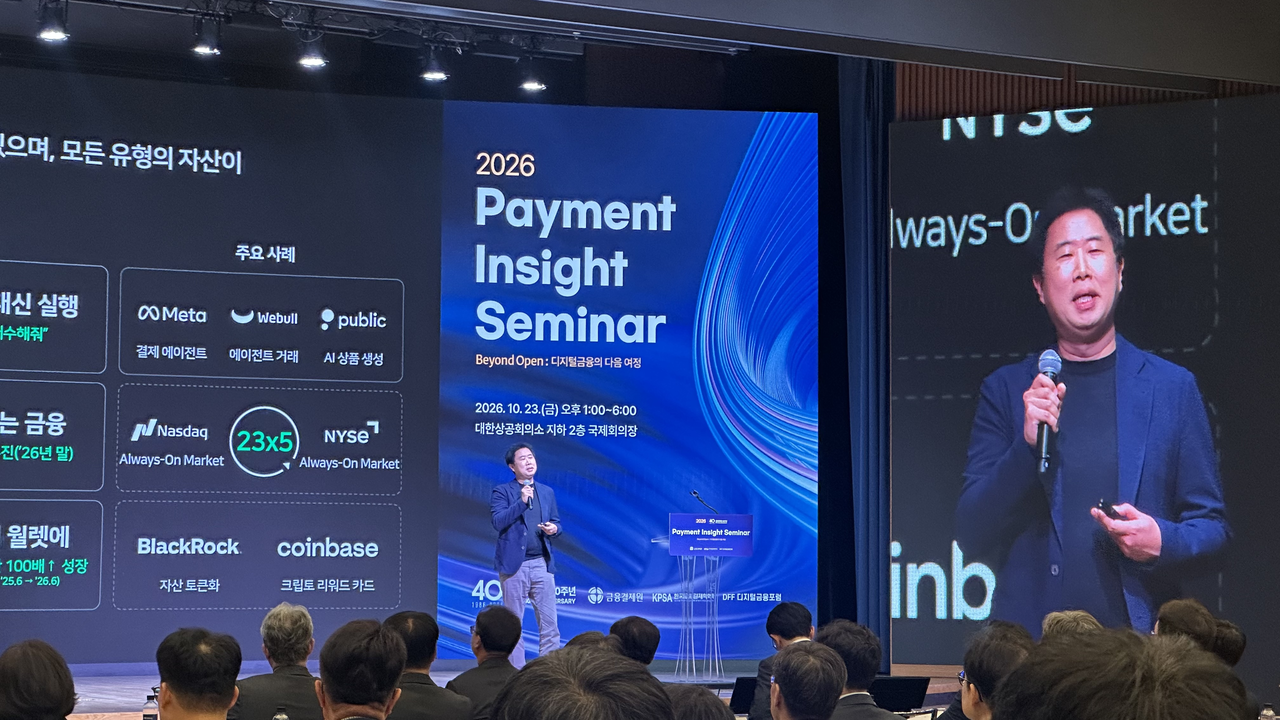
"Agents will become the customers of financial institutions. Over the past 40 years we have built up payment infrastructure, open banking and MyData — now personalized recommendations and cost reduction will matter most."
Cho Jae-park, executive vice president of Naver Pay, made the remarks Friday at the 2026 Payment Insight Seminar hosted by the Korea Financial Telecommunications & Clearings Institute (KFTC) at the Seoul Chamber of Commerce and Industry.
Naver Pay and the KFTC are currently running a proof-of-concept in which an AI agent is granted payment authorization and spending limits, handling everything from product search to purchase. Under the system, a user can instruct the AI to buy a pair of sneakers priced at 200,000 won ($151) only when the price falls below 180,000 won, and the agent executes the transaction automatically once the condition is met.
Cho said the spread of AI agents would reshape not only how consumers shop but also how sellers compete. "In the past, what mattered was getting your product noticed and placed prominently on a marketplace," he said. "Going forward, agents will seek out the best deal on their own, so price and quality will become even more important."
AI-driven financial transactions are already gaining traction abroad. US online brokerage Webull supports conversational AI-based stock trading using the Model Context Protocol, which connects AI systems to external services.
Cho said LLM-based transactions currently account for about 8 percent of Webull's total trading volume and are expected to reach 20 percent by year-end. "In the past you had to open a brokerage app, go through multiple authentication steps, select an account and then buy a stock," he said. "Now all of that happens through a conversation."
Cho also highlighted cases linking digital assets to everyday payments. Coinbase One Card, offered by Coinbase — the largest digital asset exchange in the United States — is a credit card that returns up to 4 percent of each purchase in bitcoin, depending on the cardholder's asset holdings. "It connects cash spending to coin accumulation and creates a new kind of experience," Cho said.
He also touched on the role of stablecoins in the future payments landscape. "Stablecoins have slowed a bit recently, but their total issuance stands at around 400 trillion won," Cho said. "At that scale, I think they have to be considered part of the mainstream financial system." He added that the ability to handle such assets well would be a key competency in future finance.
Cho cited Polymarket, a blockchain-based prediction market, as another example of how financial markets are changing. The platform allows users to bet on the outcomes of future events such as Federal Reserve interest rate decisions and elections. "Polymarket could be seen as gambling in some respects, but because people are putting their own money on the line, it can reflect genuine market sentiment," he said.
He drew particular attention to the roughly $1.6 billion investment that Intercontinental Exchange (ICE), the parent company of the New York Stock Exchange, made in Polymarket. When ICE announced the investment in October last year, Polymarket was valued at approximately $8 billion. "The ability to capture market data along with user attention and sentiment — and use that to recommend payments or financial investments — will be an increasingly powerful competitive edge," Cho said.
Cho argued that South Korea's financial infrastructure would itself be a competitive asset in the age of AI agents. He outlined five stages of financial services — connectivity, integrated inquiry, comparison and recommendation, delegated agent execution, and autonomous agent management — and said South Korea had achieved world-class standing in the first three.
"The United States has Plaid, a private company that aggregates financial data, but it is still weaker than South Korea's MyData infrastructure," he said. "That infrastructure will be a valuable foundation for future payment systems and AI agent adoption."
Cho also identified security as a key challenge before AI agents can conduct financial transactions autonomously. "The greater the convenience, the greater the security risk," he said. "We need to manage AI agent authentication, spending limits and anomalous transaction checks so that users have autonomy while the financial infrastructure remains safe."
kyoung@heraldcorp.com