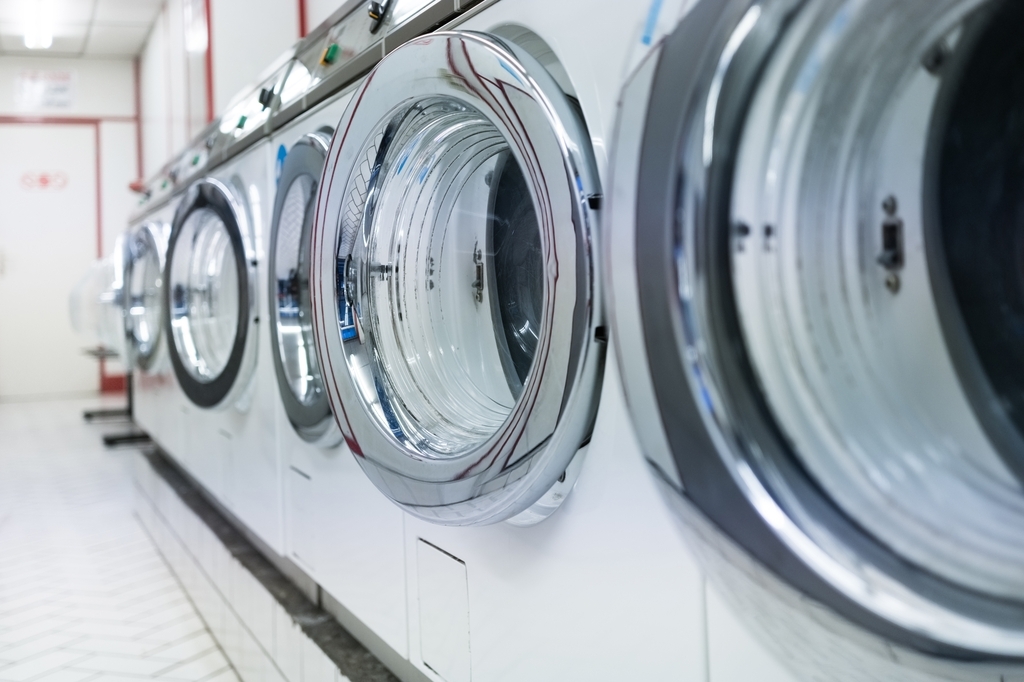
Videos of laundromat owners scooping coins out of washing machines and counting wads of cash have gone viral on American social media, turning the self-service laundry business into a hot new entrepreneurial trend. Drawn by the promise of easy, hands-off income, a growing number of people are opening laundromats — only to run into unexpected repair bills, labor costs and customer management problems they never anticipated.
The Wall Street Journal reported Monday that videos circulating on TikTok and other platforms showing steady passive income from self-service laundromats have fueled a surge of interest in the business. The trend reflects a broader appetite for so-called "passive income" — revenue that requires minimal ongoing labor — amid economic uncertainty and growing fears that AI will displace jobs.
Yet there is a significant gap between the cash revenues shown in those videos and what operators actually take home. Acquiring a laundromat can cost hundreds of millions of won, and ongoing expenses — maintenance, repairs and staffing — are far from trivial.
The figure most credited with igniting the laundromat craze in the United States is Carlos Ochoa, who goes by "Laundromat Money" on TikTok. He began running a laundromat in Visalia, California, about five years ago.
Ochoa built a following by posting videos of himself collecting coins from machines and counting bills. A clip in which he revealed he had earned $1,419 over five days surpassed 1 million views. He now has roughly 2 million followers on TikTok.
His videos typically show coins cascading out of machines and cash piling up, creating the impression that once the washers and dryers are installed, customers do all the work and the owner simply collects the profits.
What those videos do not show, however, is that the figures cited are gross revenue before expenses. After rent, utilities, labor and equipment repairs, actual profit is considerably lower.
According to the Coin Laundry Association, about 30,000 self-service laundromats operate across the United States. Acquiring a small one costs around $300,000, while larger, more profitable locations can fetch up to $3 million.
The industry's average net profit margin is about 24 percent, meaning that for every $100 in sales, roughly $24 remains after operating costs.
Brian Wallace, CEO of the Coin Laundry Association, said some social media content fails to convey the real difficulties of running a laundromat. The problem, he said, is that people assume it is a business where you stop by once a week to collect coins.
Some operators who took the plunge after watching social media videos have encountered problems they never expected.
Atousa Farsa, who runs a laundromat in Fullerton, California, bought an existing one three years ago after watching online videos. The appeal was the prospect of steady income without too much effort.
Reality set in almost immediately. Drug dealers had taken over the store's restroom, and she had to remove them — ultimately with the help of police.
Farsa said that no matter how easy the business looks online, running it in practice demands far more effort.
Equipment maintenance is another major burden for operators.
Sam Cohen, who runs a laundromat in Old Bridge, New Jersey, left a career as a software developer to enter the business. Unexpected repair costs have kept him from reaching the break-even point.
Although customers operate the machines themselves, owners must continuously manage breakdowns, cleaning and equipment inspections. When a washer breaks down, the repair bill arrives at the same time the machine stops generating revenue.
Dealing with waste and mess left behind by customers is also unavoidable.
Nancy Connelly opened a laundromat in Charleston, South Carolina, this year after leaving a career in corporate finance. Rather than posting videos of cash earnings like many other operators, she shares footage of herself removing pet hair from washing machines and dealing with customers who smoke in the restroom.
Connelly said she focuses on showing what actually happens in the store and what it takes to grow the business, rather than glamorizing the profits.
To boost profitability, a growing number of operators are combining their laundromats with other revenue streams.
Francis Dayamba, who runs a laundromat in Chicago, installed claw-machine arcade games and electric vehicle chargers in his store to generate income beyond laundry fees.
His store is staffed from 7 a.m. to 8:30 p.m., and he said diversifying revenue is essential to cover the long hours of labor costs.
Some operators have expanded into wash-and-fold and delivery services, handling customers' laundry from start to finish rather than relying solely on machine fees.
For some, social media itself has become a new income stream.
Mark and Kathy Huntebrinker, a couple who run a laundromat in St. Louis, Missouri, post TikTok videos of tasks such as cleaning lint filters. One of their videos has racked up 24 million views. Mark said that in good months, he earns as much as $5,000 from social media content alone.
That revenue is entirely separate from the laundromat's washing income — proof that the mundane routines of running a laundromat can become a business opportunity of their own online.
Even Ochoa, who helped ignite the craze, has expressed concern about people jumping into the business based solely on social media videos. He said some people, dazzled by flashy revenue clips, are skipping the due diligence needed before acquiring a business. Ochoa himself puts significant labor into his operation, including running a wash-and-fold service.
A Coin Laundry Association survey found that average laundromat revenue rose 7.7 percent last year from the year before, with 93 percent of operators turning a profit. The average net operating profit margin climbed from 22.9 percent to 24 percent.
While most operators are in the black, performance varies widely depending on management, equipment condition and location. For new entrants, securing funds not only for the initial investment but also for machine replacements, repairs and staffing is considered one of the most critical challenges.
rainbow@heraldcorp.com