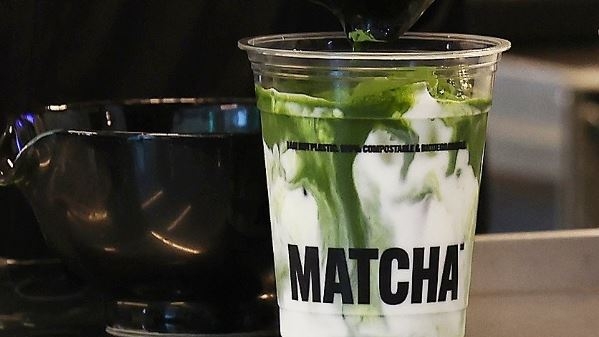
A global matcha craze has produced a striking paradox in Japan: one of the country's most beloved matcha ice cream products has been pulled from shelves, even as soaring overseas demand pushed green tea exports to an all-time high. A shortage of raw matcha forced the discontinuation of a long-running product, and with cultivation areas shrinking, farmers aging and competitors such as China ramping up production, concerns about the future of Japan's tea industry are mounting.
According to Japan's Sankei Shimbun on Wednesday, sales at major tea-producing regions have surged on the back of rising global matcha demand, but producers on the ground are grappling with raw material shortages and labor constraints. The Japanese government has begun drawing up measures to expand output and protect the brand identity of domestically grown tea.
Japanese food company Meiji discontinued its flagship Meiji Essel Super Cup Matcha ice cream in February, ending a product that had been on sale for 24 years since its 2002 launch.
The direct cause was instability in the matcha supply chain. Meiji said it decided to end sales after concluding that the risk of raw material shortages was growing due to surging global matcha demand, making stable product supply increasingly difficult.
The speed at which overseas matcha demand is expanding is illustrated by the fact that a product sold in Japan for decades was discontinued as a result. According to Japan's Ministry of Agriculture, Forestry and Fisheries, total green tea exports — including matcha — reached 72.1 billion yen ($461 million) last year, a 98.2 percent increase from the previous year. Export volume also rose 43.3 percent to 12,612 tons. Exports from January through May this year reached 40.2 billion yen, indicating the upward trend is continuing.
Demand for powdered green tea has jumped particularly in the United States and Europe, where matcha lattes and desserts have become popular. The United States accounted for roughly 41 percent of Japan's green tea export revenue last year, while European countries including Germany and the United Kingdom have also emerged as major export markets.
Foreign tourists and overseas buyers seeking Japanese-grown matcha have been flocking to Uji in Kyoto Prefecture, one of Japan's most storied tea-producing regions.
Premium matcha sold by Kyoei Seicha, a tea specialist with 190 years of history, carries a price of 100 to 120 yen per gram under its "Wakei" brand, yet some customers purchase dozens of 30-gram packages at a time. The company's matcha sales have grown three to four times compared with a decade ago and continue to set record highs, with demand for high-end Japanese matcha persisting despite the steep prices.
Unlike the export boom, Japan's tea production base has contracted over decades.
According to ministry statistics, the total area under tea cultivation nationwide stood at 33,400 hectares in 2025, down 1,700 hectares from the previous year. Cultivation area exceeded 60,000 hectares in the 1980s and has since fallen by roughly half.
The primary cause is a decline in domestic tea consumption that eroded the profitability of tea farms. As coffee and other beverages became mainstream, demand for traditional loose-leaf tea fell, leaving farmers to contend with low selling prices and mounting operational burdens.
Prolonged profitability problems led to an aging workforce and a shortage of successors. Yoshida Riichi, chairman of the Kyoto Prefecture Tea Production Council, told the Sankei Shimbun that low leaf prices made it difficult to pass farms on to the next generation, a process that accelerated the aging of the farming population.
Even with matcha demand now surging, rapidly scaling up output is no easy task. Tea plants take several years from seedling to first harvest, and converting existing tea fields to matcha production requires new equipment and processing facilities.
Tencha — the raw leaf used to make matcha — is more labor-intensive to produce than sencha, the common loose-leaf green tea. It requires shade cultivation to block sunlight before harvest, followed by a separate processing stage in which the leaves are steamed and dried.
As farms shift toward matcha production, the supply of sencha is also declining. The government is supporting sencha farmers in converting to tencha and encouraging investment in processing facilities, but the cost of equipment is substantial and farmers face the added uncertainty of not knowing how long the global matcha boom will last.
Even when demand is strong, the structure of the industry means considerable time must pass between expanding production capacity and actually generating returns.
While Japan's tea industry struggles with a weak production base, competitors such as China are accelerating their push into the global matcha market.
China is expanding matcha output by leveraging large-scale production facilities and competitive pricing. Japan's supply shortages and rising prices are effectively opening the door for other countries to enter the market. The Japan External Trade Organization has noted that in some markets, buyers are already switching to products from other countries due to insufficient Japanese supply.
The Japanese government is responding by emphasizing the quality and brand value of domestically produced tea. The Ministry of Agriculture, Forestry and Fisheries registered "Nihoncha" (Japanese tea) under the country's geographical indication protection system in July, marking the first time an agricultural product covering all of Japan has received GI status.
The GI system allows the state to protect the quality and reputation of agricultural products shaped by a region's natural environment, production methods and historical characteristics. Under the new registration, products meeting defined standards — including tea leaves grown and processed within Japan — may carry the GI label, a move aimed at differentiating Japanese tea from overseas products, including those from China, and strengthening its brand competitiveness.
The registration also addresses the problem of tea products and imitation brands overseas using Japanese place names.
Experts say Japan must pair export expansion with investment in its production base and the development of higher-value products. Nakamura Yoriyuki, director of the Tea Science Comprehensive Research Center at the University of Shizuoka, said in a recent NHK interview that Japan should use the matcha boom as an opportunity for sustainable growth in its tea industry — diversifying its product lineup rather than relying on raw material exports, and connecting traditional tea culture to tourism.
The central challenge for Japan's tea industry is converting a short-term export boom into long-term growth. Whether it can build the production capacity to meet surging overseas demand and successfully differentiate itself from competitors such as China will determine its standing in the market going forward.
rainbow@heraldcorp.com