'I earnestly appeal to Governor Choo — the province must carry on the policy legacy'
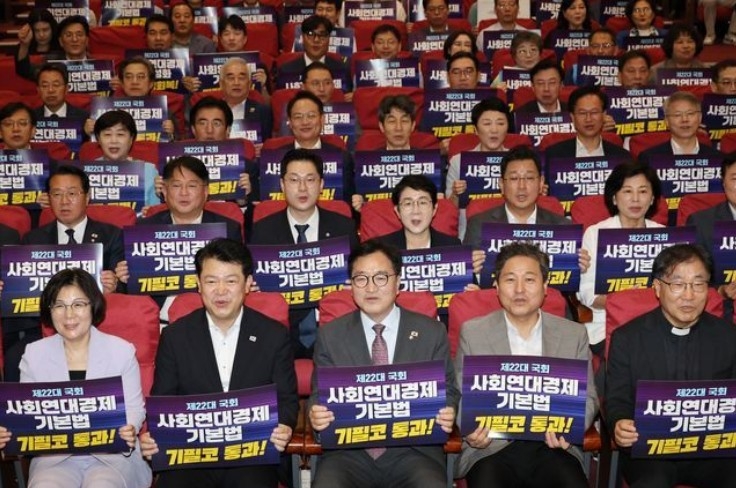
Bok Gi-wang, a Democratic Party of Korea lawmaker who chairs the party's Social Solidarity Economy Committee and leads his party's side on the National Assembly's Land, Infrastructure and Transport Committee, said Saturday he was "devastated" by Gyeonggi Province's announcement that it plans to dissolve the Social Innovation Economy Bureau — the province's dedicated social solidarity economy unit — and called for the plan to be immediately withdrawn.
In a statement released Friday, Bok said the announcement came "barely two months after the Social Solidarity Economy Framework Act, a goal we pursued for 13 years, finally passed the National Assembly."
He said Gyeonggi Province had served as "the last refuge" for the social solidarity economy when the Yoon Suk Yeol administration slashed its budget, and recalled that President Lee Jae Myung, during his tenure as Gyeonggi governor in the seventh elected term, had laid the groundwork by establishing a dedicated social economy division through an organizational restructuring in 2018.
"The efforts of the Lee administration in Gyeonggi — listening to voices on the ground and systematically building up the organization — turned the province into the undisputed base camp and last line of defense for the social solidarity economy," Bok said. He added that the philosophy of decentralization and inclusive economics had grown through the eighth elected term into an independent bureau-level body, the Social Innovation Economy Bureau, and had produced landmark institutional achievements including the launch of the Gyeonggi Social Economy Institute in 2023.
Bok said policy "is a solemn promise to the people of the province that should not be shaken simply because one local leader changes," and argued that it showed disrespect for the party's identity for the current Gyeonggi administration — led by fellow Democratic Party member Governor Choo Mi-ae — to dismantle the policy assets and continuity that President Lee had built and expanded since his time as governor.
He said it was "a shortsighted blunder that runs directly counter to the tide of the times and the direction of the central government" for Gyeonggi Province — the country's largest local government — to dismantle its own control tower at a moment when the central government was drawing up a comprehensive plan for social solidarity economy development and significantly increasing its budget.
Bok added that the social solidarity economy "is the Democratic Party's history and a solemn commitment enshrined in its platform," noting that the party had worked persistently for 13 years, beginning with former lawmaker Shin Gye-ryun, to enact the framework law, which passed the National Assembly in August and is set to take full effect on March 16, 2027. "It is simply unacceptable for Gyeonggi Province — which has the largest social solidarity economy base in the country — to shut its doors on that very achievement," he said.
"This is not the time to shrink organizations and erase functions in the name of short-term efficiency," Bok said, calling the current moment "a critical opportunity to strengthen the policy capabilities and public-private cooperation networks built up over the years, in this inaugural year of the framework law's passage."
He closed with a direct appeal to the governor. "I earnestly appeal to Governor Choo: please fully withdraw the plan to dissolve the Social Innovation Economy Bureau," he said, urging the province to carry on the policy legacy stretching back to President Lee's time as governor and to stand firmly as a leader in advancing the social solidarity economy — a core Democratic Party value.
bigroot@heraldcorp.com