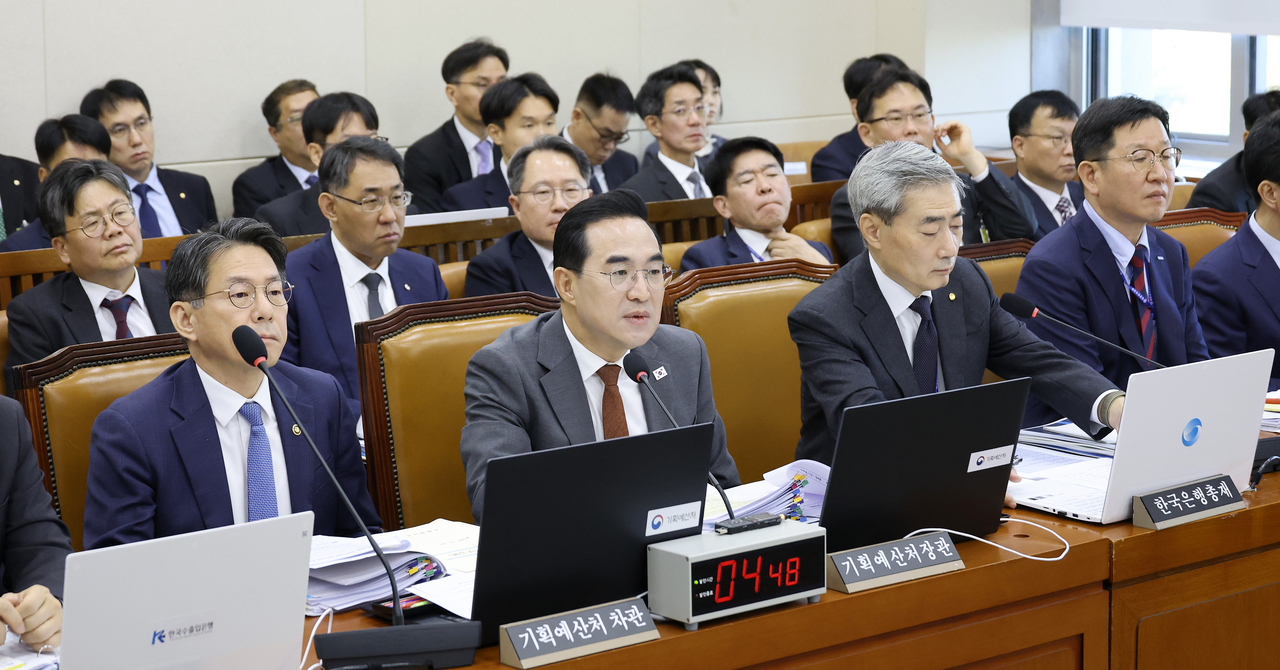
Ruling and opposition lawmakers clashed again Friday over government policy at the National Assembly's Finance, Economy and Planning Committee comprehensive audit, which targeted the Ministry of Planning and Budget and the Bank of Korea, among other agencies.
People Power Party lawmaker Park Soo-young said the Ministry of Economy and Finance was being sidelined by the Ministry of Planning and Budget, noting that the ministry had submitted 10 amendment requests — three on the National Finance Act and seven on the Future Response Fund Act — none of which were reflected.
Park also pressed the government on procedural grounds, saying that two ruling party-government consultations had concluded with only the planning minister present and without the finance minister. "If there is a procedural defect, it should be nullified — why has no such action been taken on the Future Response Fund?" he said.
Minister Park Hong-keun said the government had agreed to submit its proposal on the understanding that the two ministries would further coordinate their positions during the National Assembly stage.
Fellow PPP lawmaker Im Yi-ja argued that the Future Response Fund was designed to exhaust its funding sources from 2029 onward, and said it would fail to provide meaningful support for fiscal stabilization.
She added that there were concerns the Lee Jae Myung administration was treating 162 trillion won ($122 billion) as pocket money to spend during its own term before walking away. "This is not investment in the future — it will end up being a bill sent to the future," she said.
The Democratic Party of Korea, meanwhile, highlighted the results of government policies including the oil price cap. Lawmaker Kim Nam-jun said the cap, which took effect in March following the spillover from the Middle East war, had effectively shielded domestic prices from the shock of rising international oil prices. "A comparison of consumer fuel prices with those in major countries clearly confirms this," he said.
Kim added that while the policy could also be seen as shifting the cost burden from consumers to the public purse, sustaining such a shift required sufficient fiscal capacity. "In other words, this can be interpreted as meaning the Lee Jae Myung administration has secured a clearly greater degree of fiscal room than previous governments," he said.
Democratic Party lawmaker Jeong Tae-ho raised the issue of fire department funding, noting that the national government's share of fire service costs had actually declined even after firefighting was transferred to national civil servant status in 2020. "This runs counter to the very purpose of that transfer," he said.
He recommended that the government explore a combination of measures — including a dedicated earmarked tax or a surcharge on fire insurance premiums — and called for an overhaul of the fiscal burden-sharing framework between the central and local governments, with the overall direction being an expansion of national funding for fire services.
bigroot@heraldcorp.com