- Ultra-thin 2–3 micrometer coating applied to lithium metal surface improves battery lifespan and stability
- Cells retain 92.5% capacity after 200 charge-discharge cycles, with potential applications in electric vehicles and drones

Researchers have developed a technology that can improve the lifespan and stability of lithium metal batteries — a leading next-generation battery type — using a simple coating process. The key is forming a protective layer on the lithium metal surface by dropping a special solution onto it and letting it dry, reducing performance degradation and the risk of internal short circuits.
The Gwangju Institute of Science and Technology announced Friday that a research team led by Jo Jin-hyeon of the Battery and Electrochemistry Research Center at its Next-Generation Energy Research Institute, under the supervision of Professor Eom Gwang-seop of the Department of Materials Science and Engineering, has developed a protective layer technology that suppresses irregular growth on lithium metal anodes and improves charge-discharge stability.
Lithium metal batteries are a next-generation battery type that uses lithium metal as the anode instead of the graphite found in conventional lithium-ion batteries. Lithium metal has a theoretical storage capacity per unit weight roughly 10 times greater than graphite, making it well suited for extending the driving range of electric vehicles and the flight time of drones.
A persistent problem, however, is that repeated charging and discharging causes tree-branch-shaped crystals known as dendrites to grow irregularly on the lithium metal surface. If these crystals damage the separator, internal short circuits can occur. The fact that lithium metal expands and contracts in volume during cycling — while the electrolyte simultaneously breaks down — also shortens battery life and remains a major obstacle to commercialization.
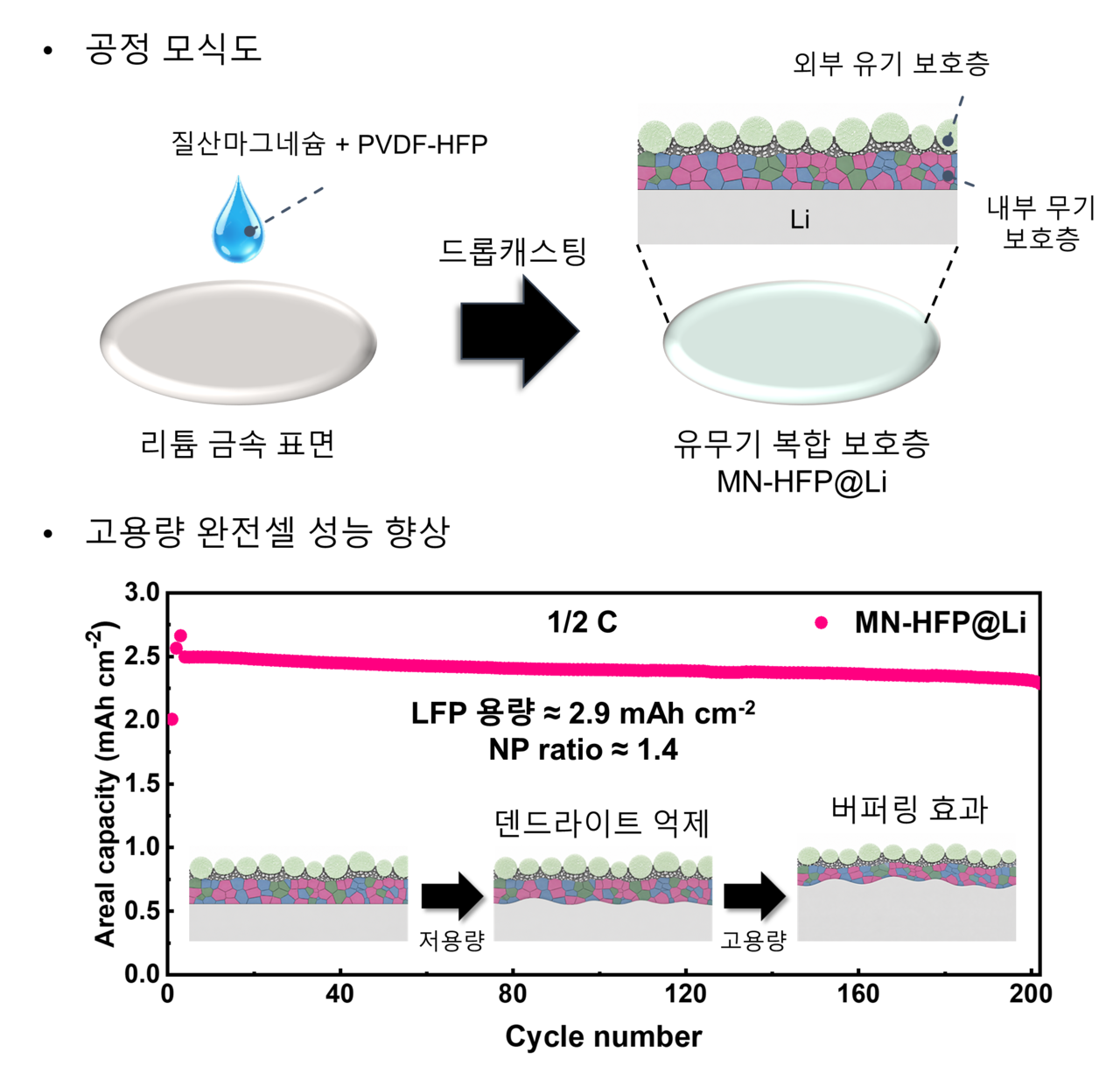
To address these problems, the research team developed a protective layer combining magnesium nitrate with a flexible polymer material, PVDF-HFP.
When a solution of the two substances is dropped onto the lithium metal surface and dried, it forms a protective layer just 2 to 3 micrometers thick — roughly one-thirtieth the width of a human hair.
The inner side of the protective layer forms a film rich in hard inorganic components that suppresses irregular lithium growth. The outer flexible polymer layer helps prevent the protective coating from breaking down even as the lithium metal expands and contracts during charging and discharging.
In experiments, electrodes without the protective layer showed uneven lithium buildup and the formation of protruding structures, while electrodes with the coating showed comparatively uniform lithium deposition.
Coulombic efficiency — a measure of how effectively lithium is recovered and reused during cycling — also improved. Cells with the protective layer averaged 94 percent over 250 charge-discharge cycles, while cells without it averaged 92 percent over just 120 cycles.
Performance gains were also confirmed in batteries using different electrolytes.
A cell using a carbonate-based electrolyte and a nickel-cobalt-manganese (NCM811) cathode retained 90.6 percent of its initial capacity after 80 charge-discharge cycles, while a cell without the protective layer saw capacity drop sharply after just 30 cycles.
A cell using an ether-based electrolyte and a lithium iron phosphate (LFP) cathode demonstrated stable charge-discharge performance for more than 500 cycles. Under high-capacity cathode conditions in particular, it retained 92.5 percent of its initial capacity after 200 cycles.

The team also confirmed that the technology operates stably for more than 70 cycles in pouch-type cells, which closely resemble commercial batteries.
Because the protective layer can be created through solution coating alone — without complex equipment — the technology has potential for scaling up to mass production. However, the uniformity of large-area coatings, the long-term lifespan of larger cells, and safety must all be further verified before commercial use becomes feasible.
"We confirmed that a thin protective layer formed by simple solution coating can mitigate unstable surface reactions and volume changes in lithium metal, and that it works effectively across different electrolyte environments," Jo said. "We will conduct further verification of the manufacturing process and long-term durability to contribute to the practical realization of high-capacity, high-safety lithium metal batteries."
The findings were published in Chemical Engineering Journal, an international peer-reviewed journal in the field of chemical engineering.
nbgkoo@heraldcorp.com