Smaller apartments in Suwon, Hwaseong and Yongin now command higher prices
Company loans and jeonse shortage drive record highs for mid-small units
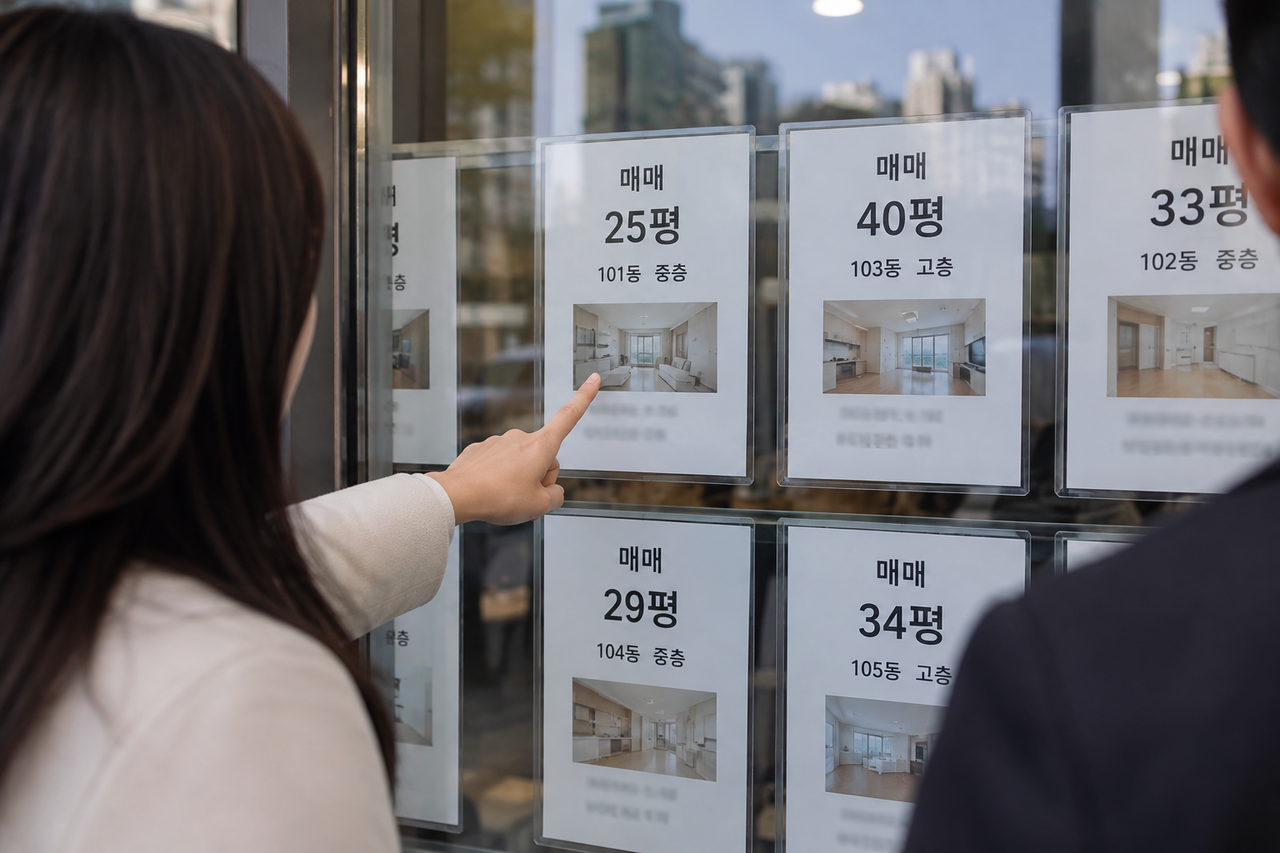
"This neighborhood has always had a lot of Samsung Electronics employees, but we're also seeing more people coming over from Suwon and Dongtan. You can assume that most buyers who come to view properties are looking for units in the 83–84 square meter range."
— Head of real estate agency A, Pungdeokcheon-dong, Suji-gu, Yongin, Gyeonggi Province
A price-reversal phenomenon is emerging in southern Gyeonggi Province's housing market, where smaller apartments are trading at higher prices than larger ones in the same complexes. Samsung Electronics and other chipmakers have introduced in-house mortgage loans of up to 500 million won ($375,000) at 1.5 percent — but only for units classified as the "national standard size" — channeling buying demand into smaller homes. Analysts say workers in their 20s and 30s who have secured purchasing power through performance bonuses and company loans, amid a worsening jeonse shortage, are driving up prices for smaller apartments as they move to buy their first homes.
84-square-meter units now the priciest across all sizes in their complexes
According to the Ministry of Land, Infrastructure and Transport's actual transaction price disclosure system, an 84-square-meter unit at Shibom Daeun Maeul Posco The Sharp in Bansong-dong, Dongtan-gu sold for 955 million won on Oct. 13, surpassing the all-time high of 930 million won for a 120-square-meter unit in the same complex. The price gap with the 98-square-meter unit's record high of 960 million won also narrowed sharply, from 105 million won last year to just 5 million won this year.
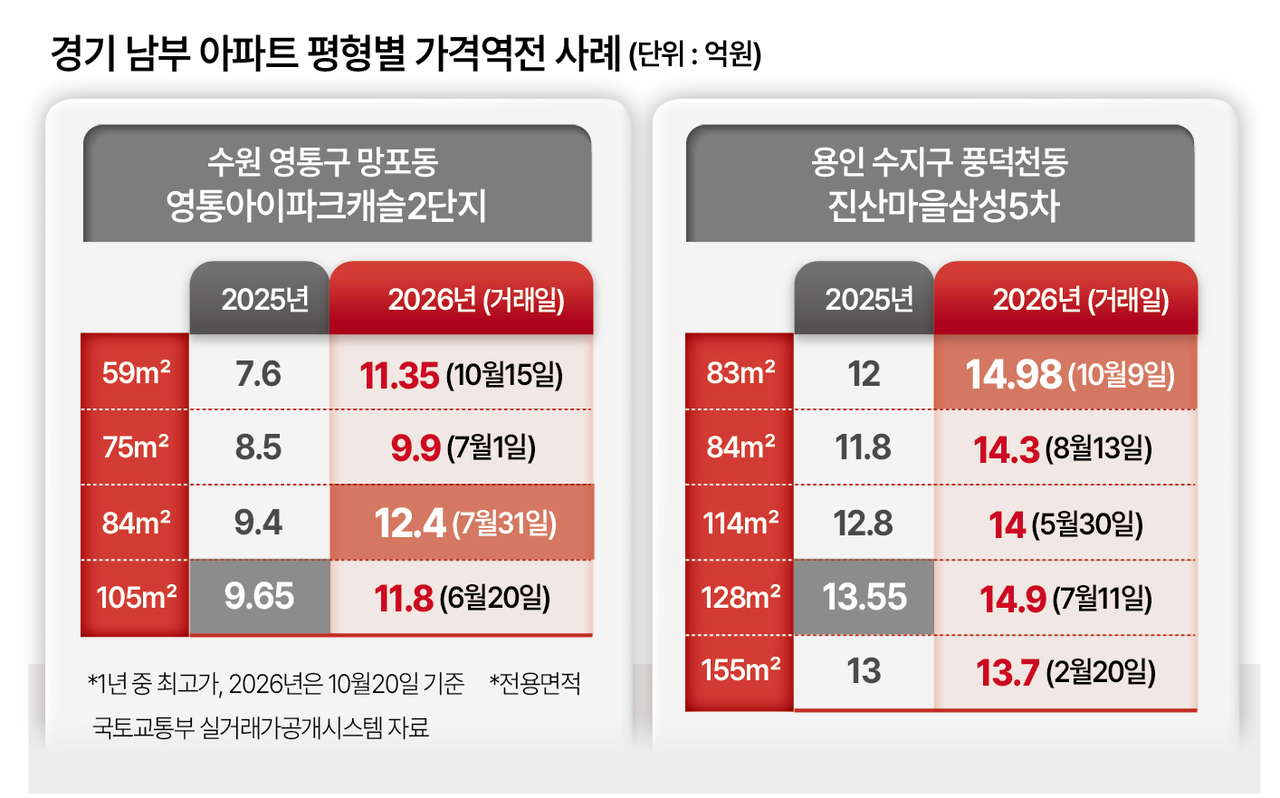
An 84-square-meter unit at Yeongtong iPark Castle 2 in Mangpo-dong, Yeongtong-gu, Suwon also changed hands in late July for 1.24 billion won, well above the year's peak transaction price of 1.18 billion won for a 105-square-meter unit in the same complex.
A similar pattern has emerged in the nearby Gwanggyo new town. An 84-square-meter unit at Gwanggyo Prugio World Mark in Iui-dong, Yeongtong-gu, Suwon sold for 1.585 billion won on July 31 — 55 million won more than the year's highest transaction price of 1.53 billion won for a 106-square-meter unit in the same complex, recorded June 1.
Even at the median price level — setting aside differences in specific floors and sub-addresses — the reversal holds at that complex. The median price for 84-square-meter units this year stood at 1.5 billion won, 65 million won above the 1.435 billion won median for 106-square-meter units. Last year, 84-square-meter units fetched 1.18 billion won against 1.372 billion won for 106-square-meter units — a gap of 192 million won in favor of the larger size — but this year the bigger units have become the cheaper option.
Company loans available up to 85 sq. m. — agents say buyers want only the standard size
The price reversal in southern Gyeonggi is widely attributed to Samsung Electronics' in-house loan program, which took effect last month and is restricted to smaller homes. Samsung Electronics and Samsung Display introduced the scheme between August and September for employees who do not own a home, offering loans of up to 500 million won at an annual rate of 1.5 percent.
Before the program launched, concerns arose that extending large housing loans would conflict with financial regulators' tightening stance on lending and could stoke home-price inflation. In response, the companies revised their plans in early July to cap eligibility at units of 85 square meters or smaller in the greater Seoul metropolitan area and six other major cities nationwide.
Local real estate agents say the restriction has concentrated buying demand from Samsung employees and other end-users on smaller units. An agent at real estate agency A in Suji-gu, Yongin, said the condition of a well-renovated listing played a role in one recent sale, but added that most buyers are looking for the standard size from the outset. "We have four or five people on a waiting list who asked us to call them when a reasonably priced unit comes up," the agent said. "Samsung Electronics performance bonuses and the company loan seem to be having quite an effect."
Larger units seen as a burden — 59-sq.-m. homes also gaining popularity among one- and two-person households
Other factors are also boosting the appeal of smaller homes in southern Gyeonggi. With high interest rates and tight lending restrictions persisting, there is a growing perception that buying a large apartment creates more problems than it solves.
A 59-square-meter unit at Yeongtong iPark Castle 2 sold Thursday for 1.135 billion won — 145 million won above the year's peak price of 990 million won for a 75-square-meter unit in the same complex. A 59-square-meter unit at Dongtan Station Central Prugio in Cheongye-dong, Dongtan-gu, Hwaseong set a record high on Aug. 15 at 1.08 billion won, topping the year's highest transaction price of 970 million won for a 74-square-meter unit — recorded June 6 — by 110 million won.
The head of a real estate agency near Dongtan Station Central Prugio said asking prices differ from actual transaction prices: units around 83 square meters currently range from 1.06 billion to 1.1 billion won, while units around 99 square meters are priced in the high 1.1 billion to 1.2 billion won range, making smaller units more accessible to young buyers who can secure larger loans and save at least 100 million won. "Newlyweds and young workers at Samsung Electronics are coming in to view properties after taking out company loans," the agent said.
Experts also cited a shift in demand from jeonse rentals to outright purchases — driven by a shortage of jeonse listings — as another factor supporting the preference for smaller apartments. One- and two-person households that had planned to rent on a jeonse basis are pivoting to buying, factoring in housing costs and loan conditions, and concentrating demand on smaller units that offer advantages in transaction turnover and maintenance fees.
Lee Dong-hyun, a senior real estate specialist at Hana Bank, said demographic shifts are making downsizing the dominant trend in the housing market, with units in the around-66-square-meter range becoming the new mainstream. "From the perspective of end-users such as single-person households and newlyweds, there is no reason not to prefer a smaller unit as long as it meets their daily needs," Lee said. He added that the jeonse shortage is likely to persist for another two to three years, and that jeonse demand will continue converting into buying demand for homes within a price range that allows for mortgage financing.
shy@heraldcorp.com
hss@heraldcorp.com