
- KAIST analysis of 47 years of climate data confirms late-summer weather front shifting northward
- Compound disasters up to 19 times more likely; researchers urge urgent policy response
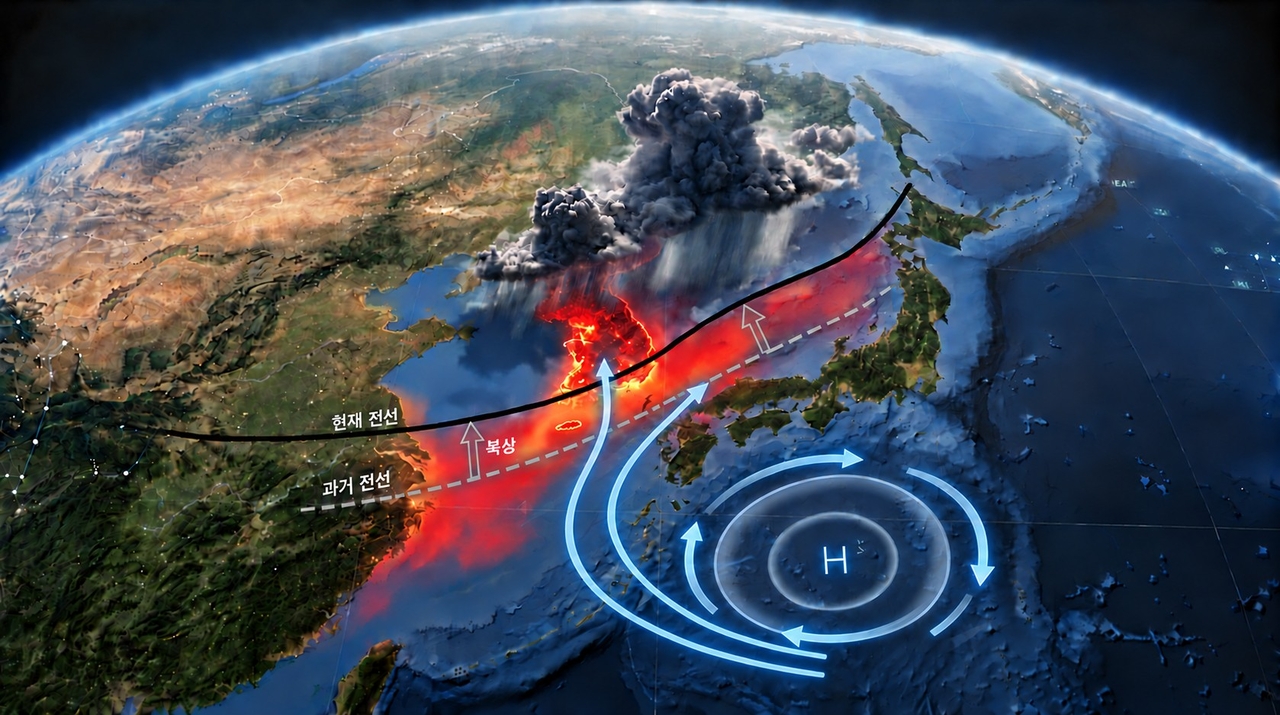
The risk of heavy rain and extreme heat striking the Korean Peninsula simultaneously is growing, according to new research. The average position of the late-summer weather front in mid-to-late September has shifted more than 200 kilometers northward compared with the past, the researchers said, warning that the country must now prepare for both torrential rain and intense heat well into late summer.
KAIST announced Friday that a research team led by Professor Kim Hyung-jun of the Department of AI collaborated with Moon Su-yeon and Kim Ok-yeon of the Asia-Pacific Economic Cooperation Climate Center to analyze 47 years of climate data from 1979 to 2025, confirming a northward trend in the East Asian summer weather front and a rising risk of compound disasters.
The East Asian summer weather front forms where air masses of different properties meet and accounts for roughly 40 percent of summer precipitation. In June and September in particular, about half of total rainfall is influenced by the front.
The research team applied an automated front-detection algorithm to high-resolution climate reanalysis data from the European Centre for Medium-Range Weather Forecasts (ECMWF), tracking the front's position at six-hour intervals over the 47-year period.
The analysis found that the summer weather front in the most recent 20-year period, from 2006 to 2025, formed generally farther north than during the earlier 20-year period from 1979 to 1998.
During the peak monsoon period of June 25 to July 15, the front shifted northward by an average of 146 kilometers. From Sept. 10 to Sept. 30, the northward displacement reached 213 kilometers. The late-summer front, which previously tended to remain near China's Yangtze River or south of Jeju Island, has in recent years advanced as far north as the southern Korean Peninsula.
The shift in the front's position also affected patterns of precipitation and extreme heat. When the front moves north, rainfall tends to increase across the Korean Peninsula and surrounding northern areas, while heat stress intensifies in regions to the south.
In years when the late-summer front was positioned farther north, the wet-bulb globe temperature on the Korean Peninsula rose by 0.4 degrees Celsius or more. The wet-bulb globe temperature is a heat stress index that accounts not only for air temperature but also for humidity and radiant heat; higher readings indicate a greater risk of heat-related illness.
Particularly striking is the elevated risk of compound disasters in which heavy rain and extreme heat occur simultaneously.
In years when the late-summer front was positioned farther north, above-average precipitation and heat occurred on the same day at a frequency roughly 8 to 19 times higher than in years when the front remained farther south. Even after removing the long-term climate change trend from the data, the frequency remained 3 to 9 times higher.
This indicates that the shift in the front's position itself is closely linked to the occurrence of compound disasters — going beyond the simple phenomena of increased rainfall and rising temperatures.

The research team said the findings could be applied to summer disaster prevention policy, as well as to efforts to prevent heat-related illness, manage cooling demand, and improve flood control and water resource management.
However, the team noted that the results establish a statistical association based on observational data and do not directly attribute the northward shift of the front to global warming caused by human activity. The researchers plan to analyze the causes through climate model experiments and to project future changes.
"This research shows that as the front's position — not just its intensity — changes, so do the locations and timing of rain and heat events," Professor Kim said. "September in particular has long been a blind spot in summer disaster preparedness, so an adaptation strategy that treats late-summer heavy rain and extreme heat as a single compound risk is urgently needed."
The findings were published in the international journal npj Climate and Atmospheric Science.
nbgkoo@heraldcorp.com




