Minister rebuffs criticism over fund management change limits
EV production tax credit under government discussion
No decision yet on further treasury bond issuance cuts
Minister of Planning and Budget Park Hong-keun said Wednesday that if necessary, the government would comprehensively examine the impact of declining tobacco excise tax revenues, the fiscal capacity of local governments, and the adequacy of central government support to determine what needs to be addressed regarding fire department funding. He said the review would take place during the National Assembly's budget deliberation process.
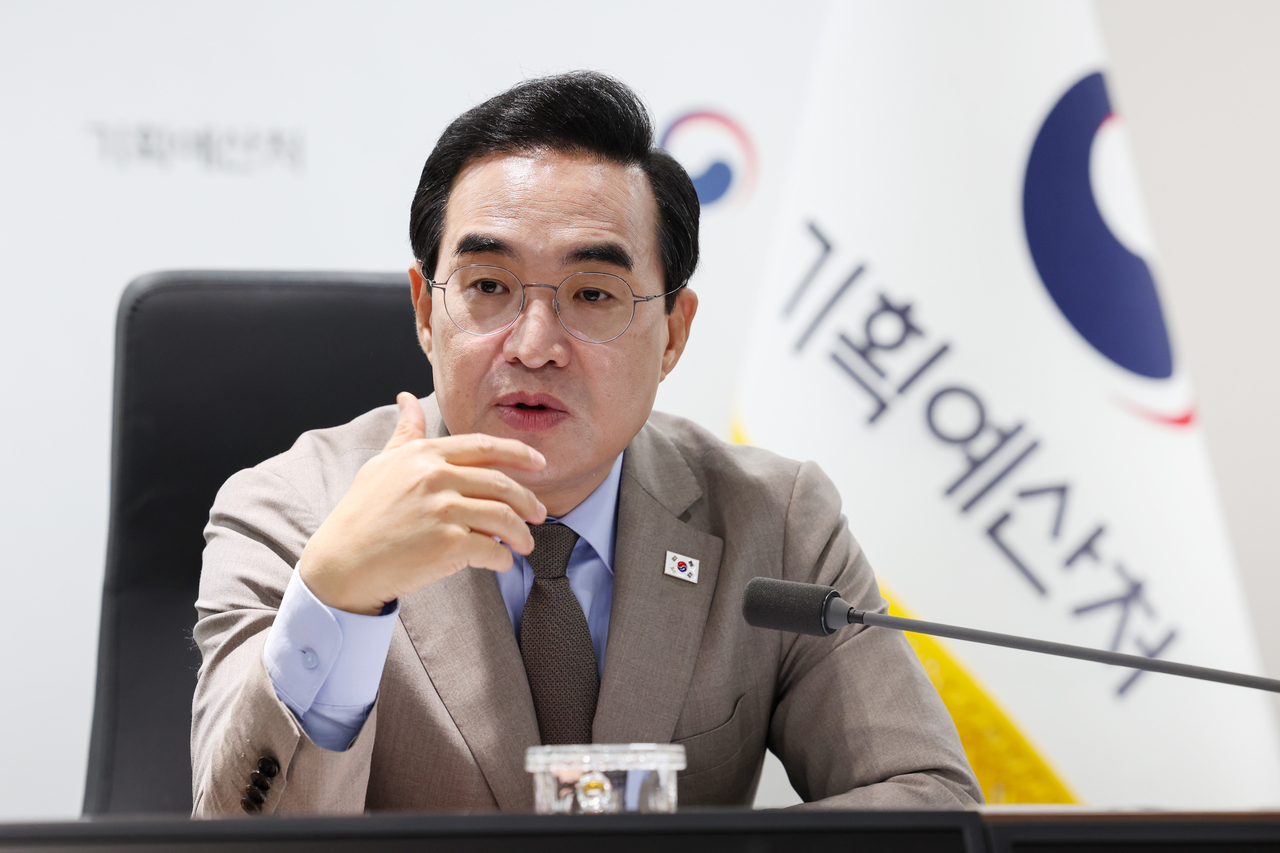
Park made the remarks during a visit to the press room at Government Complex Sejong, saying he strongly agreed with the need to examine the issue more closely in light of recent public concerns.
"It is the state's responsibility to create an environment where those who have sacrificed and dedicated themselves for the country and its people can carry out their duties more safely," he said, adding that the fire department funding support structure warranted a thorough review.
Firefighters currently hold national civil servant status, but fire administration affairs remain under the jurisdiction of local governments. Park said that when firefighters were reclassified as national civil servants in 2020, the government and the National Assembly agreed to shift their status to the national level while keeping administrative duties with local governments. To ease the financial burden on local governments from expanding firefighting personnel, the government has provided funding by raising the share of tobacco excise tax revenues allocated to the fire safety grant — a special local transfer tax earmarked for fire safety.
However, declining tobacco consumption has reduced the revenues flowing to local governments through this channel. Park said the financial strain on local governments had worsened as falling tobacco consumption cut into excise tax revenues on top of the large tax shortfalls recorded in 2023 and 2024.
"Internal discussions have not yet reached the point of deciding specifically how to address this," Park said, but added that the government would work with Cheong Wa Dae, the Ministry of Interior and Safety, the National Fire Agency, and local governments to explore improvement measures.
On the Future Response Fund, Park said the focus would be on supporting the government's strategic investment role rather than on generating returns in and of itself.
Regarding his earlier statement that the fund would aim for returns 1.7 percentage points above the yield on three-year treasury bonds, Park said he had made the remark based on the average returns of pension funds, suggesting that level should be achievable.
"Because this is taxpayers' hard-earned money, we must ensure both profitability and safety," he said. "There needs to be a justification for managing surplus funds, and that means generating returns above the interest cost of treasury bond issuance."
He added, however, that the fund was not intended to create new national wealth. "The more central purpose is for it to serve as a fiscal reservoir for future strategic investment — the goal is not returns for their own sake," he said.
Park said the fund's size could vary depending on whether surplus tax revenues from this year and next year are reflected in the fund, as well as future tax revenue conditions tied to the semiconductor cycle. The government is also weighing whether to use a dedicated external asset manager or the pension fund investment pool, and plans to design the fund by comprehensively considering the balance between short-term and medium-to-long-term investments, the allocation between safe and risky assets, and the direction of domestic and overseas investment.
Park rebuffed criticism that setting the fund's self-adjustment limit for fund management plans at 30 percent would allow it to be used as a discretionary slush fund, saying the money was not something the president or a minister could simply draw on at will.
"All funds carry the obligation to be executed in accordance with the fund management plan submitted to and deliberated and approved by the National Assembly," he said. "Funds are created under the National Fiscal Act to be operated flexibly — that is, elastically — with specific revenues for specific purposes."
On setting the self-adjustment limit at 30 percent, he said the fund includes not only project-type accounts but also financial accounts, and that a 30 percent threshold was appropriate given that financial accounts make up the majority.
"New AI models are emerging every six months, and external uncertainty is greater than ever," Park said. "I believe the need for fund adjustments to respond proactively and swiftly is also consistent with the intent of the National Fiscal Act." He noted, however, that changes to major line items and increases to items the National Assembly had reduced were restricted.
Asked about expanding production tax credits and providing subsidies to loss-making companies, Park said tax credits fall primarily under the judgment of the Ministry of Economy and Finance, while subsidies are a matter of fiscal expenditure and therefore something the Ministry of Planning and Budget should lead on. He added that discussions on production tax credits were ongoing within the government.
Park said solar energy and other sectors appear to be among the candidates under consideration for production tax credits, and noted there are calls to expand tax credits for electric vehicles not only at the purchase stage but also at the production stage. "There are parts that are difficult to speak to since nothing has been finalized yet," he said, adding that he hoped an agreed position on production tax credits could be announced in the near future.
On the decision to cut October treasury bond issuance by 5 trillion won ($3.77 billion) from the original plan, Park said it was made in consideration of market interest rates on treasury bonds, and noted he had mentioned at a previous F4 meeting that further volume adjustments could be made as needed. On the scale and timing of any additional cuts, he said no decision had been made — "whether it's 5 trillion won or 10 trillion won" — and that the government would respond based on monitoring results.
Park said the ministry's "2045 National Medium- and Long-Term Strategy" was currently in the draft preparation stage. "As soon as a draft is ready, we will provide an interim briefing, incorporate feedback to make it a practical plan, and aim to announce it by year-end," he said.
y2k@heraldcorp.com