19 joint development projects identified; target vehicles selected for 9 chip types
Ministry of Trade, Industry and Energy, Hyundai Motor, LG Electronics join 'one-team' TF
Participating firms and institutions nearly double to 53
Collaboration to span design through verification and mass production
Hyundai Mobis has launched domestic development of 13 types of automotive system semiconductors in partnership with South Korean chipmakers, with target vehicle models already selected for nine of them. The collaboration — built on ties forged last year with Samsung Electronics and SK Keyfoundry — has now moved into active development, and with the government joining as a backer, efforts to reduce the automotive supply chain's heavy dependence on foreign chips are gaining momentum.
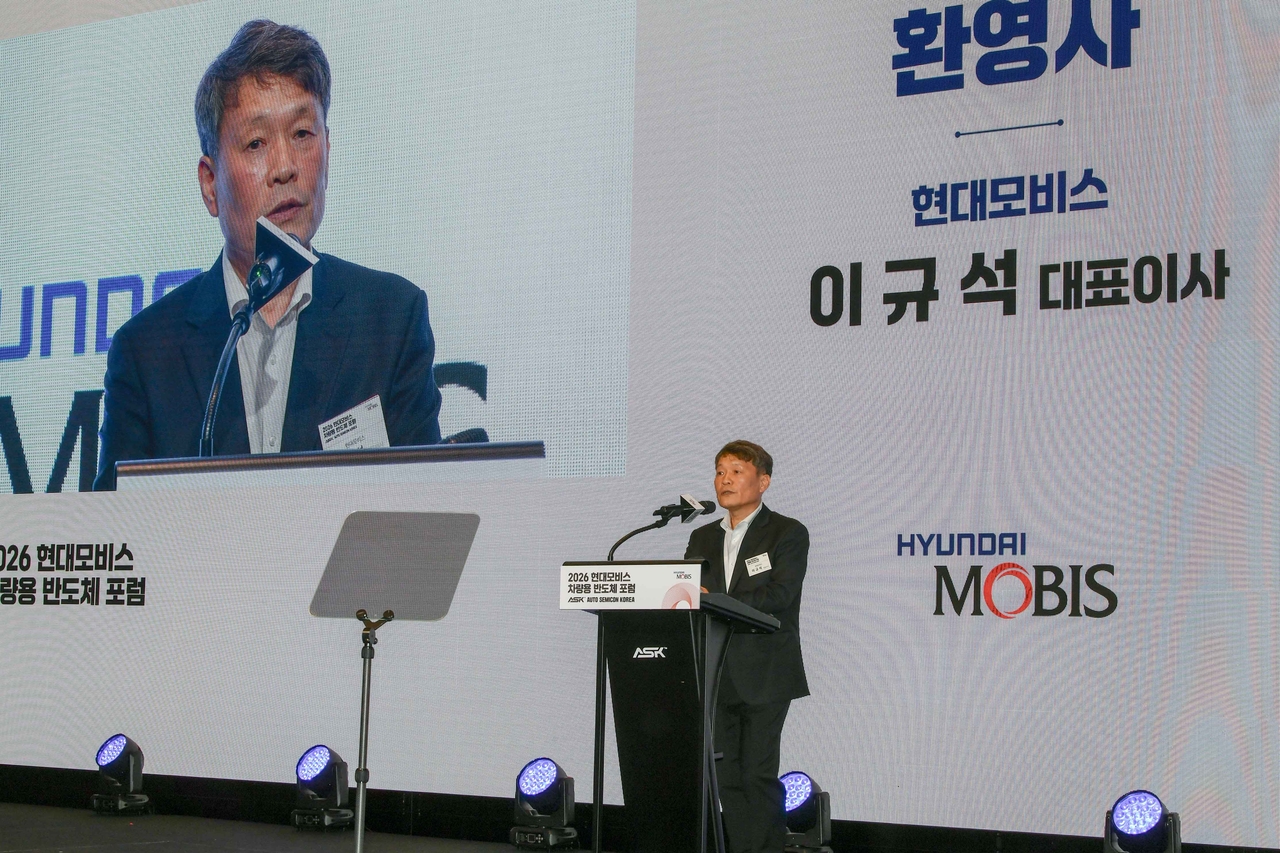
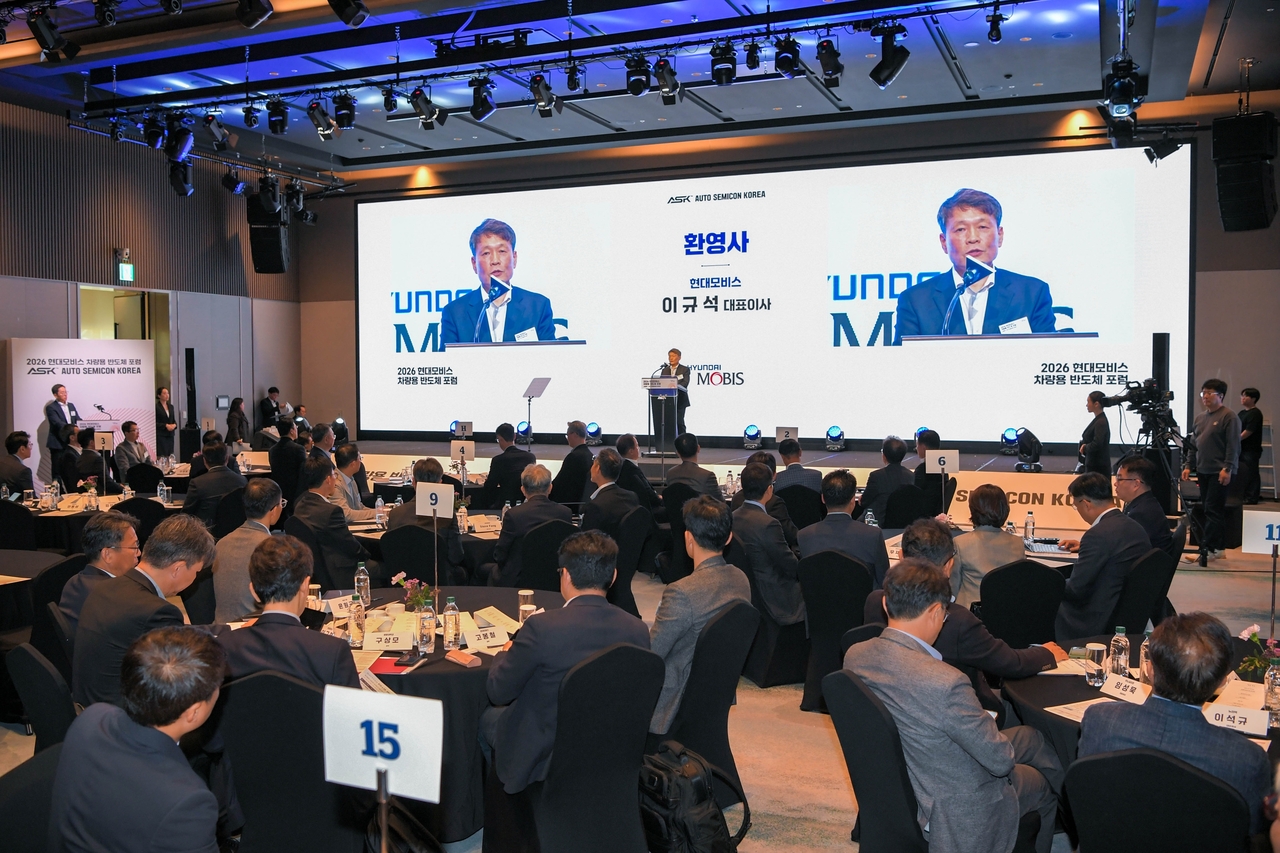
Hyundai Mobis hosted the second Auto Semicon Korea (ASK) forum on Wednesday at the DoubleTree by Hilton Seoul Pangyo in Seongnam, Gyeonggi Province.
ASK is a consultative body launched last year by automakers, parts suppliers, fabless chip designers and foundries to advance the domestic production of automotive semiconductors.
South Korea currently imports about 95 percent of its automotive semiconductors, leaving its supply chain exposed to external shocks. The 2021 global chip shortage disrupted vehicle production, and supply instability resurfaced last year amid tensions between China and the Netherlands. The forum aims to build a framework in which domestic companies collaborate from development through mass production to reduce that foreign dependence.
This year's forum was notably larger in scale. The number of participating companies and institutions nearly doubled, rising from 27 last year to 53. The roster includes Samsung Electronics and SK Keyfoundry alongside Global Technology, Abov Semiconductor, LX Semicon and Dongwoon Anatech, and has expanded to cover firms and institutions working in software, semiconductor intellectual property, packaging, testing and evaluation, and functional safety.
About 90 executives and officials attended, including Hyundai Mobis President Lee Kyu-seok, Minister of Trade, Industry and Energy Kim Jung-kwan, Samsung Electronics Foundry Business Division President Han Jin-man and SK Keyfoundry CEO Lee Dong-jae.
The most notable outcome of the forum was the progress made since ASK's launch last year. Hyundai Mobis and domestic chipmakers identified 19 joint development projects in the system semiconductor field. Of those, 13 have entered active development and nine have been matched to specific Hyundai Motor and Kia production models. What began as technology exchanges and exploratory discussions has evolved into full-scale co-development aimed at putting domestically made chips into actual vehicles.
"As a company that relies on automotive semiconductors, we will actively share the know-how we have accumulated," Lee said. "We will build a full-cycle collaboration structure — connecting each partner's strengths and sharing responsibility from development through verification and mass production — so that no single company has to clear the high barriers of the automotive semiconductor market alone."
The forum also marked the launch of the Automotive Semiconductor One-Team Task Force, led by the Ministry of Trade, Industry and Energy, Hyundai Motor, Hyundai Mobis and LG Electronics. The TF is designed to go beyond bilateral corporate partnerships, creating a framework in which the government and major end-users jointly identify localization projects and support technology development and commercialization.
This year, the emphasis shifts from simply securing the technology needed to develop chips to confirming whether those chips can actually be deployed in vehicles. Automotive semiconductors must operate reliably under extreme conditions — high temperatures, vibration and other harsh environments — and therefore require far more rigorous quality and reliability verification than chips used in consumer electronics.
To that end, Hyundai Mobis plans to share performance requirements, quality standards and production schedules set by automakers with domestic chipmakers from the earliest stages of development, helping companies pursue research and capital investment with a clear picture of real-world vehicle applicability.
Park Cheol-hong, executive vice president in charge of Hyundai Mobis's semiconductor business, said the company would "proactively present requirements and technology roadmaps for future core semiconductors from a systems and controller perspective." He described the strategy as one of "demand-driven development — working with automakers to define functions, quality standards, application timelines and target models early, then following through to verification and mass production to deliver real business results."
Development cooperation centers on system semiconductors and power semiconductors. In the system semiconductor segment, the initiative targets domestic production of microcontrollers (MCUs) that govern various vehicle functions, as well as chips for communications and power management. The partners also plan to define the specific roles that end-users, designers, manufacturers and testing and certification bodies will each play at different stages of development.
Power semiconductors — which determine the energy efficiency of electric vehicles — are another key focus. Hyundai Mobis aims to strengthen development and mass-production competitiveness in silicon carbide (SiC) semiconductors and IGBTs, while working with the government and SK Keyfoundry to create a research and development environment that allows domestic chip designers to produce prototypes at lower cost.
Within this collaborative framework, Hyundai Mobis serves as the link between chip development and actual vehicle application. The company is both a tier-one supplier of major components to automakers and an entity that designs chips in-house and co-develops them with external specialists.
Hyundai Mobis is also expanding its own semiconductor business. Since taking over the semiconductor operations of Hyundai Autron in 2020, the company has built up design capabilities focused on system and power semiconductors. It currently designs 16 types of system semiconductors — used in power supply, actuation, communications, sensing and data processing — and produces about 20 million units annually through external foundries.
On the power semiconductor side, the company is focused on building an integrated development capability spanning semiconductors, power modules, inverters, motors and electrification drive systems. The strategy is to improve efficiency not just at the individual chip level but across the components and systems in which those chips are embedded.
As software-defined vehicles and autonomous driving technology grow more sophisticated, semiconductors that process data and control systems inside the vehicle will become increasingly critical. Hyundai Mobis plans to move beyond simply purchasing and integrating off-the-shelf chips, instead co-designing the semiconductors it needs with domestic partners — starting from the functions and architecture of future vehicles.
Government support is also being put in place. An automotive semiconductor support center in Cheonan, which will provide quality and reliability verification services for automotive chips, is under construction with a target completion date of next year. Hyundai Mobis plans to link projects identified through the forum to government research and development programs and to monitor development schedules and progress through a dedicated consultative body.
"Last year's inaugural forum focused on identifying opportunities to extend domestic companies' existing capabilities in home appliances, mobile and industrial semiconductors into the automotive space and to pursue co-development," Lee said. "This year, we move into a more advanced stage — confirming the feasibility of actual product development, vehicle application and commercialization."
kwater@heraldcorp.com