Local governments shoulder 89.3% of national fire budget of 8.6 trillion won
State covers only 8.4% of firefighter personnel costs
Local personnel cost burden up 2.24 trillion won since 2020 nationalization
Lawmaker urges pan-government TF, expanded state fiscal responsibility
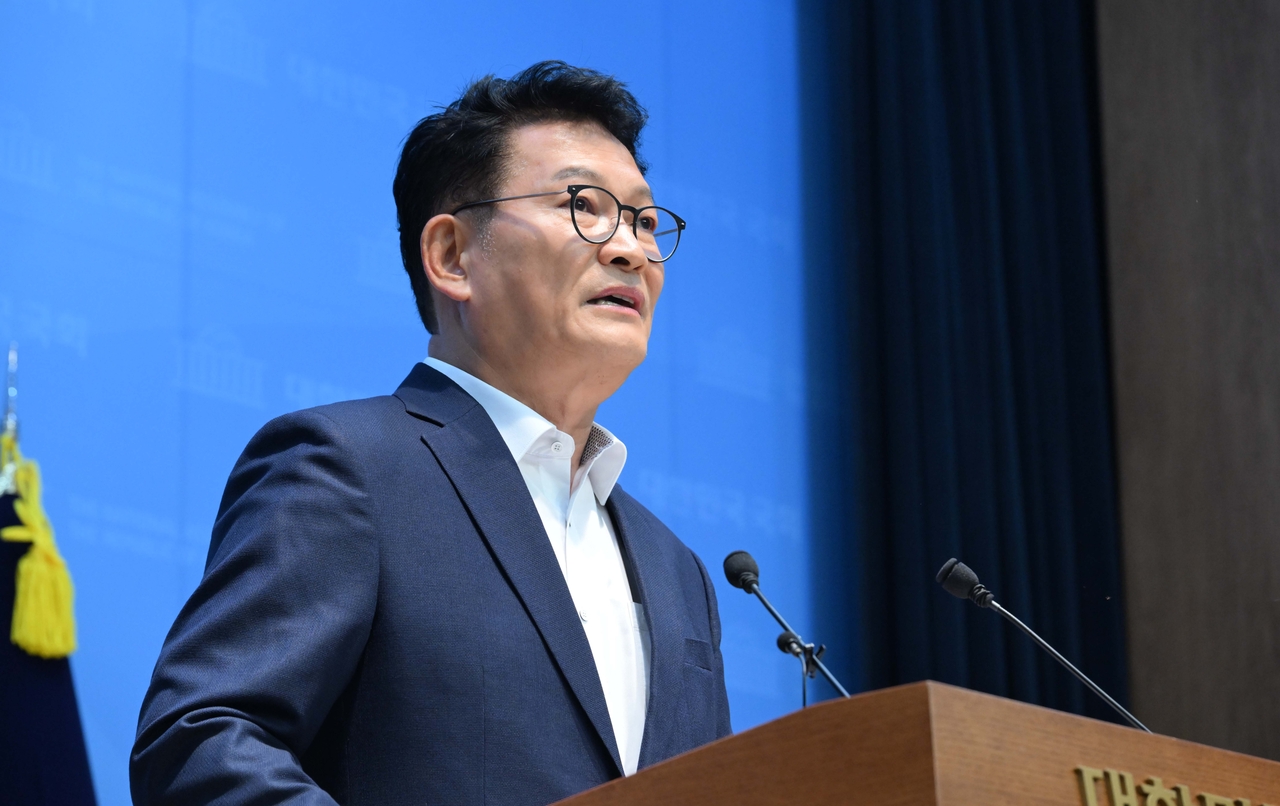
Democratic Party of Korea lawmaker Song Young-gil on Wednesday called for a structural overhaul of fire service financing, saying local governments still bear more than 90 percent of firefighter personnel costs despite the nationalization of the fire service.
Song made the remarks at a press conference held in front of the main building of the National Assembly, titled "Restoring the Honor of Firefighters and Normalizing Fiscal Responsibility for the Fire Service." He questioned whether it was a rational arrangement to classify firefighters as national civil servants while forcing local governments to cover more than 90 percent of their wages.
According to data Song obtained from the National Fire Agency, local governments accounted for 89.3 percent of the total national fire budget of 8.6 trillion won ($6.47 billion) this year. The state covered only 8.4 percent of firefighter personnel costs, which totaled 6.51 trillion won. Since firefighters were reclassified as national civil servants in 2020, the local government burden for their wages has actually increased by 2.24 trillion won.
"Their status became that of national civil servants, but the personnel cost burden remains concentrated on local governments," Song said. "The quality of fire safety and the treatment of firefighters must not vary depending on the fiscal conditions of each region."
Addressing recent controversy over remarks about fire service finances, Song said those who had spoken of firefighters as a fiscal burden owed a sincere apology. He added, however, that an apology alone was not enough. "The real problem is the structural contradiction in fire service financing that has gone unresolved even after nationalization," he said.
As a remedy, Song proposed forming a pan-government TF on fire service fiscal normalization and improved working conditions, to include the Ministry of Interior and Safety, the Ministry of Economy and Finance and the National Fire Agency. He also urged an expansion of the state's share of firefighter personnel costs, stable funding for the fire safety earmarked grant tax, and an increase in firefighting allowances to reflect actual conditions.
"I will formally propose to the party leadership that a TF be formed and will work to secure the necessary legislation and budget," Song said. "True mourning must be proven not through words but through institutions and funding."
Meanwhile, the press conference was organized by the Firefighters' Labor Union under the Federation of Korean Government Employees' Unions, and was also attended by Democratic Party lawmakers Seo Mi-hwa and Im Mi-ae. The union called for stronger state fiscal responsibility, the establishment of an independent investigation team for on-duty deaths, and enhanced accountability for safety management at the scene.
thanks@heraldcorp.com