Youth employment falls for 47th straight month despite semiconductor export boom
Exports generate fewer jobs per billion won as capital-intensive industries grow
One in six young workers logs 17 hours or less a week; 25% start careers in part-time roles
Government to raise youth employment budget 41% to 5.1 trillion won next year
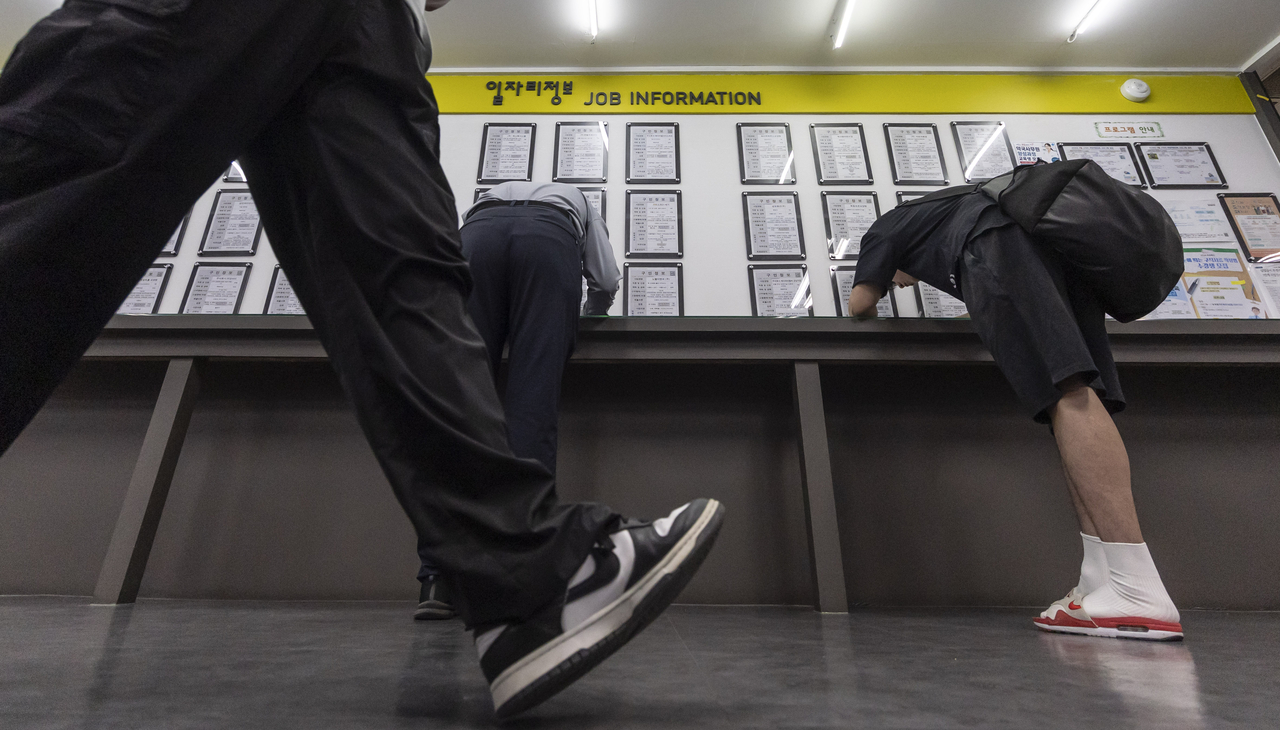
South Korea's semiconductor export boom is driving economic growth, but the youth job market is moving in the opposite direction. Opportunities are narrowing, and even young people who find work are struggling to secure enough hours. One in six employed young Koreans works 17 hours or fewer per week, leaving the youth labor market caught in what analysts describe as a "double cliff" — shrinking access to jobs and deteriorating job quality.
Data released Wednesday by the Ministry of Statistics showed that the average monthly number of employed people from January through September reached about 28.887 million, up 116,000 from the same period a year earlier — the smallest gain since the COVID-19 shock of 2020.
To meet the government's annual target of adding 150,000 jobs, monthly employment would need to rise by roughly 250,000 compared with the same months last year for each of the remaining three months of the year. That would require surpassing the single-month record of 234,000 set in February for three consecutive months, making the target look increasingly out of reach.
Sector-by-sector figures tell a similar story. From January through September, employment in professional, scientific and technology services fell by an average of 64,000 per month compared with the same period last year. Manufacturing shed 51,000 and construction 37,000.
The persistence of weak manufacturing employment despite booming semiconductor exports reflects the sector's structural character. Semiconductors are a capital-intensive industry that raises productivity through large-scale facility investment and technological innovation — meaning production and exports can grow without a proportional increase in new hiring.
According to the Bank of Korea's 2024 input-output tables, the number of jobs generated per 1 billion won of exports fell from 5.4 in 2023 to 5.0 in 2024. At the same time, the share of production induced by exports rose from 32.7 percent to 35.1 percent. Exports are contributing more to the economy, but generating fewer jobs per unit of export value.
The situation is more acute for young workers. The number of employed people aged 15 to 29 fell by 147,000 in September compared with the same month a year earlier, marking 47 consecutive months of decline. The youth employment rate dropped to 44.0 percent, down 1.1 percentage points from a year ago.
The Korea Employment Information Service said the slump reflects not only an overall contraction in hiring across industries but also a declining share of young workers within those industries and a weakening pipeline into full-time, permanent positions.
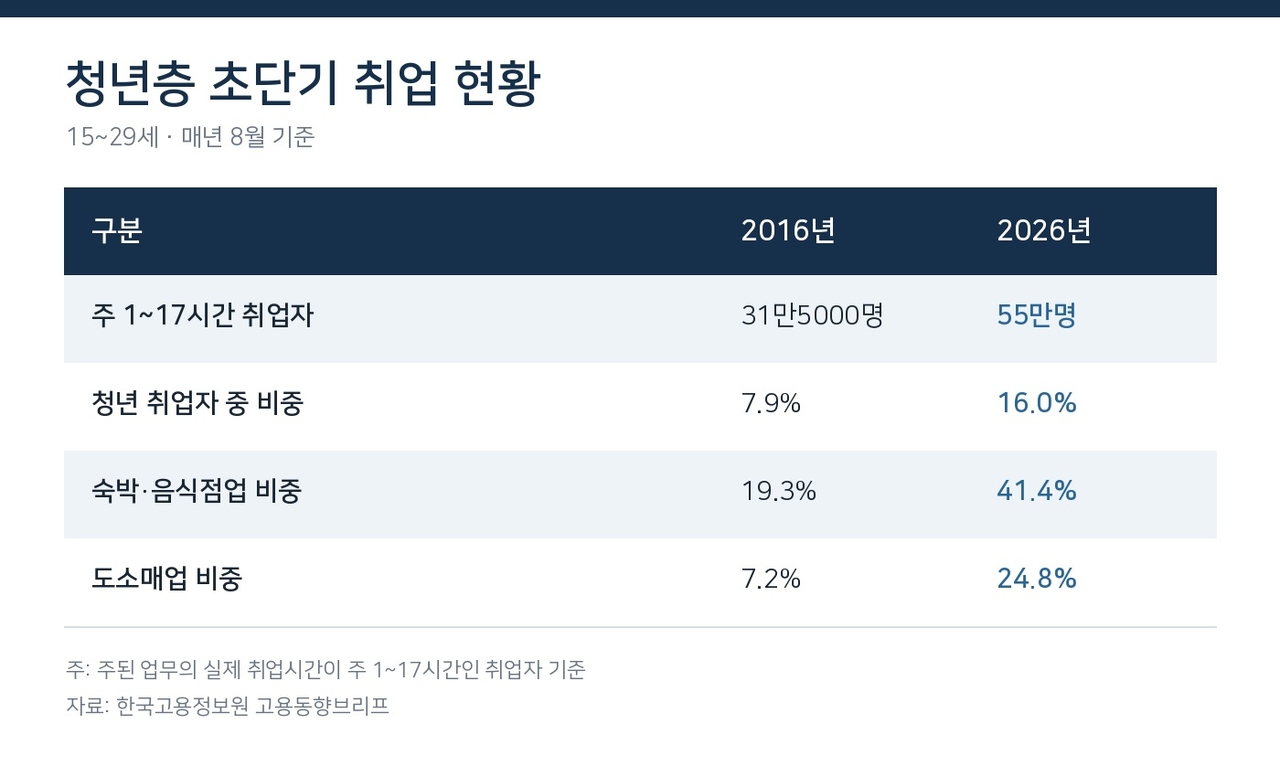
The hours young workers put in are also shrinking. According to the Korea Employment Information Service's employment trends brief, the share of young employed people whose actual weekly working hours in their primary job fell between one and 17 hours reached 16.0 percent in August — more than double the 7.9 percent recorded in August 2016. The number of such workers rose by 235,000 over the same period, from 315,000 to 550,000.
In accommodation and food services, the share of young workers in ultra-short-hour positions surged from 19.3 percent in 2016 to 41.4 percent this year, a rise of 22.1 percentage points. In wholesale and retail trade, the figure climbed from 7.2 percent to 24.8 percent. Short-hour employment is expanding rapidly in the service sectors that young people find relatively easy to enter.
Not all short-hour work is voluntary. According to the Ministry of Statistics, the number of young workers classified as "time-related underemployed" — those working fewer than 36 hours a week who want more hours and are available to work them — reached 123,000 in the first quarter of this year, up 24,000 from the same period in 2024 and the highest first-quarter figure since 2021.
When these underemployed workers are added to the unemployed to calculate a broader labor underutilization measure, the supplementary employment indicator reached 10.7 percent in the first quarter, well above the official youth unemployment rate of 7.4 percent. The Korea Employment Information Service also found that 25.0 percent of first jobs taken by young people in 2025 were part-time positions.
Shorter hours also constrain monthly income. Workers whose contractual hours fall below 15 per week are excluded from entitlements including weekly holiday pay, annual paid leave and severance benefits — though not all young workers logging 17 hours or fewer necessarily fall below that threshold.
The government is stepping up fiscal support. According to the Ministry of Planning and Budget, the budget for youth employment and startup support will rise 41.6 percent next year, from 3.6 trillion won to 5.1 trillion won ($3.83 billion). Yet even as the overall employment rate for people aged 15 to 64 hit a record high of 70.6 percent in September, the youth employment rate fell for the 29th consecutive month, underscoring the widening divergence.
"The structural problem continues — precarious non-regular workers still make up a large share of the workforce, older workers are finding more employment, while young people are being left behind," said Kim Seong-hee, a professor at Korea University's Graduate School of Labor Studies.
fact0514@heraldcorp.com